




Moving away from pharma’s paternalistic approach
September 12, 2018 | Patient-centric, Patient-centricity, life sciences, patient engagement
New handbook makes the case for greater patient engagement in the development of new medicines
12 September 2018, Cambridge, UK—The pharmaceutical industry has achieved great success in delivering innovative medicines, but life science companies must become ever more consumer-centric if they are to realise the step change in improving patient outcomes that their science promises, according to a new patient engagement handbook released today. 
Patient Engagement for the Life Sciences by Guy Yeoman and Mitchell Silva explains the ‘why’ and the ‘how’ of patient engagement, presenting the compelling argument for why life science companies need to embrace and partner with patients and outlining an operating framework for doing it effectively.
“It’s so important to shift from patient-centric rhetoric to an integrated model where life cycle decisions are informed by patient insight and patient solutions are created with patients,” Yeoman commented.
Guy Yeoman has worked for the last two decades in the pharmaceutical industry, and in the last three years he built a patient-engaging capability in a large pharma organisation. Mitchell Silva is a patient expert and Chair of the European Patients’ Academy (EUPATI) in Belgium. They are co-founders of MediPaCe, a strategic consultancy that works with the life science industry to make patient engagement a reality. 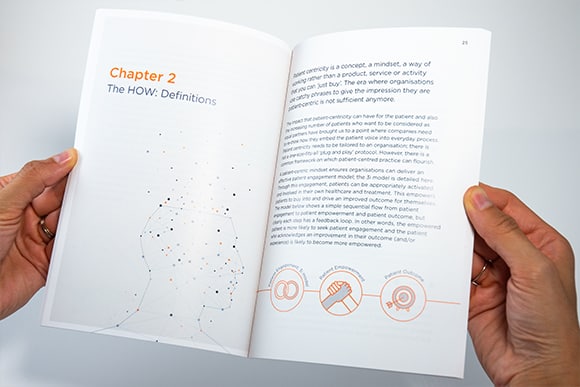
In Patient Engagement for the Life Sciences, the authors discuss the future of the pharmaceutical industry and how a number of drivers — including digital technology, patient expectations, outcomes-based payments and spiralling R&D costs — will make co-creating medicines with patients crucial to pharma companies’ ability to continue to deliver patient value.
It goes on to describe the framework necessary for embedding patient engagement into business practice, and the process for transforming into a company with patients at the centre of its culture.
Silva said, “Patients increasingly want to contribute to the development of better medicines and better services to support new treatments, but often the infrastructure to involve patients in a structural way is lacking. Patients are waiting to contribute.”
Cuttsy+Cuttsy provided editorial support, cover design and illustrations for the publication. Director Caroline Benson said, “As a healthcare communications agency where people matter, Guy and Mitchell’s book aligned perfectly with our company values. We were delighted to help bring it to life, as working with patients to make sure products and services work for them is what we have always done, and we truly believe that it gives the best results for everyone.”
Patient Engagement for the Life Sciences is now available as an eBook. Any profits generated from book sales will be donated to International Health Partners UK, Europe’s largest coordinator of donated medicines, to support patients around the world.
Download your copy from www.medipace.com/book
This content was provided by Cuttsy + Cuttsy
Company Details

Latest Content from Cuttsy + Cuttsy
Long-term clinical trial engagement is a behavioural challenge – not just an informational one
Explore why long-term clinical trial engagement is a behavioural challenge, showing how proactive support from site teams can help participants stay connected, confident and committed throughout a study.
Patients are telling the truth — just not to you
Patients are often most honest outside the clinic—revealing vital insights that can help clinical trial teams build trust, improve participation and collect better data.
When what matters to patients is hard to measure
Patient-relevant outcomes sit at the heart of the EU HTA reforms, but ensuring they reflect lived experience requires you to look beyond what traditional clinical endpoints measure.
Permission to pause: making treatment breaks part of the cancer care conversation
Exploring how empathetic, patient-centred communication can make planned treatment breaks easier to discuss as part of cancer care.
A seat at the table: what the EU HTA reforms really ask of patient involvement
The EU HTA reforms give patients a formal role in assessing new medicines, but meaningful involvement requires more than simply offering them a seat at the table.
Why faster trials make participant understanding more important than ever
As clinical trials accelerate, clear, accessible consent is essential to help participants understand, engage with and remain in a study.
Older trial participants reject bad design, not technology
Older trial participants aren’t rejecting digital technology — they’re rejecting poorly designed, inaccessible experiences that make participation harder.
5 key takeaways from the Patient Centricity and Engagement Conference
Key takeaways from the Patient Centricity and Engagement conference, exploring how trust, inclusion and meaningful partnership can help turn patient engagement from intention into action.
It’s time to stop calling adverse events ‘manageable’
A single word—manageable—can minimise the real burden of treatment side effects, and it’s time clinical trial communication reflected patients’ lived experience more clearly.
The value: why localisation pays off across global trials
Strong localisation reduces trial friction, supports site teams, improves participant understanding and helps global studies run more smoothly, fairly and efficiently.