




Evaluating the Forces Shaping Women’s Healthcare
March 6, 2024 | Leadership, Women in healthcare
Gaps in women’s healthcare go beyond access and cost. Do clinicians have the tools they need to understand women’s health?
If there are any lingering doubts about how today’s healthcare system fails many women, a 2022 study from the Kaiser Family Foundation will set the record straight. Their report revealed that close to 20 percent of all women in the U.S. ages 18 and older considered their health fair or poor. Out of a population of 168 million women, that is a shockingly large number of people who feel less than well.
Drilling down by race and ethnicity, the numbers break out to 31% of American Indian and Alaskan Native women, 25% of Hispanic women, 23% of black women, 16% of white women, and 10% of Asian Native Hawaiian and other Pacific Islander women. The same study found that 10% of all women 18 and older did not see a doctor due to cost.
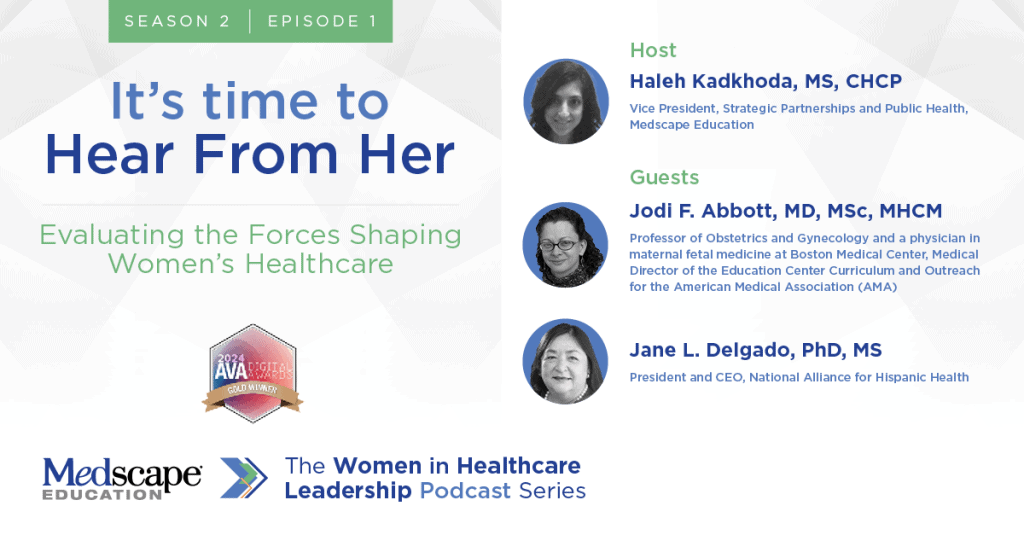
And here’s something else to consider, says Jane Delgado, clinical psychologist and President and CEO of the National Alliance for Hispanic Health. Even if you can afford it, if you have access to health insurance, “once you get through the door, does the person you see hear you? Does that person have the tools to understand women’s health? Are you getting the care you need, and does your healthcare provider have the tools and information they need?”
Not to mention the additional barriers of ethnicity and age that women often face, says Jodi Abbott, who has dual roles as Professor of Obstetrics and Gynecology and a physician in maternal fetal medicine at Boston Medical Center, and Medical Director of the Education Center, Curriculum and Outreach for the American Medical Association (AMA). Women’s complaints “are much less likely to be listened to, and they end up being underdiagnosed and undertreated for most conditions.” While you’re seeing a physician to try to feel better, “they are there to cross a disease off a list. There’s a mismatch between the hopes and expectations of many people who enter the system and how most physicians are trained. Our healthcare system is geared toward disease management, rather than addressing the elements that help keep people healthy.”
Abbott says she’s “privileged” to work at Boston Medical, which is an ACO, or accountable care organization. “The difference between that system and traditional insurance-based or fee-for-service systems is that our organization is set up to have a certain amount of money every year to keep people healthy as opposed to receiving money for how much time they spend in the hospital because of certain diagnoses. When we switched to that, it really opened the door to physicians and health care providers with the desire to widen their team—for example, to include non-physician team members—and to be able to focus on initiatives that can improve health, and not just those that identify complications.”
One example of this, says Abbott, has been a large investment in the community and in “nontraditional” mechanisms of health care, such as doulas—birth attendants who are not physicians, not nurses, “who represent the women in the communities that our patients come from. They are multilingual, and can have a personal connection, sort of a mother or auntie figure, but they also know how a hospital works and can guide people who are attending for the first time.
“There’s an important investment that needs to be made [in programs] that help keep people healthy,” Abbott says.
We need to hit our health enterprise at many different levels to really effect change, says Delgado. “From how the system includes women in every place from researcher to clinician to participant, to how women approach that system. And we need to talk to women about their total health and teach them about how to take care of themselves, not just when they’re pregnant but throughout their whole lives.”
Listen now to season two, episode 1 on Medscape, Spotify or Apple.
For more information please contact Jelena Spyropoulos (Global) or Piyali Chatterjee-Shin (US).
Hosted by Haleh Kadkhoda, MS, CHCP, Vice President, Strategic Partnerships and Public Health at Medscape Education
About Medscape Education Medscape Education (medscape.org) is the leading destination for continuous professional development, consisting of more than 30 specialty-focused destinations offering thousands of free accredited CME and CE courses for physicians, nurses, and other healthcare professionals.
This content was provided by Medscape Education
Company Details

Latest Content from Medscape Education
The Pulse of AI Innovation: From More Data to Better Care
At the European Society of Cardiology (ESC) Congress, two of cardiology’s most influential voices sat down to talk about artificial intelligence at Medscape’s ‘The Pulse of AI Innovation’ event: Professor…
Next-Level Clinical Practice, Real-World Impact: Evolving Patient Simulation with the Clinical Readiness Studio
Healthcare is changing rapidly, bringing unprecedented data and complex treatment pathways to the point of care. Clinical mastery requires active experience, the confidence to make decisions when real patient outcomes…
Medscape Sponsors The John Ritter Foundation’s “Evening From the Heart”
When independent, evidence-based education directly connects with clinicians at the point of care, clinical practice changes. Driven by this vital mission, Medscape Education was proud to sponsor The John Ritter…
From Booth to Bavaria: A Recap of Impact at ESC 2026
We have officially wrapped up another year at ESC. For Medscape Education, 4 days on the ground confirmed what 3 decades of cardiovascular education have already shown: when independent, evidence-based…
Why Modern Dermatology Demands Curiosity Over Precision
In the high-stakes world of healthcare research and product development, success has long been measured by rigid definitions of precision and predictable trajectories. However, as Dr. Hawa Dumbuya, Director of…
The Heart of the Matter: Medscape Education’s Cardiology Footprint at ESC 2026
For more than 30 years, Medscape Education has built independent, accredited cardiovascular education designed around one goal: improved patient outcomes. This year at the European Society of Cardiology Congress (ESC…
More Than Pink Walls: What Women-Centric Care Actually Requires
The phrase “patient-centered care” is tossed around freely in healthcare corporate boardrooms. Yet, for more than half the population, that promise routinely fractures. In the latest episode of the Hear…
Women in Healthcare Leadership Have a Lot to Say. Medscape’s Hear From Her Wins an APEX Grand Award.
Medscape Education has been honoured with the prestigious APEX Grand Award for Publication Excellence at…
Moving Beyond the 10%: A New Era in Preterm Birth Prevention
For decades, the rate of spontaneous preterm birth in the United States has hovered stubbornly around 10%. Despite advancements in other areas of medicine, prematurity remains the second leading cause…
Medscape Education to Showcase the Impact of Neurology CME at EAN 2026
Medscape Education, the leading global provider of continuing medical education (CME), has announced its agenda for the upcoming 12th Congress of the European Academy of Neurology (EAN) 2026 in Geneva,…