



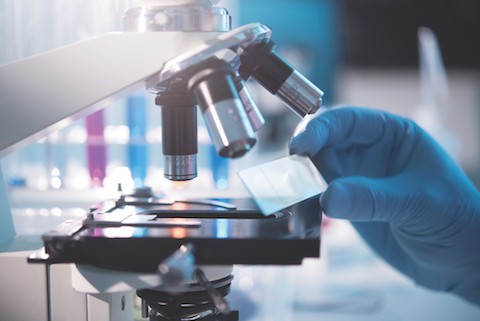
Researchers from the Massachusetts Institute of Technology and Harvard Medical School’s Brigham and Women’s Hospital have developed a new microscopy technique to reveal brain tissue cells and structures in greater detail.
The high-resolution imaging method could help doctors diagnose and treat patients with brain tumours.
Accounting for 85% to 90% of all primary central nervous system tumours, a brain tumour is a growth of cells that multiplies in an abnormal and uncontrollable way.
Researchers labelled around 16 different molecules per brain tissue sample, which included markers for a variety of structures, such as axons and synapses, as well as maskers to identify cell types, including astrocytes and cells that form blood vessels.
In addition, they labelled molecules that were linked to tumour aggressiveness and neurodegeneration.
Researchers then analysed health brain tissue as well as samples from patients with two types of gliomas: high-grade glioblastoma, the most aggressive primary brain tumour and low-grade gliomas, a less aggressive form.
They found that some low-grade brain tumours contained more putatively aggressive tumour cells, suggesting that some of these tumours could be more aggressive than previously thought.
The new imaging method works by embedding the tissue into a polymer that swells when water is added, which then softens up and breaks apart the proteins that normally hold tissue together and swells the polymer, pulling all the proteins apart from each other.
This method enlarges tissues, allowing researchers to obtain images with a resolution of around 70 nanometres.
Pablo Valdes, assistant professor of neuroscience, University of Texas Medical Branch and lead author of the study, said: “We’re starting to see how important the interactions of neurons and synapses with the surrounding brain are to the growth and progression of tumours.
“A lot of those things we…couldn’t see with conventional tools, but now we have a tool to look at those tissues at the nanoscale and try to understand these interactions.”
Researchers are planning to conduct further research, including a larger study of tumour types to establish diagnostic guidelines based on tumour traits that can be revealed using these techniques, as well as a study to focus on other aspects of brain function in healthy and diseased tissue.