



Does real-world use of AI in systematic literature reviews result in time and cost savings?
November 27, 2025 | AI, Market Access, artificial intelligence
By Manca Povsic and Emma Griffiths

Systematic literature reviews (SLRs) are a resource heavy, time-consuming but necessary part of evidence generation. SLRs present an opportunity for artificial intelligence (AI) to deliver significant resource savings, and several AI tools have been developed to reduce the burden on literature review teams.
Here we examine if an AI-powered SLR platform, EasySLR™, can replace a human reviewer with accuracy and whether this translates into time and cost savings in the real world.
Replacing a human reviewer with AI in an SLR
As the basis of comparison, we used an economic SLR in two very similar breast cancer populations. We tested the ‘AI as a reviewer’ function, which replaces one human reviewer in the SLR process. The transparency of the platform meant that we could examine the decisions and speed of AI and compare them with those of human reviewers in several areas: abstract and full-text screening, data extraction, and development of Preferred Reporting Items for Systematic Reviews and Meta-analyses (PRISMA). To measure accuracy, we used the final decision from the human reviewers as the ‘correct’ decision, against which the AI decision was then compared. Lastly, we assessed the time and cost investment by comparing the time needed and the associated costs across projects with and without EasySLR™.
AI-powered analysis shows similar accuracy to humans and saves ~40% of time on SLR tasks
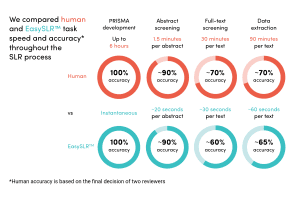
The AI platform outperformed humans in speed for all tasks (Figure 1). In terms of accuracy, EasySLR™ produced similar results to humans for PRISMA generation and abstract screening. For full-text screening and data extraction, platform accuracy was ~10% lower than human accuracy (Figure 1) because AI relied too heavily on identifying exact wordings from the population, intervention, comparator and outcome (PICO) criteria and struggled to extract complex data such as some economic model assumptions and costs.
Figure 1. Accuracy and speed comparison between human reviewers and an AI-powered platform, EasySLR™, at each step of the SLR process
Cost savings of ~30% are possible in the real world, but there are caveats
Use of the AI platform saved a significant amount of time at each step, which could translate into cost savings of up to ~30% versus a fully manual process across PRISMA development, screening and extraction. AI was particularly cost effective when there was a need to investigate sub-populations or tweak the PICO and re-run the searches, which would otherwise be time prohibitive in an SLR project.
However, we found that time and cost savings can differ depending on project type (systematic vs targeted review), complexity of the SLR question and familiarity of the human reviewers with AI prompting.
Some of these complexities could be mitigated by using AI tools that improve prompting, optimize protocols and train AI in human decision making. Optimization tools such as these can further enhance time savings with AI SLRs, and they will likely translate into additional cost savings as AI understanding improves.
Conclusion
In conclusion, an AI-powered platform, EasySLR™, can replace a human reviewer and save up to ~40% of the time and up to ~30% of the costs needed to conduct an SLR. Utilizing AI in SLRs can significantly reduce the human workload required, but limitations such as reduced AI accuracy still exist. New features that improve AI understanding are required in all AI SLR tools to ensure that the time savings achieved can be translated into cost savings, and that these improvements do not plateau.
To learn more, contact Manca Povsic (manca.povsic@amiculum.biz) or visit our insights page for more content
This content was provided by Amiculum
Company Details

Latest Content from Amiculum
Stacking the odds in your favour with landscape analysis
By James Aird and Jess Choi
AMICULUM earns EcoVadis silver award for second consecutive year
We are proud to announce that AMICULUM has achieved the silver award from EcoVadis, a global leader in sustainability assessments, for the second year running! Scoring 73 out of 100,...
AI in market access: silver bullet or spanner in the works?
By Emily Morton-West
Answering some of Pharma’s big questions to drive brand strategies
By James Aird and Zoë van Helmond
Artificial intelligence versus real insight – does pharmaceutical industry consulting face a dilemma or a progression?
By Frank Fisher and Zoë van Helmond
Generative AI, storytelling and patient inclusion: key publications trends in 2024
By Teal Brechtel and Jennifer Gillman
Joint Clinical Assessments: bureaucratic nightmare, AI opportunity, or both?
By Manca Povsic and Andrew Dobb
Eyes on the horizon: six (and a half) predictions for the future of healthcare communications
By Zoë van Helmond and Leyna Prince