



Is AI the answer? Translating complex medical information into public understanding
August 26, 2025 | AI, Medical literature, artificial intelligence, health literacy, medical information
By Rebecca Helson and Ben Clarke
When it comes to healthcare developments, peer-reviewed scientific literature is the gold standard for objective and reliable information. But here’s a question: have you, or a friend, or a family member, felt overwhelmed trying to sift through vast amounts of complex data and technical language to find credible healthcare information? It seems that many patients face such a challenge when trying to educate themselves about their health.
We recently discussed the topic of empowering patients in the age of misinformation with our International Society of Medical Publications Professionals (ISMPP) colleagues through roundtable discussions. We enjoyed passionate exchanges focused on understanding the barriers created by the current scientific publication system and how these can restrict access to timely information, affect patient trust and potentially influence healthcare outcomes. We then considered the ever-expanding role of artificial intelligence (AI) as a tool to help bridge the gap between complex scientific literature and patient understanding. Although theoretical, conceptualizing an AI-driven resource that delivers personalized, culturally sensitive, multilingual medical information tailored to individual patients helps us close the divide between medical research and comprehension by lay audiences.
What’s driving the accessibility crisis in scientific research?
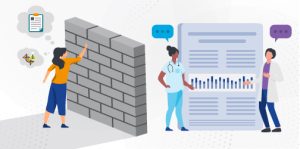
The pace of medical innovation continues to accelerate, but patient access to understandable information lags behind. With an increasing focus on shared decision making between healthcare providers and patients, it is vital that patients are able to make informed decisions about their healthcare. Multiple barriers exist that often prevent patients from having a higher level of health literacy. These include (but are not limited to):
- Complex technical language used in scientific publications
- Limited discoverability of information (eg paywalls)
- Wealth of available information (including outdated and/or contradictory materials)
- Language and literacy limitations
- Cultural differences in health communication
- One-size-fits-all patient education materials
- Knowing what and who to trust
What would an AI-powered patient knowledge companion look like?

Now, imagine a centralized, trustworthy resource offering accessible, accurate and timely information about medical advancements, developed specifically for the public – ‘The People’s PubMed’, if you will. With rapid advancements in AI, such a resource could potentially offer:
- AI-driven summarization of peer-reviewed medical literature
- Real-time updates on relevant medical advancements
- Multilingual support with cultural nuance
- Personalized content and formats based on patient profiles and personal preference
- A chatbot feature to answer questions any time, day or night
- A direct link to trusted influencers
Turning insight into action: where do we go from here?
A resource such as this would come with its own challenges, such as ensuring data privacy and security, maintaining scientific integrity, identifying/removing out-of-date guidance, and addressing digital literacy and access disparities. However, imagine the impact of empowering patients to make informed decisions or at least have meaningful discussions with their healthcare providers. Not only could this lead to better health outcomes, but it could also build greater trust in our healthcare systems. With no single industry or stakeholder solely responsible for patient health literacy, a coordinated approach seems necessary.
As an industry, we need to ensure an awareness and understanding of the barriers limiting health literacy in patients and be proactively looking for ways to overcome them. Although an AI-powered patient knowledge companion is only hypothetical, conceptualizing the idea highlights the need to be thinking of patients and patient groups throughout the publications process, to give them a voice to help shape the narrative. At AMICULUM, we are continually challenging ourselves to consider innovative avenues that can empower patients in their quest for knowledge, from co-creation of plain language materials to disseminating information via trusted channels.
We specialize in transforming complex scientific and medical information into clear, meaningful communication tailored to diverse audiences. Our expertise in medical writing, combined with cutting-edge digital strategy, enables us to drive patient engagement at every stage of the publication journey, from trial design and publications planning to development of lexicons and plain-language content.
Contact us for guidance on how to enhance patient engagement and ensure that meaningful patient perspectives are incorporated fully in your publications activities. Get in touch with Ben at Ben.Clarke@amiculum.biz
For more insights, visit the AMICULUM News and Insights page
This content was provided by Amiculum
Company Details

Latest Content from Amiculum
Stacking the odds in your favour with landscape analysis
By James Aird and Jess Choi
AMICULUM earns EcoVadis silver award for second consecutive year
We are proud to announce that AMICULUM has achieved the silver award from EcoVadis, a global leader in sustainability assessments, for the second year running! Scoring 73 out of 100,...
AI in market access: silver bullet or spanner in the works?
By Emily Morton-West
Answering some of Pharma’s big questions to drive brand strategies
By James Aird and Zoë van Helmond
Artificial intelligence versus real insight – does pharmaceutical industry consulting face a dilemma or a progression?
By Frank Fisher and Zoë van Helmond
Generative AI, storytelling and patient inclusion: key publications trends in 2024
By Teal Brechtel and Jennifer Gillman
Joint Clinical Assessments: bureaucratic nightmare, AI opportunity, or both?
By Manca Povsic and Andrew Dobb
Eyes on the horizon: six (and a half) predictions for the future of healthcare communications
By Zoë van Helmond and Leyna Prince