




What’s next for scientific congress booths: five trends for 2025
January 15, 2025 | Conferences, booths, trends
By Lauren Vosseller and Alison Dufour
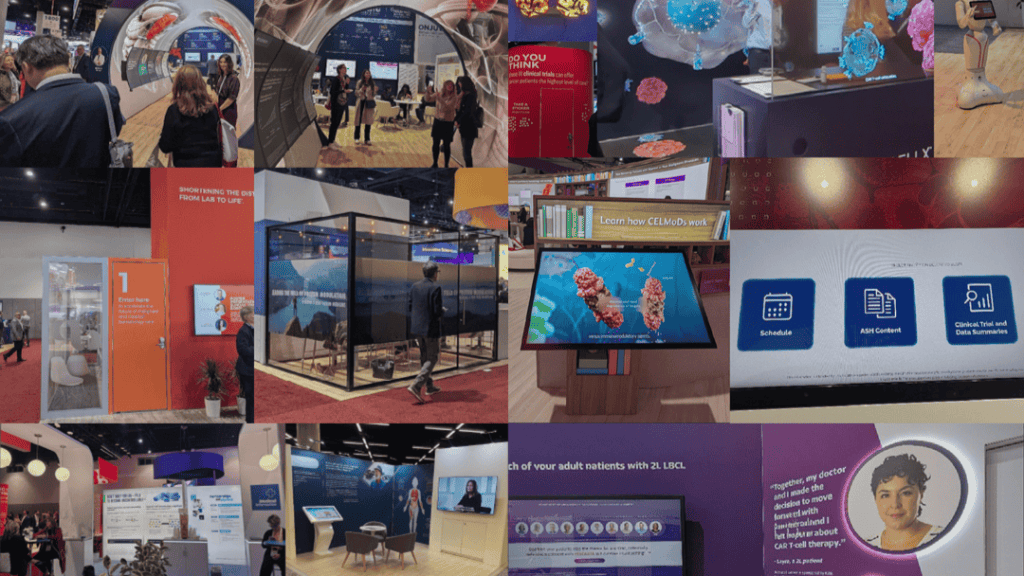
Over the past few years, in-person attendance at many prominent medical congresses has rebounded back to pre-pandemic levels.1–3 With healthcare providers (HCPs) and industry leaders eager to share insights on cutting-edge science and connect with colleagues,4 meetings continue to offer pharmaceutical and biotechnology companies unique opportunities for engaging thought leaders, patients and patient advocacy groups, establishing new relationships and strengthening existing ones. Congress booths in particular provide an ideal setting for exhibitors to increase disease state or brand awareness, communicate their latest data developments and engage in meaningful dialogue with attendees.
However, visiting a crowded exhibit floor immediately demonstrates the stiff competition between exhibitors, all vying for attendees’ attention and time. Innovations in technology and shifting congress regulations have resulted in exciting advancements on the show floor, but this has also made it more difficult for exhibitors to navigate ever-changing trends. Optimally located booth spaces can come at a premium, and adding features to draw in your customers comes at a price.
Here, we explore booth trends we saw at 2024 congresses (including most recently at ASH in San Diego), to inspire your future congress activities and highlight areas where partnership with experienced and scientifically minded booth planners is paramount. Armed with the ability to translate trends into meaningful engagements, your team will be ready to capitalize on congress exhibits in 2025 and beyond, getting the biggest return on your investment (ROI).
1. Creating a journey through your booth
In 2024, exhibitors moved beyond focusing on attention-grabbing tactics to prioritize creating spaces that better enable relationship building and idea exchange among booth visitors. Successful 2024 booths were those that took visitors on a journey through the booth, with each stop focused on a specific engagement goal. For instance, placing the most important focal points along key sightlines helps draw attendees in who are interested in specific medical content. Once in the booth, subtle lighting, directional cues and strategic furniture placement guide visitors along a pre-planned track that tells a story.
Booth designers also take advantage of demarcating functional areas to encourage the use of different spaces with specific goals in mind:
- Comfortable lounge or bistro-style seating centred around catering counters tends to keep visitors in the booth to engage with staff and each other while enjoying a tasty snack, dessert or (non-alcoholic) beverage. This is especially useful when exhibitors wish to establish their space as a hub for the open exchange of ideas or as a networking hotspot
- Content areas physically or visually divided from gathering areas encourage attendees to take a deeper dive into scientific content, focusing the visitor on learning and discussion; dividing content-focused areas further based on topic is useful for customizing attendees’ educational journeys according to specific learning objectives
- Built-in meeting rooms are a smart choice to offer private spaces within booths for staff to hold small planned or impromptu meetings with HCPs. When insights gathering and substantive discussions are the priority, adding meeting rooms to your booth space can maximize your ROI by foregoing the need for separate, costly business suite space outside of the exhibit floor. This can offer a more convenient option for HCPs who do not want to navigate to a potentially distant business suite and may increase the overall number of engagements
Much like building a house, booth designers can be the architects to design your space in a way that uniquely suits your story.
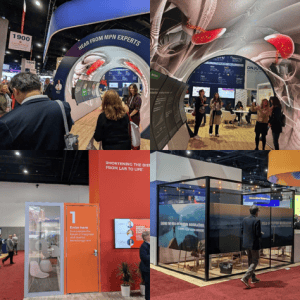
A carefully planned booth design naturally guides attendees through spaces according to exhibitor goals; exhibitors also utilize built-in meeting rooms not only to display visual content but to maximize engagements.
2. Making the patient experience front and centre
While HCPs are often the primary audience for congress booths, 2024 was marked by a continuation of efforts by pharmaceutical companies to increasingly elevate the patient voice and demonstrate patient centricity. After all, patients and their caregivers, along with patient advocacy groups, attend congresses and are eager to see greater awareness and accurate representations of their lived experiences. Examples of impactful patient centricity in congress exhibits include:
- Videos showcasing patients describing their journey from diagnosis to treatment
- Interactive audio and visual representations of what the disease feels like to patients
- Emotive artistic interpretations of a patient’s burden, often focusing on invisible symptoms or stigmatized aspects of their disease and highlighting unmet needs
- Live panel or Q&A sessions at scheduled times during the congress
- Access and affordability tools showcasing patient assistance programs, adherence guidelines and reimbursement resources
HCPs are keen to understand different aspects of patient experiences, to share their perspectives on their patients’ journeys and to offer opinions on their patients’ unmet needs. Interactive case summaries and art installations inviting HCPs to add their opinions on how to improve patients’ lives were popular in 2024 booths to both engage attendees and leave lasting impressions.
Ultimately, the overall goal of all stakeholders involved in congress exhibits is to improve patients’ lives through education and dialogue. Congress booths will continue to offer great opportunities to remind your audience of this shared commitment to patients while simultaneously allowing you to meet your strategic objectives.
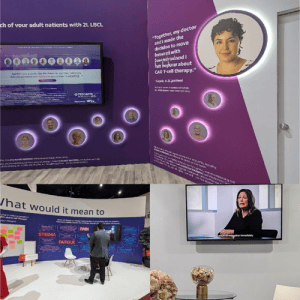
Amplifying patient experiences through emotive booth content demonstrates the ultimate goal is to serve patients.
3. Engaging interactivity
Exhibits in 2024 had more interactive features than ever. To cut through and get the greatest ROI, thoughtful consideration of goals allows designers to prioritize the right interactivity.
Popular booth traffic builders in 2024 included interactive catering stations, often advertised in congress ‘food guides’. Exhibitors also used visually striking sculptures to provide fun, social media-friendly photo opportunities and informal rendezvous points for attendees to meet with colleagues. This approach can boost their company’s social media presence amplifying the impact of the booth.
In 2024, we also saw booth staff aided in their engagement by interactive elements that provide opportunities for self-guided learning:
- Artificial intelligence-assisted chatbots and robots trained on unique disease state language models to provide accurate and relevant information to HCPs and patients on demand
- Virtual and augmented reality tools to demonstrate drug mechanisms of action or mechanisms of disease and diagnostic challenges
- Intuitive content on touchscreens to give easy-to-access information to attendees without the need to engage booth staff
Finally, to promote purposeful engagement with booth staff, exhibitors leveraged strategies including:
- Prominently displaying scientifically focused games, quizzes and challenges, with leaderboards stoking booth visitors’ competitive spirits. As attendees play and watch others do the same, booth staff are provided with the opportunity to engage in the science that underpins the games
- Encouraging booth visitors to weigh in with their opinions on a pre-specified topic (eg by sticky note board or live word cloud) facilitated by a booth representative
- Featuring immersive art installations with interactive elements, providing booth staff with an opportunity to engage visitors as they navigate the content
Interactivity reliably offers a springboard for deeper conversations and lasting impressions among booth visitors.

Interactive elements capture attention by creating intrigue and eliciting feedback but can also deliver a meaningful experience to your booth attendees.
4. Environmental sustainability
There’s increasing consideration of environmental impacts of congresses as a whole and booths in particular require a lot of materials to be built. To reduce these impacts clever solutions to common hurdles to sustainability are being implemented, including:
- Reducing the use of disposable items like print handouts and single-use catering cups in favour of digital assets and reusable catering items
- Reusing booth structural elements and art installations between shows and, where possible, donating unused materials to local community organizations
- Recycling or composting waste by opting for innovative materials such as bioplastics or cardboard furniture
- Incorporating energy-efficient lighting (eg, LED bulbs, solar power)
Planning a booth with environmental sustainability in mind can offer benefits aside from aligning with corporate responsibility goals; for example:
- Digital assets can be more easily disseminated to specific audience members than print materials and can be added to existing CRM or omnichannel platforms
- Utilizing reusable catering items means that attendees stay within the booth to eat/drink, offering booth staff more engagement opportunities
- Potential to reduce the cost of producing new materials for each congress and offer continuity and brand recognition between meetings
- Using lightweight, compact designs to minimize shipping impact
In 2025, expect to see a continued emphasis on minimizing the environmental footprint of congress booths without compromising your exhibit’s impact.

A trend towards digital-only content and sustainable catering items.
5. Small spaces, big impact
You don’t need a large booth footprint to deliver an outsized impression on congress attendees. 2024 saw many innovative small booths that shone in more modest footprints than their larger competitors. However, smaller spaces come with unique challenges that are best addressed by partnering with a booth designer with experience in smaller-scale exhibits. Specifically, look for a partner with experience in:
- Selecting structures and creating design elements/colour schemes to enable an open-feeling space and avoid an unwelcoming, closed-in atmosphere
- Creating hanging signs and other tall elements like art installations or branded light shades that maximize the use of vertical space to display content and catch the eye of attendees in a crowded exhibit hall
- Leveraging digital walls or screens to cycle through different scientific content as opposed to printing limited content on a static wall
- Minimize clutter through integrated storage solutions within the exhibit design
In 2025, we expect to see more innovative uses of small areas to deliver big ROIs.
From an expanding (or strengthening) focus on patient experiences and environmental sustainability to creating immersive experiences in small spaces or dividing large spaces into bespoke functional areas, exhibits can increasingly be tailored to meet unique needs. But as congress booth options diversify and become ever more technologically innovative, it is vital to know how to prioritize what will work best for your goals. In 2025, make the most of your company’s medical conference budget by taking inspiration from the trends of the past year and by working with a booth design team with the skills to turn insights into reality.
Ready to take your congress booths to the next level in the new year and beyond? At AMICULUM, we love to partner with our clients to develop impactful exhibits tailored to their strategic needs. To learn more about how we combine our scientific, design and logistical expertise to deliver high-quality congress booths, please contact Adam Handler at adam.handler@amiculum.biz.
For more insights, visit the AMICULUM News and Insights page.
References
- American Society of Clinical Oncology. Exhibitor Newsletter – June 2019. Available at: https://society.asco.org/sites/new-www.asco.org/files/content-files/meetings/documents/ASCO-Exhibitor-Newsletter-June-2019.pdf (accessed 17 December 2024).
- American Society of Clinical Oncology. Meeting Demographics. Available at: https://conferences.asco.org/am/meeting-demographics (accessed 17 December 2024).
- International Society of Nephrology. Past World Congresses. Available at: https://www.theisn.org/wcn/about/past-world-congresses (accessed 17 December 2024).
- Ram SS, Stricker D, Pannetier C et al. Cliques within the crowd: identifying medical conference attendee subgroups by their motivations for participation. Adv Health Sci Educ Theory Pract 2023;28:1485–508.
This content was provided by Amiculum
Company Details

Latest Content from Amiculum
Amiculum earns EcoVadis silver medal for the 3rd year running
We’re proud to announce that we have once again strengthened our commitment to sustainability! Our 2025 EcoVadis reassessment has resulted in a score of 75/100, allowing us to maintain our...
AI persona generation for healthcare: quick wins & real-world impact
By Aaron Fletcher
VuuAI and Amiculum partner to transform content engagement in pharma
Amiculum, a global health communications agency, has entered into an exciting strategic collaboration with VuuAI, a GenAI-driven content production automation platform. The collaboration is designed to optimize the deployment of...
Does real-world use of AI in systematic literature reviews result in time and cost savings?
By Manca Povsic and Emma Griffiths
New brand, same great team!
We’re excited to launch our refreshed Amiculum visual identity today. Our new brand encapsulates the vibrancy and creativity that we see every day from our team. It’s fresh, forward-looking and...
Is AI the answer? Translating complex medical information into public understanding
By Rebecca Helson and Ben Clarke
Unlocking the future of Learning
By Potter Li and Aaron Fletcher