




Age is not just a number when it comes to clinical trials
October 22, 2024 | Age, Diversity, Inclusion, Representation, Trial Design, clinical trials
In this blog we look at the critical underrepresentation of older adults in clinical trials, emphasising the need for inclusive trial designs and targeted strategies to ensure safe and effective medicines for this population.
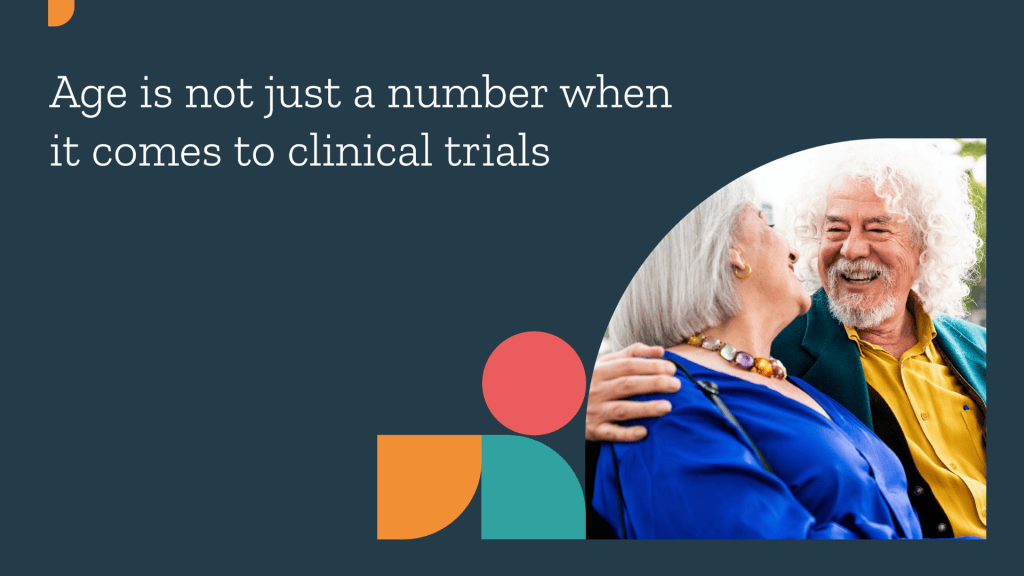
Age is just a number. You’re as young as you feel.
Right? Well, when it comes to clinical trials, not quite.
Older people (those aged 65 and above) use the largest share of medicines, but are severely underrepresented in clinical trials across most treatment areas.1 This is especially true for the over-75s, who account for as few as 1% of trial participants.2
This has some big implications. It means medicines are coming into use that may not have been fully tested with, by, or for their intended audience.
As an example, less than half of the US Food and Drug Administration (FDA)’s drug approvals include safety and efficacy data from older people.2 This data can’t just be generalised from younger trial participants.1 When it is, HCPs have difficulties prescribing,3 and older people may experience unexpected, serious side effects.1
It’s clear then that greater representation of older people in clinical trials is not just a nice to have, it’s crucial to ensure safe, effective medicines in the real world. Older people do want to take part in clinical trials, and generally have positive experiences when they do.4 But, despite action from the European Commission, FDA1 and UK MHRA5, the problem of low representation still exists.
Why is this?
Eligibility criteria are essential to ensure the safety and accuracy of clinical trials. But many trials feature poorly justified, restrictive criteria, based on arbitrary upper age limits6, comorbidities7, and polypharmacy6, among others, which exclude many older people from taking part. And those who do take part are often fitter, healthier, and less representative of the general population.8
But this is just one part of the equation. Older people who meet all of a trial’s eligibility criteria still face other barriers that younger participants might not. Things like:
- Poorer understanding of the informed consent process1
- Increased risk and burden of side effects1
- Issues with trial site access, and the number and length of visits1
- Simply losing interest if they’re not being appropriately engaged7
So, how can the industry address this?
Through fresh perspectives on how trials are designed and communicated.
If older people are the intended population for a new medicine, involving them, and their loved ones, in trial planning from the start can help to set priorities, remove logistical barriers, and ensure eligibility criteria are fully justified.8
Alternative trial designs may offer effective new ways to involve older people. For example, some adaptive trials have completely removed age restrictions5, and trials featuring expanded-eligibility cohorts may allow the inclusion of more people with comorbidities9. Where appropriate, decentralised trials could also allow treatment, testing, and monitoring from the comfort of home5.
Whatever the design, human interactions are a cornerstone of any successful clinical trial. To engage with older people in clinical trials, they need a network of engaged people around them:
– Familiar faces among site staff, with the skills, time and resources to adapt to their needs1
– Family, friends, and caregivers who understand the trial and can advocate for them8
– A broader community they feel part of, to provide motivation and moral support1
Every part of this network needs targeted strategies, from accessible participant information sheets that help overcome cognitive and sensory barriers, to bespoke support materials for caregivers, to communication training for site staff.
If we can do this right, it’ll mean new medicines, developed with older people, for older people.
References
- Buttgereit, T., ‘Barriers and potential solutions of older patients in clinical trials’, Oxford Academic, Age and Ageing, Vol. 50, Issue 6. Accessed August 2024. Available here.
- Van Marum, J., ‘Underrepresentation of the elderly in clinical trials’, British Pharmacological Society, Vol. 86, Issue 10. Accessed August 2024. Available here.
- Schwartz, B., ‘Representative enrolment of older adults in clinical trials’, The Lancet, Healthy Longevity, Vol. 4, Issue 7. Accessed August 2024. Available here.
- Parks, M., ‘Current Challenges Faced by Cancer Clinical Trials’, Springer Link, Oncology and Therapy, Vol. 9, pages 55 – 67. Accessed August 2024. Available here.
- Walker, E., ‘The status of drug evaluation in older adults in the United Kingdom’, Journal of the American Geriatrics Society. Accessed August 2024. Available here.
- Cruz-Jentoft, J., ‘Upper age limits in studies submitted to a research ethics committee’, National Library of Medicine. Accessed August 2024. Available here.
- Forsat, D., ‘Recruitment and Retention of Older People in Clinical Research’, Journal of the American Geriatrics Society. Accessed August 2024. Available here.
- Pitkala, H., ‘Clinical trials in older people’, Oxford Academic, Age and Ageing, Vol. 51, Issue 5. Accessed August 2024. Available here.
- Jin, S., ‘Re-Evaluating Eligibility Criteria for Oncology Clinical Trials’, National Library of Medicine, Journal of Clinical Oncology. Accessed August 2024. Available here.
This content was provided by Cuttsy + Cuttsy
Company Details

Latest Content from Cuttsy + Cuttsy
Invited, but not equipped: patient involvement needs more than an open door
Explore how pharma can help patients and patient organisations prepare for meaningful involvement in EU HTA without shaping their contribution.
The outcomes are already chosen. So when can patients really shape them?
Explore why involving patients early in Joint Scientific Consultations is critical to shaping the outcomes measured in clinical trials.
Long-term clinical trial engagement is a behavioural challenge – not just an informational one
Explore why long-term clinical trial engagement is a behavioural challenge, showing how proactive support from site teams can help participants stay connected, confident and committed throughout a study.
Patients are telling the truth — just not to you
Patients are often most honest outside the clinic—revealing vital insights that can help clinical trial teams build trust, improve participation and collect better data.
When what matters to patients is hard to measure
Patient-relevant outcomes sit at the heart of the EU HTA reforms, but ensuring they reflect lived experience requires you to look beyond what traditional clinical endpoints measure.
Permission to pause: making treatment breaks part of the cancer care conversation
Exploring how empathetic, patient-centred communication can make planned treatment breaks easier to discuss as part of cancer care.
A seat at the table: what the EU HTA reforms really ask of patient involvement
The EU HTA reforms give patients a formal role in assessing new medicines, but meaningful involvement requires more than simply offering them a seat at the table.
Why faster trials make participant understanding more important than ever
As clinical trials accelerate, clear, accessible consent is essential to help participants understand, engage with and remain in a study.
Older trial participants reject bad design, not technology
Older trial participants aren’t rejecting digital technology — they’re rejecting poorly designed, inaccessible experiences that make participation harder.
5 key takeaways from the Patient Centricity and Engagement Conference
Key takeaways from the Patient Centricity and Engagement conference, exploring how trust, inclusion and meaningful partnership can help turn patient engagement from intention into action.