




Clinical trial considerations: Why diversity matters…
February 15, 2024 | Diversity, Inclusion, clinical trials
Diversity in clinical trials is crucial for understanding diseases and developing new treatments. Here’s why diversity matters…
Clinical trials are crucial for understanding diseases and developing new treatments. For trials to truly benefit everyone, diversity among participants is key. But why does diversity matter?
Accurate results – Everyone’s genes, environment and lifestyles are different. Which is why it’s important that participants from different locations, and with differing ways of living are included; it helps in understanding how different populations may respond to treatment.
Health equity – Achieving health equity involves addressing social, economic and environmental factors that impact health outcomes. The principle behind health equity is that everyone should have the same access to healthcare, regardless of their background, race, ethnicity or circumstances, giving them a fair opportunity to be as healthy as possible.
Builds trust – Having a diverse representation of people participating in clinical trials helps to boost trust between healthcare providers, researchers and communities.
Hopefully we can agree that diversity in clinical trials is vitally important! So how can we ensure individuals feel seen, heard and respected? Here are a few things we always keep in mind when developing clinical trial support materials:
- Patient engagement – It’s important to fully understand the patient population we are creating for. By meeting with real people, there is potential to learn more about barriers to participation and what we can do to overcome them. For patients from diverse communities, we also consider different perceptions, the use of language and how information is received and acted upon. In our experience, the best way to do this is to engage with patients and ask for their feedback at every step of the process.
- Removing barriers – Some people face significant barriers that prevent them from being able to participate in a trial. These could be not having access to a local treatment centre or no way to get to a treatment centre if there is one. Financial burdens may also prevent someone from being able to take time out of work to take part in a trial or having the money to get to and from study visits. Digitalising trials can help to overcome some of these barriers by allowing patients to receive treatment, tests and assessments at home. Want to know more about how we can support you in navigating new digital strategies for clinical trials? We wrote a blog on this very topic!
- Create materials that represent a wide range of people – We ensure that variations in race, culture, age, gender, ethnicity, sexuality, and ability within any given target audience are always represented. And we do this via visual style or imagery, the words we use and how we localise the content, as well as the format of materials:
- Imagery – It can be difficult to achieve representative diversity in the imagery we use when there is such a range of body types and skin tones across the world. However, difficult doesn’t mean impossible. We recommend using illustrations as stylistically, they are better able to convey diversity.
- Localisation – In many cases, there may not be a one-size-fits-all approach to achieving diverse representation. This is why we never consider development of a single material to be sufficient. Instead, support materials should always be localised for all countries the study is planned for.
This doesn’t just mean translating the content though. It’s essential to also account for cultural adaptations that may be needed. Such as, are there technical limitations in some of your target countries? Do regional differences mean that some content may not be relatable across the board?
For example, here is how we created alternative food-related content for Latin America versus a more typical Western diet:
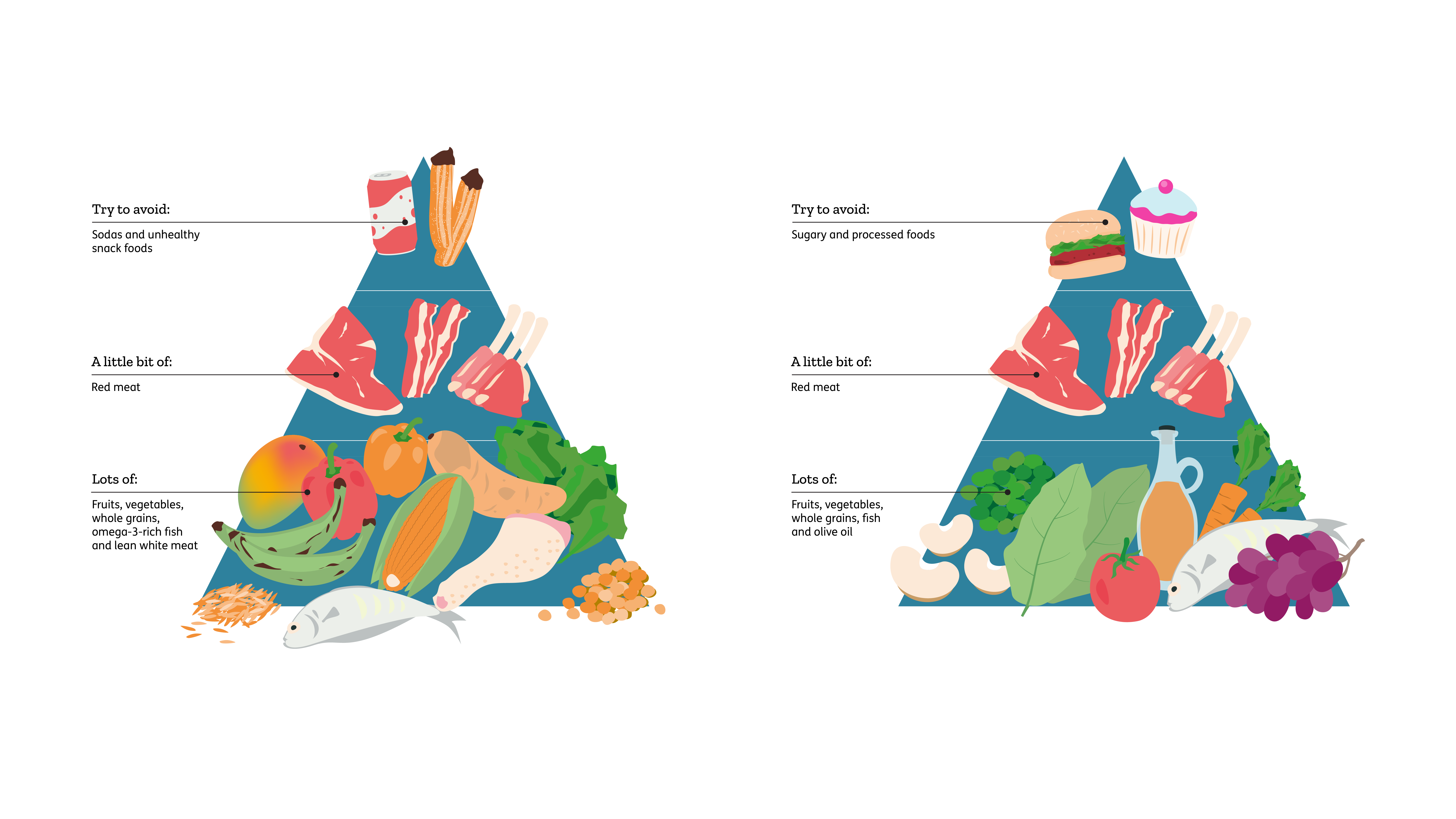
Diversity in clinical trials matters. Making sure participants feel represented matters. And representing diversity in clinical trial materials definitely matters. If you would like help in making sure every individual involved in your trial feels seen and appreciated, let’s talk.
This content was provided by Cuttsy + Cuttsy
Company Details

Latest Content from Cuttsy + Cuttsy
Patient Engagement for the Life Sciences
Patient Engagement for the Life Sciences, written by Guy Yeoman and Mitchell Silva with editorial and design support from Cuttsy+Cuttsy, explains the ‘why’ and the ‘how’ of patient engagement. It...
Moving away from pharma’s paternalistic approach
New handbook makes the case for greater patient engagement in the development of new medicines
Why patient education isn’t simple
The terms patient education, patient activation and patient engagement are increasingly popular as healthcare becomes more patient-centric. In this article, Clare Mariconda discusses how the concepts link together and shares...
Empowered patients improve outcomes
This white paper co-authored by our own Caroline Benson and Guy Yeoman, MediPaCe, discusses why non-adherence is occurring, how patients’ can be better engaged with their conditions and treatments and...
It’s nice, but it’s not an infographic
If you want to know if you’ve created an infographic, you can have a go with our flow diagram
Emotional Intelligence and Blended Learning in Healthcare
EI and emotional selling are rising up the agenda when it comes to healthcare training. This article outlines how blended learning approaches can help put them into action.
Patient engagement changes people’s lives…
Find out how one family’s experience of CF led to the development of a game which made essential physio a positive experience for everyone involved.
Health literacy… it’s not just plain English
In this day and age, you would think that clear communication would be second nature to us all, but this is not so. In our digital world misunderstanding and confusion...
Health Literacy Explained
Hear from Dr Elizabeth Walder, author of a series of patient-focused e-books in plain english and why health literacy is so important.
So how do you really engage with patients?
The most valuable insights from patient engagement are the most unexpected ones. Simple things, which may seem unimportant to you, may be the key to making patients’ lives easier and...