



Content for all – how to connect with neurodiverse audiences
March 31, 2025 | Inclusion, Neurodivergent, content, design, healthcare comms
Discover essential strategies for crafting inclusive and accessible written content tailored for neurodivergent readers.

Most written content is generally designed and presented for a neurotypical audience. This means that for the 1 in 5 people who are neurodivergent,1 engaging with written content can be a daily challenge.
Accessible and inclusive content is vital in creating equity and embracing diversity. The good news is that there are many ways to support neurodivergent individuals to process information being communicated. In this blog, we will explore three ways to support the development of accessible content for neurodivergent readers.
Key strategies for inclusive content
- Prioritise the style and appearance of written information
The readability of content begins with choosing the right font and layout.Sans serif fonts like Arial, Verdana, and Calibri are most inclusive for a neurodiverse audience. This is because they make letters look less crowded, which can facilitate understanding and speed of reading.
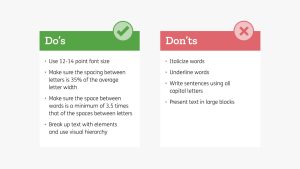
There are other ways to improve the style and appearance of writing too:2,3
- Use colours that consider sensory processing differences
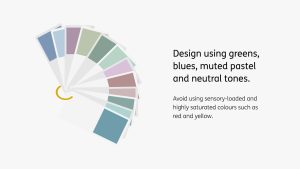
Colour plays a crucial role in how content is perceived and processed by neurodivergent audiences. It is important to avoid sensory-loaded and highly saturated colours such as red and yellow in designs since they may trigger sensory overload in some readers. Greens, blues, muted pastel and neutral tones are better to choose from because they are less stimulating and evoke feelings of peace and tranquillity.4,5
High contrast colours such as white and pure black on printed materials can be dazzling and visually stressful for neurodivergent readers. Instead, a light background with dark grey text can help with readability. The same is true for digital materials, whilst giving the option to switch the interface between light and dark mode or to a specific hue saturation can help enormously.6
- Use visuals and graphics to communicate information
Concise writing that avoids metaphors and figurative language as well as visual aids can significantly enhance attention, comprehension and retention for neurodivergent readers.7,8
Visual elements act as cues and bring structure and sequence to writing. Icons and images placed throughout documents can also help to anchor words to the page and help readers navigate through a written resource more efficiently. Icons and images may also help form memories and improve understanding.2
While traditional content often caters to neurotypical audiences, making small adjustments in font choice, colour use, and visual aids can create a more inclusive experience for neurodivergent readers. For more detailed guidelines on creating accessible content, explore resources from the Neurodiversity Design System, Inclusion & Accessibility Labs, and the British Dyslexia Association.
At Cuttsy+Cuttsy, we are committed to making healthcare communications accessible for everyone. Please get in touch if you’d like to find out more about the work we do.
References
1. The Brain Charity (2022). Accessed: September 2024.
2. British Dyslexia Association (2023). Accessed: September 2024.
3. Dyslexia Support South (2023). Accessed: September 2024.
4. Full Fabric (2024). Accessed: September 2024.
5. Experia (2021). Accessed: September 2024.
6. Neurodiversity Design System (2024). Accessed: September 2024.
7. Fighting Talk Communications (2024). Accessed: September 2024.
8. Bedrock Learning (2022). Accessed: September 2024.
This content was provided by Cuttsy + Cuttsy
Company Details

Latest Content from Cuttsy + Cuttsy
Season’s Greetings
Do you have Tinsilitus?
Cuttsy+Cuttsy launch their latest patient e-book
On the eve of ‘World Osteoporosis Day’ (worldosteoporosisday.org), Cuttsy+Cuttsy are proud to launch their latest e-book ‘Osteoporosis…in plain English’.
Insights from the charity sector – from patient engagement to people-driven design
Marianne Guldbrandsen, Strategy Director at Cuttsy+Cuttsy and former Head of Innovation and Strategic Partnerships at Macmillan, discusses how people-driven research leads to truly patient-centred products and services, and what the...
Patient Engagement for the Life Sciences
Patient Engagement for the Life Sciences, written by Guy Yeoman and Mitchell Silva with editorial and design support from Cuttsy+Cuttsy, explains the ‘why’ and the ‘how’ of patient engagement. It...
Moving away from pharma’s paternalistic approach
New handbook makes the case for greater patient engagement in the development of new medicines
Why patient education isn’t simple
The terms patient education, patient activation and patient engagement are increasingly popular as healthcare becomes more patient-centric. In this article, Clare Mariconda discusses how the concepts link together and shares...
Empowered patients improve outcomes
This white paper co-authored by our own Caroline Benson and Guy Yeoman, MediPaCe, discusses why non-adherence is occurring, how patients’ can be better engaged with their conditions and treatments and...
It’s nice, but it’s not an infographic
If you want to know if you’ve created an infographic, you can have a go with our flow diagram
Emotional Intelligence and Blended Learning in Healthcare
EI and emotional selling are rising up the agenda when it comes to healthcare training. This article outlines how blended learning approaches can help put them into action.
Patient engagement changes people’s lives…
Find out how one family’s experience of CF led to the development of a game which made essential physio a positive experience for everyone involved.