




Flexible working: a fad or the future?
October 10, 2023 | Agency life, Flexible working, Healthcare Marketing Agency, mental health
As the Flexible Working Bill gets written into UK law, we took a look at what this means for businesses of all sizes and specialities.
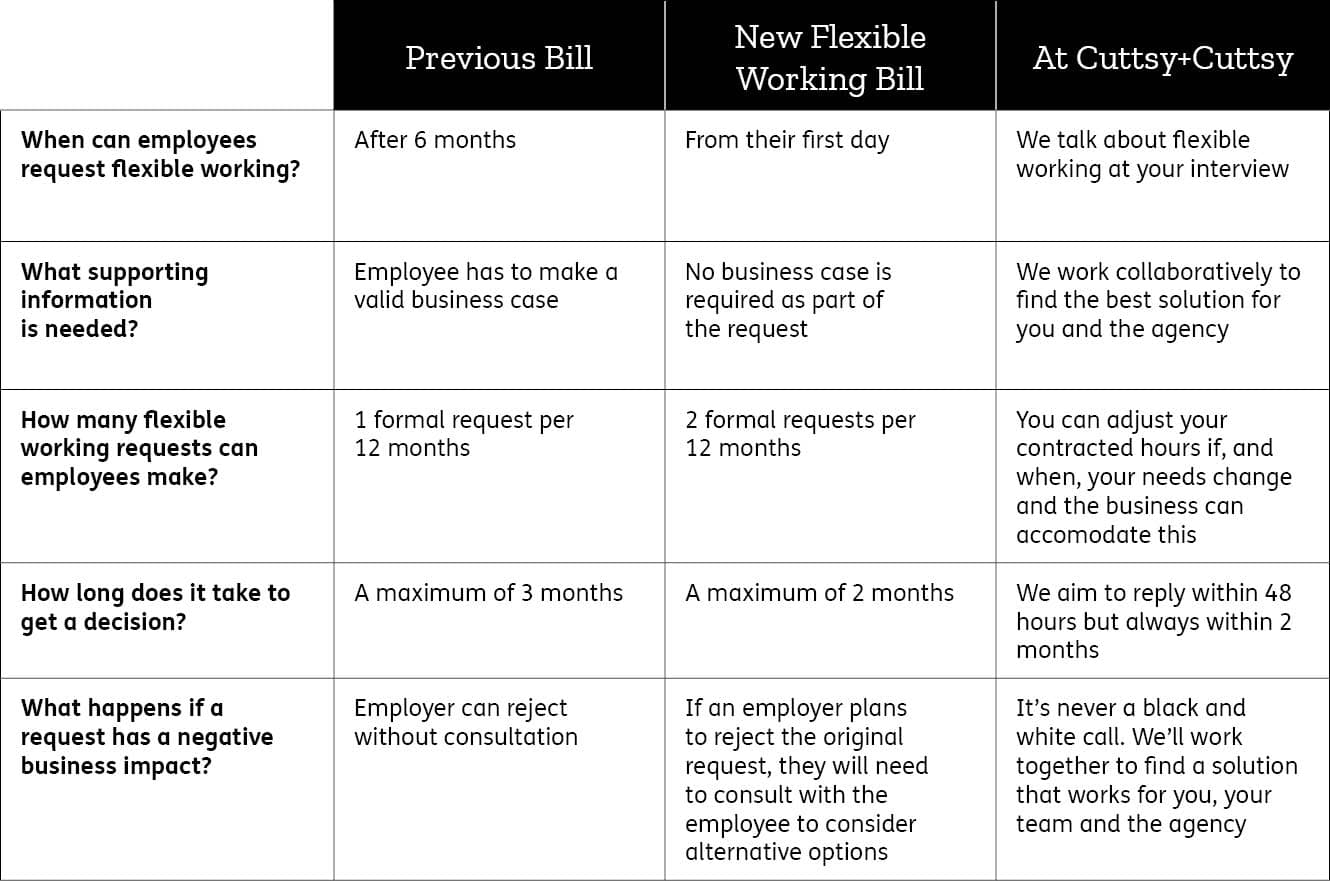
The flexible working bill (or, Employment Relations Act 2023) received Royal Assent on 20th July 2023 bringing it into UK law. The bill guarantees an employee the right to be considered for flexible working within the terms of their employment.
Our take
Flexible working has always been part of the DNA at Cuttsy+Cuttsy; founders Mathew and Caroline ingrained the practice as one of the agency’s core values when creating their vision of a high-performing independent agency.
However, no one business model is the same and every industry is different. The bill will mean that anyone (regardless of their company size, structure, or industry) can request flexible working from day one. While this is a great step forward, we ask candidates what their ideal working preferences are as part of our interview process. What is their preferred pattern of work? Do they have commitments outside of work that would benefit from flexible hours? Taking flexible working seriously means taking the time to understand individuals and whether a job can be tailored to them, rather than simply a tick box exercise of whether a candidate fits a job description. We also like to think it’s a great way for an interviewee to understand more about the company culture.
Flexible working comes down to supporting individual preferences. While we have always allowed for remote working, the office forms a vital part of the equation. We find working together in the office not only results in some of our best creative ideas, but it holds benefits beyond business performance. Believe it or not we like spending time together. It is good for mental health to socialise away from a screen, it provides a routine and structure as well as solidifying the borders between ‘work’ and ‘home’ – something many of us struggled with during lockdown.
Last year, almost 2 million people changed jobs due to the lack of flexibility and double this number left their sectors entirely for the same reason.1 It’s a no-brainer then, that on a business level, greater flexibility will help reduce turnover and increase productivity. We’ve seen this with our own team and we’re excited to see how this new bill will help reshape the working lives of everyone in the UK – from day one.
[1]. Gov.uk. Millions to benefit from new flexibleworking measures. Available at: https://bit.ly/47FHh3S Accessed August 2023.
This content was provided by Cuttsy + Cuttsy
Company Details

Latest Content from Cuttsy + Cuttsy
Invited, but not equipped: patient involvement needs more than an open door
Explore how pharma can help patients and patient organisations prepare for meaningful involvement in EU HTA without shaping their contribution.
The outcomes are already chosen. So when can patients really shape them?
Explore why involving patients early in Joint Scientific Consultations is critical to shaping the outcomes measured in clinical trials.
Long-term clinical trial engagement is a behavioural challenge – not just an informational one
Explore why long-term clinical trial engagement is a behavioural challenge, showing how proactive support from site teams can help participants stay connected, confident and committed throughout a study.
Patients are telling the truth — just not to you
Patients are often most honest outside the clinic—revealing vital insights that can help clinical trial teams build trust, improve participation and collect better data.
When what matters to patients is hard to measure
Patient-relevant outcomes sit at the heart of the EU HTA reforms, but ensuring they reflect lived experience requires you to look beyond what traditional clinical endpoints measure.
Permission to pause: making treatment breaks part of the cancer care conversation
Exploring how empathetic, patient-centred communication can make planned treatment breaks easier to discuss as part of cancer care.
A seat at the table: what the EU HTA reforms really ask of patient involvement
The EU HTA reforms give patients a formal role in assessing new medicines, but meaningful involvement requires more than simply offering them a seat at the table.
Why faster trials make participant understanding more important than ever
As clinical trials accelerate, clear, accessible consent is essential to help participants understand, engage with and remain in a study.
Older trial participants reject bad design, not technology
Older trial participants aren’t rejecting digital technology — they’re rejecting poorly designed, inaccessible experiences that make participation harder.
5 key takeaways from the Patient Centricity and Engagement Conference
Key takeaways from the Patient Centricity and Engagement conference, exploring how trust, inclusion and meaningful partnership can help turn patient engagement from intention into action.