



Shared Care, Digital Tools, and AI: What Do Nurses Really Think?
July 22, 2025 | #patientengagement #healthcarecommunication #behaviourchange #personalisedcare #sharedcare
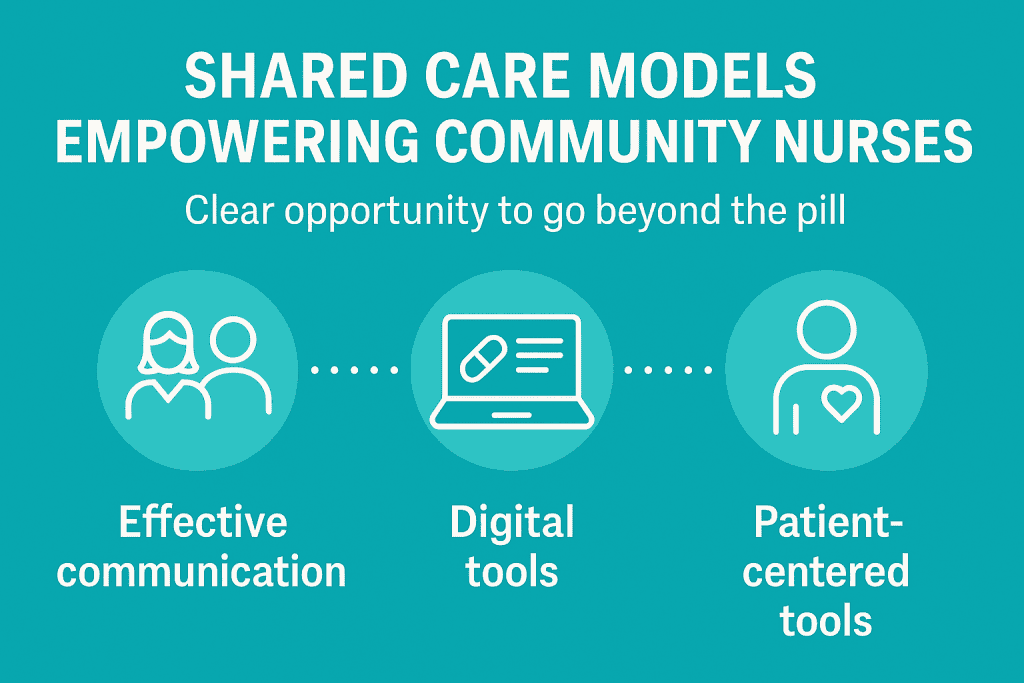
Shared care models, supported by effective communication and digital tools, are helping community nurses like Ashleigh Tropp empower patients and improve outcomes, especially in managing long-term conditions. For pharma and medtech brands, this presents a clear opportunity to go beyond the pill by investing in patient-centered tools that drive engagement, adherence, and sustainable impact.
An interview with Ashleigh Tropp, Community Paediatric Nurse, Ealing District
Community healthcare is an essential, yet stretched, part of the NHS, delivering care to over 200,000 people daily — many of whom live with long-term, complex conditions. With rising demand and limited resources, frontline healthcare professionals are being asked to do more with less.
A 2024 Royal College of Nursing survey found that 82% of nurses feel they lack the time to provide the level of care they aspire to — with 47% reporting that patient care has been compromised as a result. For pharmaceutical and medtech brands, these pressures present both a challenge and an opportunity: how can we support health systems to deliver more sustainable, impactful care?
One compelling answer lies in shared care models — and the communications and technologies that make them successful. We spoke to Ashleigh Tropp, a community paediatric nurse, about the front-line reality of shared care, what clinicians need from pharma, and how communication and digital support are essential to driving patient behaviour change.
Reframing patient engagement: from passive to partner
The evolving patient role is not just a policy ambition — it’s a clinical and commercial imperative.
“Shared care is about partnership,” says Ashleigh. “It’s not about replacing clinical input. It’s about giving patients the clarity, tools, and confidence to take a more active role.”
In the context of long-term condition management — where adherence, activation, and education are critical to brand success — shared care represents a shift in mindset. It calls for deeper investment in communication and support, beyond prescribing.
“In our community, we’ve seen shared care work in diabetes and chronic wound care,” Ashleigh continues. “It frees up nursing time, improves outcomes, and gives patients a real sense of control. But only if the right resources are in place.”
Communication: The missing link in shared care success
Patients may be prescribed the best product — but without the right support, confidence and knowledge, adoption suffers. Effective shared care depends not just on tools, but on how those tools are communicated and embedded.
“Patients need practical, day-to-day guidance,” explains Ashleigh. “We can’t walk them through every step, so we rely on communication materials — visual, digital, written — to fill the gap.”
At EatMoreFruit, we specialise in developing pharma-led patient engagement tools that support uptake, reduce barriers, and drive measurable impact — from behavioural nudges in digital apps to onboarding packs that support treatment initiation.
Technology as an enabler: real-world lessons
Ashleigh recalls a recent case: “We supported a teenager newly diagnosed with diabetes using a mobile app that tracked insulin and provided simple prompts. Within weeks, she felt more in control and more committed to her care.”
Whether it’s apps, remote monitoring tools, or conversational AI, digital platforms are extending pharma’s role beyond medication — helping to close the adherence loop with timely, patient-focused interventions. But adoption varies.
Pharma marketers should be aware of key challenges:
- Sustained engagement: Tools must be intuitive, rewarding, and relevant to daily routines.
- Health literacy: Language, accessibility, and cultural nuance matter.
- Digital inequality: Not all patients have equal access — hybrid strategies remain key.
Behaviour change is a campaign — not a message
“Behaviour change doesn’t happen through good intentions,” Ashleigh emphasises. “It needs structured, consistent reinforcement — across multiple touchpoints.”
Pharma marketers are well placed to deliver that structure — especially when they think beyond the patient leaflet. The most effective campaigns leverage integrated communication, across:
- Digital explainers and onboarding apps
- Point-of-care posters or starter kits
- Short videos or animated tutorials
- Community engagement through influencers or advocates
AI: The next frontier in personalised care support
Looking ahead, Ashleigh believes AI has the potential to transform clinical decision-making and patient engagement.
“We’re already using chatbots to answer routine questions and provide reminders. Soon, I believe AI will help clinicians tailor treatment plans by interpreting patient-specific patterns or surfacing the latest evidence in real time.”
For pharma, this opens new pathways to real-world data generation, predictive engagement, and differentiated patient support.
The pharma opportunity: delivering value beyond the pill
At its heart, shared care is not just a clinical model — it’s a communications and engagement model. It creates space for pharma to play a more meaningful role in the treatment journey.
When patients are truly informed, motivated, and supported, outcomes improve — and so does brand value. From improved adherence and patient satisfaction to more effective data capture for market access, the commercial case for investing in strategic, evidence-based communication has never been stronger.
Want to co-create tools that drive patient engagement and brand impact?
At EatMoreFruit, we partner with pharmaceutical and medical technology brands to design and deliver communication strategies that change behaviour, support clinical outcomes, and strengthen your value proposition. Get in touch.
This content was provided by EatMoreFruit
Company Details

Latest Content from EatMoreFruit
Europe Celebrates the Heart of Healthcare Decision-Making as Laboratory Medicine Professionals Take Centre Stage
Today, the European Federation of Clinical Chemistry and Laboratory Medicine (EFLM) proudly marks European Laboratory Day, celebrating the professionals at the heart of healthcare decision making. Across Europe, laboratories will...
Why Trust Remains the Primary Driver of Pharma Success
In an age of precision medicine, AI-driven drug discovery, and blockbuster biologics, it’s tempting to assume clinical trial outcomes alone dictate success in pharma. But the reality is more nuanced:...
Shared Care, Digital Tools, and AI: What Do Nurses Really Think?
Shared care models, supported by effective communication and digital tools, are helping community nurses like Ashleigh Tropp empower patients and improve outcomes, especially in managing long-term conditions. For pharma and...
How can a digital PR strategy elevate your company’s profile? A spotlight on mental health
In the ever-evolving healthcare media landscape, Digital PR bridges the traditional benefits of reach, share of voice, and sentiment with the power of Search Engine Optimization (SEO)—delivering both meaningful connections...
Why events should be part of your 2025 growth strategy
Over eighty per cent of businesses rank in-person events as their most impactful marketing channel. In fact, 48 per cent of teams say events are more important today than pre-pandemic. When done...
How to make your Medical Education sync with your marketing by EatMoreFruit’s Bethany Lowes Bush
Medical education faces challenges. Time is scarce. Resources are tight. Information overload is real. But by delivering genuine value through innovative formats that respect how HCPs actually learn and consume...
Putting EU Lab Day on the Map
EU Lab Day 2024 made an impact - reaching over 1.7million people through media and social.
Want to Tell Your Story Differently in 2025?
From animation and gamification, to events, influencers, opinion leaders, and chatbots; there are tools and tactics which can engage health professionals, payors, patients and consumers. At EatMoreFruit we like to...
EatMoreFruit announces launch of European PR Network
EatMoreFruit, a UK top 10 independent healthcare communication agency, today announced the launch of its European Network to support new and existing clients across the diagnostics, med tech, life sciences,...
What if you could shape your next campaign messaging with the media before launch?
Sometimes you just can’t see the wood from the trees. Teams gets so focussed on the technology or treatment you’re selling that the inevitable outcome is a feature-peddling monologue where...
- 1
- 2