



Bridging the gap in personalised digital support: My Stroke Companion
June 27, 2025 | Cognitant, Digital Patient Support, Healthinote, Patient-centric, digital health, disease awareness, health innovation, health literacy, health tech, medical education, patient adherence, patient engagement
To empower stroke survivors to engage with their care, Cognitant, in partnership with University College London Hospitals (UCLH), identified a need for a new digital health companion that can support patients following discharge from acute care. This ultimately led to the conception of My Stroke Companion.

My Stroke Companion is an accessible digital health companion providing personalised, reliable and localised information about type of stroke, post-stroke care plans (including prescribed medicines and rehabilitation), local support provision, lifestyle changes, driving, work, finances and sex and relationships.
With a minimalistic, easy-to-use layout, the formats and functions of this digital health companion include:
- separate versions for stroke survivors and caregivers
- explainer videos and visual content
- easy read downloads
- text-to-audio
- links to further high-quality and trusted information sources
- health goal-setting, logging of health data and tracking of health trends
- translations of all content into Arabic and Polish
- personalised by clinicians through the completion of a checklist on Healthinote
Co-creation is essential for optimising all health education and support materials. To deliver My Stroke Companion, we followed our four-step co-creation process: Discover, Define, Develop and Deliver/Evaluate.
Discover: The unmet needs of stroke survivors, their caregivers and family members were explored through an intensive 6-week market research phase.
Define: Potential digital health companion content, formats and functions were presented to and critiqued by clinicians, patients and their family members via focus groups, 1:1 interviews and surveys.
Develop: An iterative design process was followed, with clinicians, patients and their family members continuing to be consulted at key steps during development, before the final build was agreed on with key stakeholders.
Deliver/Evaluate: Following an initial pilot and further iterative development of My Stroke Companion, a feasibility study explored its accessibility and usability. The digital health companion will be further developed in the future, based on these learnings and as more user feedback is gathered and processed.
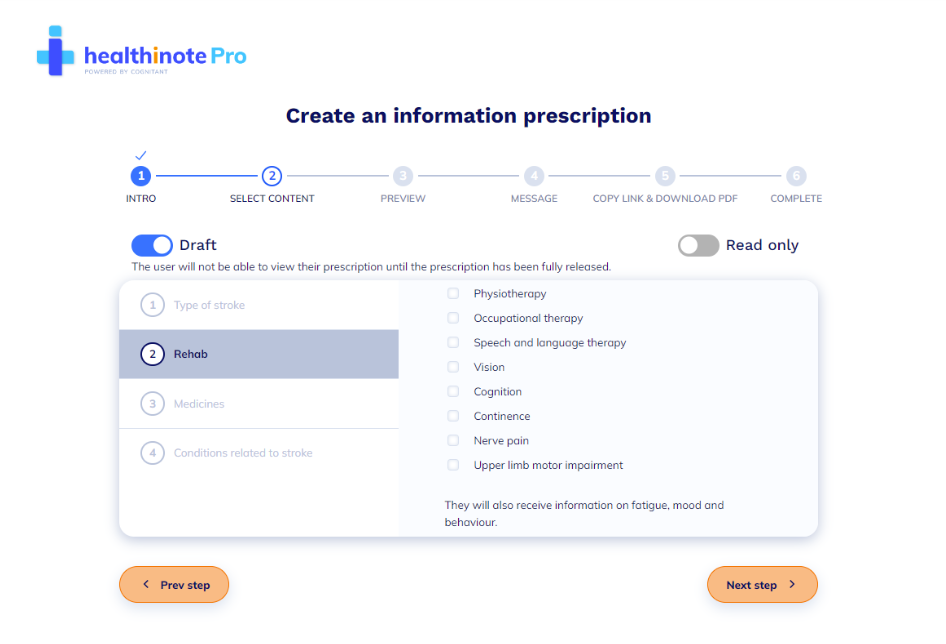
Figure 1. Information prescription user interface, as used by clinicians when tailoring the My Stroke Companion digital health companion to suit the individual stroke survivor. Personalised elements include type of stroke, prescribed medicines, conditions related to stroke, follow-up tests and contact details of their stroke team. Following submission, the checklist automatically populates a cover letter which can be fed into the patient’s electronic health record. The clinician can then send this via email, SMS, or present a QR code to their patient.
Feasibility study
Methods
Five UK NHS hospitals prescribed My Stroke Companion to stroke survivors at discharge over an 8-month period. Platform engagement and optional, anonymous, in-hub feedback surveys were analysed. Surveys included questions on the usefulness, accessibility and usability of the digital health companion, as well as intended future frequency of use.
Key results
Clinicians generated 504 prescriptions across the five NHS sites, with 400 users subsequently accessing My Stroke Companion 555 times. The average session duration was 6 minutes.
Of those who accessed My Stroke Companion, 42 stroke survivors and 26 caregivers completed the optional survey.
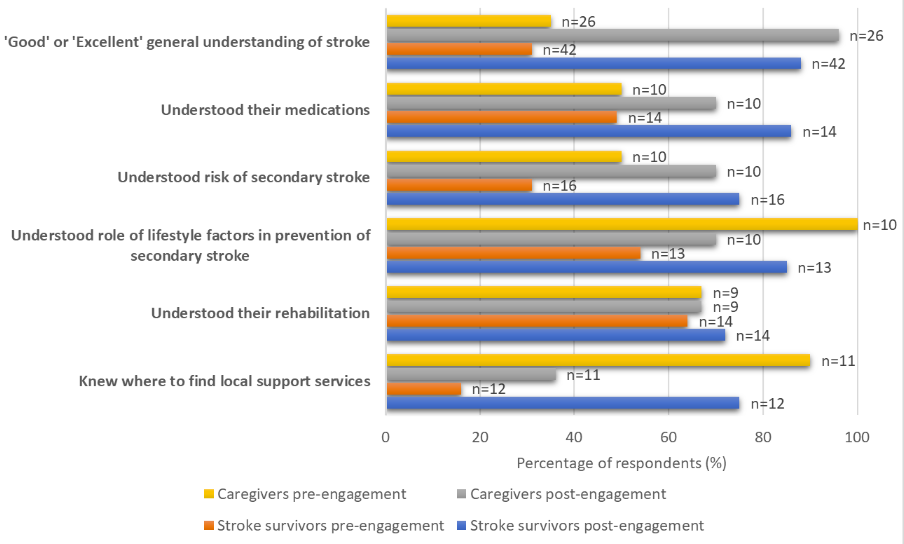
Among stroke survivors, 31% self-reported a ‘good’ or ‘excellent’ understanding of stroke before accessing the digital health companion, compared to 88% after accessing the platform. Feedback also indicates increased knowledge in all domains, including medicines, rehabilitation, accessing support and preventing further stroke. These findings were similar among the caregiver cohort.
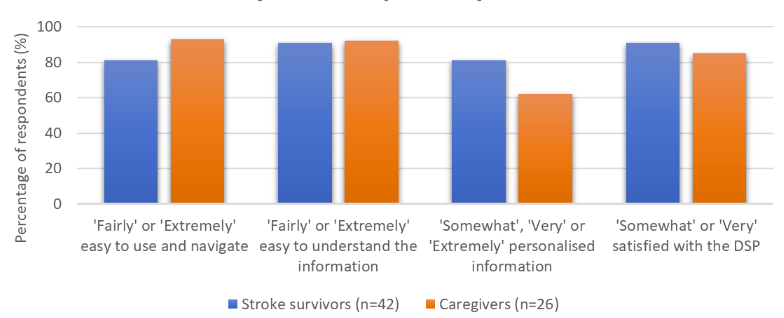
Personalisation of the content was a key feature of the digital health companion, with 81% of stroke survivors feeling that the content was suitably tailored to their needs. When questioned on the accessibility and usability of My Stroke Companion, 81% of stroke survivors and 93% of caregivers felt that the platform was ‘fairly’ or ‘extremely’ easy to use and navigate. 91% of stroke survivors and 92% of caregivers felt that the content was easy to understand. Overall, satisfaction levels were high among those that completed the survey, with 91% of stroke survivors and 85% of caregivers being ‘somewhat’ or ‘very’ satisfied with My Stroke Companion.
Regarding future use of the digital health companion, 83% of 42 stroke survivors and 84% of 26 caregivers said that they would be likely to use My Stroke Companion in the future.
Stroke knowledge before and after accessing My Stroke Companion
Usability and accessibility of My Stroke Companion
Learnings and future directions for My Stroke Companion
Having been successfully rolled out across five NHS stroke centres in the UK, My Stroke Companion is the first personalised digital health companion that supports stroke survivors and their families in the UK. Wider rollout and continued iterative development of the platform will ensure that the needs of stroke survivors and their families are met through appropriate information provision, in the right formats, at the right time.
My Stroke Companion is the only available stroke information solution embedded within the stroke pathway that curates content into one platform, enabling clinicians to create personalised digital health companions for each patient tailored to their region, language, diagnosis and care plan.
The results of the feasibility study suggest that providing multiformat, digital, personalised content to stroke survivors and their families can have a meaningful impact on their ability to understand and engage with their care plans. Our ambition is to put My Stroke Companion at the fingertips of all UK stroke survivors, empowering them to take more control over their personal health whilst providing efficiency savings to NHS Trusts.
Looking beyond the UK, there is growing international demand for personalised, digital health information that can help patients self-manage their conditions, tackle health inequalities and deliver efficiencies to health systems. My Stroke Companion could feasibly be adapted to and implemented in various health systems. Having been developed in multiple languages, further translations may easily be deployed as necessary. While the UK remains the focus of our attentions in the immediate future, the international potential of this digital health companion is clear for all to see.
For now, the iterative development of My Stroke Companion continues, with rich feedback to process and act on from a wide range of stakeholders. Key areas of focus include:
- ensuring information remains topical and up to date
- continuing to fill gaps in information provision
- enhancing accessibility of My Stroke Companion, so that it is usable and impactful to all
- providing new and improved features to help patients stay on top of their health
- streamlining the integration of the programme with clinical care pathways
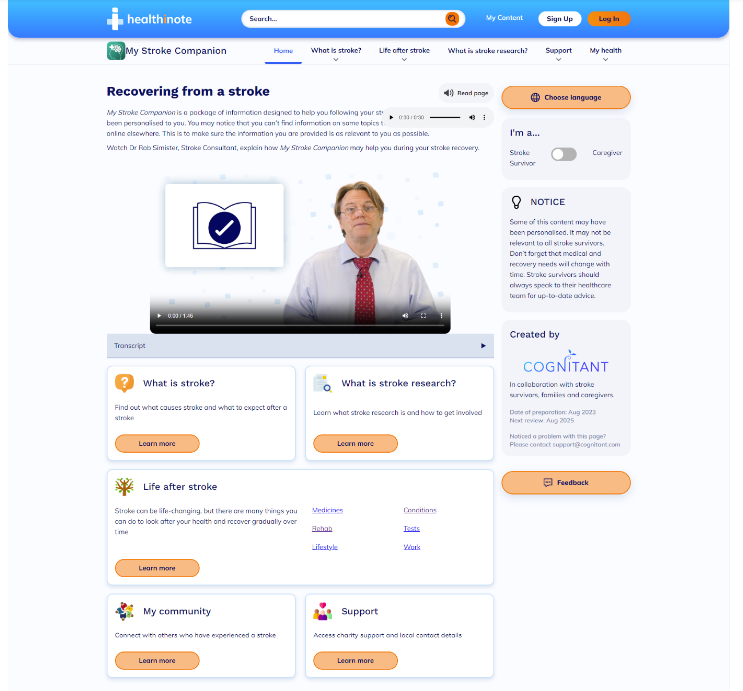
Figure 4. A view of the homepage of the stroke survivor version of My Stroke Companion, featuring an introductory video by Dr Rob Simister, Principal Investigator of this programme and Clinical Lead of the UCLH Comprehensive Stroke Service. A top navigation bar and prominent buttons below the video player provide convenient access to the various areas of the platform. The user can select their desired language, choose whether to switch to the caregiver version using the buttons near the top-right corner.
Acknowledgements
We extend our deepest gratitude to everyone involved in the co-creation and evaluation of My Stroke Companion. This initiative would not have been possible without the invaluable contributions of healthcare professionals, charitable organisations (Headway, Different Strokes, the Stroke Association and Same You), stroke survivors and their caregivers.
Special recognition goes to our primary development partner and recruitment site, University College London Hospitals (UCLH). We are particularly grateful to Dr Rob Simister, Principal Investigator and Clinical Lead of the UCLH Comprehensive Stroke Service, for his leadership, dedication and unwavering support throughout this project.
This content was provided by Healthinote (by Cognitant)
Company Details

Latest Content from Healthinote (by Cognitant)
Lack of education causes patients to stop vital treatments, survey finds
Over three quarters of healthcare professionals call for co-created patient materials to drive engagement and trust, ultimately helping more patients benefit from prescribed treatments. Nearly 80% of healthcare professionals identify...
North East and North Cumbria NHS rolls out digital health platform to combat chronic kidney disease, affecting 1 in 10 UK adults
In a significant step towards tackling one of the UK’s most underdiagnosed conditions, North East and North Cumbria Integrated Care Board (ICB) has adopted the Healthinote digital health platform, providing...
Bridging the gap in personalised digital support: My Stroke Companion
To empower stroke survivors to engage with their care, Cognitant, in partnership with University College London Hospitals (UCLH), identified a need for a new digital health companion that can support...
Kidney Research UK invests in Healthinote patient education platform which could support >15m people with long term health conditions
Kidney Research UK, the leading charity dedicated to kidney health, has made a significant investment in Cognitant Group Ltd, a leading provider of digital education and support tools to improve...
Health literacy & the creation of shared decision aids for patients with cancer
In this blog, Gini Melesi, Head of Transformation, East of England Cancer Alliance, & Diane Whitney, Head of Brachytherapy Physics, Cambridge University Hospitals NHS Foundation Trust, explore the relationship between...