




A personal perspective on autism
April 27, 2021 | Autism Awareness, Lucid, Medical Communications, healthcare communications, inclusivity
The whole month of April is Autism Awareness Month. To help mark the end of such an important month we’re sharing a personal perspective to spread kindness and autism awareness:
When the opportunity arose to write a blog on autism, I ummed and aahed a little about sharing a personal perspective; a piece of me finds putting my children ‘out there’ quite daunting, but at the same time, I want people to know how marvellous they are and that while autism makes up a good deal of them, much of their success in how they make their way in this world depends on your understanding and acceptance of what life is like for them.
How do you see the world? Do you ever think about that? How often do you suppose other people wonder how you see the world: how you feel and what you think, how you respond to what is happening? How often do they try to pre-empt your reactions to what is going on around you or might be about to happen? As a parent of two autistic children I do these things all the time, because I know that children on the autistic spectrum see things differently, but I often wonder how much time parents of non-autistic children spend thinking about this. I reflected during a conversation with a friend over the weekend, “Sometimes for me, the lines are blurred between ‘general parenting’ and ‘managing specific autistic traits” – i.e., responding to the very particular idiosyncrasies – and I wonder how much the observations are increased due to the challenges we encounter.
Autism has a huge scope for such a small word. The best way I’ve heard it described is as a pedal-bike wheel, with each spoke being a different trait, and with each trait you can have a strong or weak affinity. As such, the experience of autism in some ways is as unique as a fingerprint. Autism-trait checklists are all well and good, but the personalities of these children are as unique as those of any other child.
In many ways, you wouldn’t immediately be able to tell my older son is on the spectrum, yet he is diagnosed with Aspergers + attention deficit hyperactivity disorder (ADHD). In his Educational HealthCare plan (EHCP), a document setting out his challenges and the support he requires in school, his teaching assistant notes some of the many positives: “He is a good puzzle solver and has a thirst for knowledge. He has shown continuing interests in drawing– mythical creatures feature strongly. He has his own YouTube channel and is very popular with his peers. His IT skills are good and he can edit videos in YouTube. Everywhere he goes, he delights people with his curiosity and character. He’s a lovely, joyful boy and when he properly smiles he really does light up the room.” I can’t read anything out of the ordinary in this, and it probably accurately describes most 13-year-old boys. However, later down the page in a section called ‘How to support, communicate and work well together’, with direct input from my son himself, his day-to-day challenges become clear: “I need continued access to the music practice rooms and the library during breaks (so I don’t need to worry about being bullied). No elevated volume in tone of voice, speak calmly to me. Sitting and calmly talking to me while trying to explain. Be fair – if it seems you are not being fair, I won’t hear reason or understand. Give me time to ask questions and help me find answers. Let me have a difference of opinion and explain to you why. Listen to me when I have been upset. Active listening – let me speak and listen to me. Speak to me at my level, talk through my work with me, make me laugh and be patient. Give me responsibility and a variety of work that is interesting to me.”
These statements are probably a little different to that of a child without special educational needs, but nothing that would startle you. My other son’s autism is however more obvious:
He is the kindest, most considerate, polite, gentle boy I have ever known. He is into WWE in a big way; it used to be all he was into, but he has now discovered Queen, Metallica and Def Leppard. He has a lot of patience and is known for being able to work well with children with behavioural challenges as he has a way of calming them down. Growing up, he had huge issues being separated from me – if I wanted to go on a social night out he would break his heart (and mine) as I was leaving the house. He is extremely sensitive to sounds, textures, smells, light, taste, crowds, space and insects. He needs a routine as he struggles to adapt to change, and he needs a teaching assistant with him in every lesson just to provide reassurance as his self-esteem is so low. If I try to bring him into work, it is too overwhelming for him to come into the office, and he will curl up like a hedgehog outside. He struggles to make friends and feels uncertain about his place in this world. He worries about being depressed as he doesn’t laugh a lot. At bedtime, he has to have certain things exactly the same way every night – from the number of times he taps his toothbrush on the sink after cleaning his teeth, to the classical music tune he puts on, the order in which he dresses, and the specific words we say to each other every night. He wakes up every day thinking something horrible is going to happen to him, even though nine times out of ten it doesn’t, as he’s pretty well protected. The world for him is a very big place; not full of opportunities, but full of scary things.
Going back to the positives (this is what we use as drivers to boost our children’s confidence and outlook): we took our oldest son to see Professor Brian Cox give a lecture on space at the Manchester Arena, and of all the questions submitted by a captivated audience of 6,000, his was chosen to be read out and answered – Professor Cox commented on his age and understanding to have been able to even ask the question. He is also on the British Sprint Shoot Olympic Team, having been headhunted in his local clubs. My youngest son loves baking and cooking, has recently found he has a talent for playing the drums and has decided he’s going to be a drummer/zoo keeper when he’s older. He was also honoured with his primary school’s special award for pride and perseverance in his final year due to his remarkable attitude despite how hard he finds things.
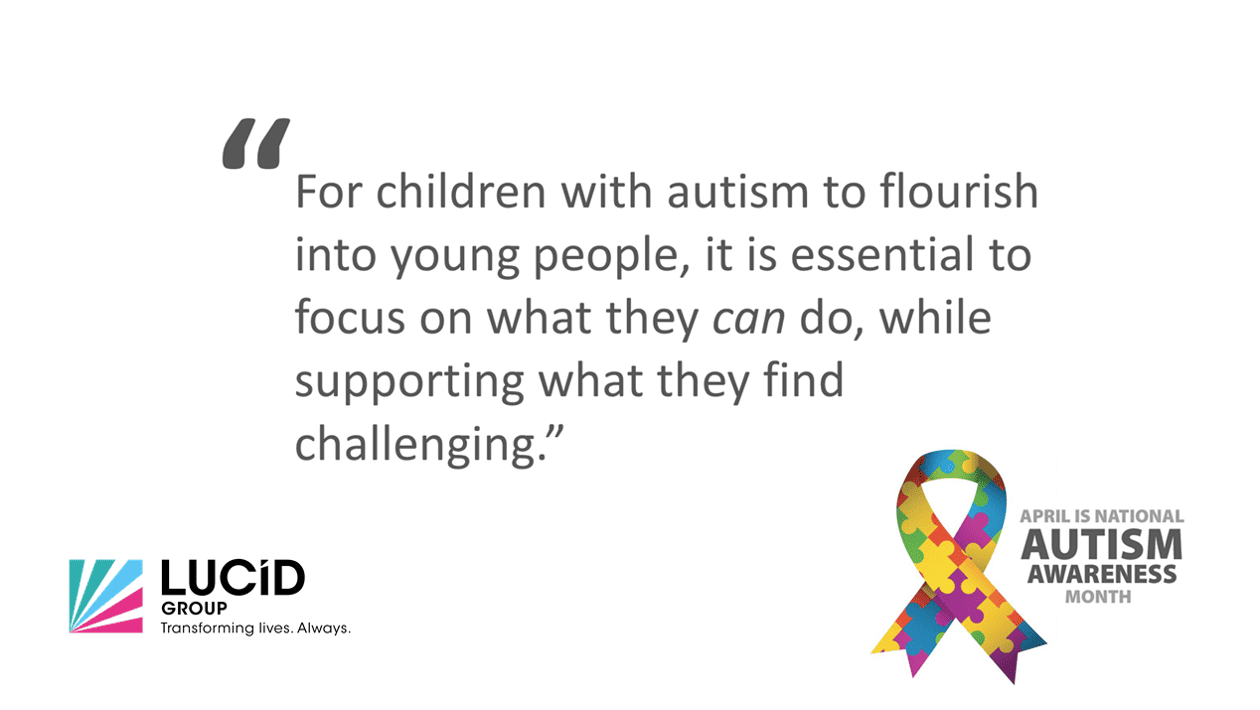
For children with autism to flourish into young people, it is essential to focus on what they can do, while supporting what they find challenging. We need to be able to provide them with a toolbox that they can draw on in any situation. Looking for the positives and talents of each child is how we deliver a top-heavy approach to parenting and work towards positive perceptions that enable each child to be the best version of themselves. Each child is different and experiences of autism for families are as different as my two children– they are like chalk and cheese, but both on the autistic spectrum.
As parents, we look at our boys and wonder what the world will be like for them as adults. Autism is a lifelong condition: these children will become adults and carry these sensitivities with them, even if they do develop and learn skills, tools and strategies for coping. A very good question was posed last week about Lucid’s provision for adults with learning difficulties and I was delighted to hear a positive answer from our HR department about how this will be addressed. We need to know our workplaces are safe, inclusive and supportive places that embrace the unique talents of all of our people.
Thank you for reading this. I know it is longer than your average blog, but I can’t simplify a complex condition.
Support resources, by another Lucid parent
When my son was little, his autism marked him out as different to his neurotypical peers. But two amazing local charities have given him a lifeline of fun and friendship. Space4Autism (Home | Autism Charity In Cheshire | Space 4 Autism) was set up as a parent support group in 2005 and has grown into a huge local resource offering social clubs and activities, drop-in advice, a café, a sensory room, workshops, training and more. My son has been going there for fifteen years and we can’t imagine life without it. Friends For Leisure (www.friendsforleisure.org.uk) is for young people with a wide range of needs, not just autism, and does what it says on the proverbial tin: provides leisure activities and a new bunch of friends. It is a joy to witness the children’s interaction in these spaces: there is no judgement, no pressure to conform, just the pleasure of having a good time in a safe space. We are blessed in Cheshire East with these two incredible organisations and my son, now 21, has as rich a social life as the rest of us. To any parent with a newly diagnosed child, don’t despair: contact your local support network; it will be there, and it will make a difference.
This content was provided by Lucid Group Communications Limited
Company Details

Latest Content from Lucid Group Communications Limited
Lucid Group bolsters its client services and medical writing team in APAC
HealthCare21, a Lucid Group company, has appointed two new team members in its Singapore office — Siew Wyn and Megan Giliam.Wyn joins the team as a Senior Account Manager and...
Lucid Group kick starts its 2020 Futures Academy
It’s a new year and the start of a new career for the six graduates starting on Lucid’s Futures Academy this week.This is Lucid’s fourth intake of graduates since the...
It’s been altogether more magic for Lucid Group in 2019
As Lucid closes its doors to 2019, there's a lot to be proud of.2019 has been a landmark year for the Group as they embarked on ambitious growth plans which...
Middlesex House hosts its first Lucid Spirit pub quiz
Dec 6, 2019Middlesex House hosted its first Lucid Spirit fundraising activity for its charity partner the Wycombe Homeless Connection. The turnout was excellent, and everyone’s synapses were on fire. However,...
Lucid Group announces the appointment of a new Legal and Compliance manager
Lucid Group demonstrates continual investment in its infrastructure by appointing Sebastian Goodwin as its new Legal and Compliance manager.Sebastian studied politics and trained to be a lawyer before moving into...
Lucid Group Experience the Magic of Mindfulness, Meditation and Massage
This time of year can be busier than normal. Lucid Group understand the importance of taking some time out to relax and unwind. That's why yesterday, relaxation, meditation and mindfulness...
The first of many celebrations for Lucid Group at Middlesex House
Lucid Group celebrated the opening of its new offices in Fitzrovia, London on Thursday evening. The workspace in Middlesex House is incredible, allowing employees to take advantage of well-designed creative,...
Lucid Group welcomes three new graduates ahead of the 2020 Futures Academy
Three new graduates have joined the Lucid Group family ahead of the launch of the 2020 Futures Academy in January.Having completed a Natural Sciences degree from Lancaster University, Tom Harrison...
Restoring Equilibrium at Lucid Group
It’s National Stress Awareness Day, which is a great opportunity to take a moment to think about our wellbeing. This time of year is often busier than normal. At Lucid,...
Lucid Group celebrates a fang-tastic Halloween
Last week the Lucid charity working group, Lucid SPIRIT, organised a fang-tastic Halloween Bingo evening to raise money for its charity partner, Wycombe Homeless Connection (WHC).Lucidians went to town with...