




A Woman Should Not Be Treated As a Small Man
April 3, 2024 | Leadership, Women in healthcare
What should the future of women’s healthcare look like? Two renowned physicians say it involves a multidisciplinary, holistic approach, where a group of different specialists work together to provide a lifetime course of holistic primary and specialty care.
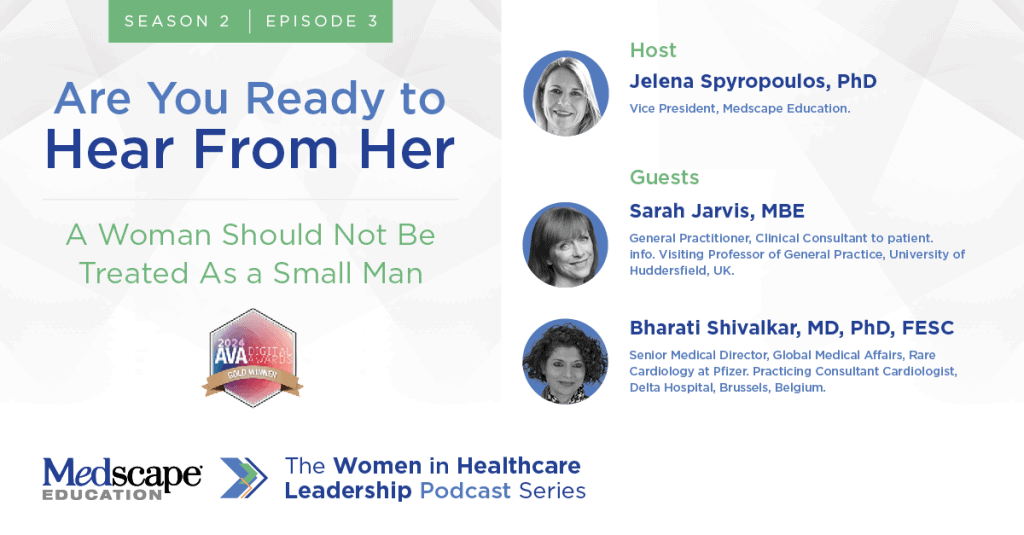
Career choices are driven by many factors. In medicine, doctors are often drawn to a particular specialty following a personal experience. That is the case with Dr. Sarah Jarvis, MBE, General Practitioner, and resident doctor on BBC Radio 2.
“I decided at the age of seven or eight that I wanted to be a GP—not a doctor, but a GP!” Jarvis says, an early career decision based on her interaction with the family physician who came to the house to treat her father. “I was absolutely overawed by this almost mythical figure who came and made my daddy better. He was somebody who genuinely made a difference,” she recalls.
The mythical GP also gave the fascinated 8-year-old a needle and syringe to “play with” afterwards, says Jarvis, acknowledging that house calls and offering syringes as playthings are both unthinkable today. “I started injecting my teddy bear with [the soft drink] Ribena, and I kept the needle very carefully in a cork.” And from then on, I’ve never wavered. I went all the way through Cambridge and Oxford always wanting to be a GP” — though she kept her aspirations under her hat since the feeling was that at Cambridge and Oxford “we train professors!”
The episode’s other renowned guest, Dr. Bharati Shivalkar, Senior Medical Director for Rare Cardiology at Pfizer and Practicing Consultant Cardiologist at Delta Hospital in Brussels, Belgium, says she settled on a career in medicine somewhat later—at about age 11.
Both physicians agree that one of the (many) gaps in women’s healthcare today is around communication, and creating a safe pathway for open, honest dialog between doctors and patients.
“Communication skills are crucial,” says Jarvis. “They are not ‘soft skills.’ If I have 2 patients come to me, they may have very different priorities depending on what else is going on in their lives. If I don’t know that, and respect that, then they are much less likely to get the treatment that A), they need, and B), are likely to stick with.”
The benefits are many: fewer complications and return visits means a lightened physician workload (and hopefully reduced burnout). Helping women feel better makes their life better, and that of their families. And since many patients are of working age, it will “have a socioeconomic impact. It [has] a ripple effect on communities,” Jarvis says.
There are some exciting advances in women’s health, adds Shivalkar, including “strong movements in certain domains to create equitable, women-centered care involving a multitude of stakeholders.” The future of women’s health, both physicians believe, is a model where different specialists look at women’s issues and work together to provide a lifetime course of care that includes but extends beyond sexual and reproductive health. It’s important to understand that “many sex-specific and sex-related health issues” for example “may eventually cause cardiovascular disease, which takes a huge toll not only on the individual but society at large,” Shivalkar says.
At The World Economic Forum in Davos this year, “the importance of redesigning healthcare for women with women in mind and addressing the healthcare gap” was emphasized, says Shivalkar, largely because it is finally being recognized that it’s “going to create huge societal economic benefits. There’s talk about creating a trillion-dollar business or generating trillion-dollar businesses through improving women’s health. And recently, there’s also been more cultural investments in women’s health research.
“When you put it in terms of economics,” Shivalkar says, “you get a lot more attention.”
You won’t want to miss this conversation. Listen now via Medscape, Apple or Spotify.
Hosted by Jelena Spyropoulos, Vice President of Clinical Strategy and Sales, Medscape Education.
Follow us on LinkedIn for updates on upcoming podcasts and more insightful conversations.
For more information, please contact Jelena Spyropoulos (Global) or Piyali Shin (US).
About Medscape Education Medscape Education (medscape.org) is the leading destination for continuous professional development, consisting of more than 30 specialty-focused destinations offering thousands of free accredited CME and CE courses for physicians, nurses, and other healthcare professionals.
This content was provided by Medscape Education
Company Details

Latest Content from Medscape Education
The Pulse of AI Innovation: From More Data to Better Care
At the European Society of Cardiology (ESC) Congress, two of cardiology’s most influential voices sat down to talk about artificial intelligence at Medscape’s ‘The Pulse of AI Innovation’ event: Professor…
Next-Level Clinical Practice, Real-World Impact: Evolving Patient Simulation with the Clinical Readiness Studio
Healthcare is changing rapidly, bringing unprecedented data and complex treatment pathways to the point of care. Clinical mastery requires active experience, the confidence to make decisions when real patient outcomes…
Medscape Sponsors The John Ritter Foundation’s “Evening From the Heart”
When independent, evidence-based education directly connects with clinicians at the point of care, clinical practice changes. Driven by this vital mission, Medscape Education was proud to sponsor The John Ritter…
From Booth to Bavaria: A Recap of Impact at ESC 2026
We have officially wrapped up another year at ESC. For Medscape Education, 4 days on the ground confirmed what 3 decades of cardiovascular education have already shown: when independent, evidence-based…
Why Modern Dermatology Demands Curiosity Over Precision
In the high-stakes world of healthcare research and product development, success has long been measured by rigid definitions of precision and predictable trajectories. However, as Dr. Hawa Dumbuya, Director of…
The Heart of the Matter: Medscape Education’s Cardiology Footprint at ESC 2026
For more than 30 years, Medscape Education has built independent, accredited cardiovascular education designed around one goal: improved patient outcomes. This year at the European Society of Cardiology Congress (ESC…
More Than Pink Walls: What Women-Centric Care Actually Requires
The phrase “patient-centered care” is tossed around freely in healthcare corporate boardrooms. Yet, for more than half the population, that promise routinely fractures. In the latest episode of the Hear…
Women in Healthcare Leadership Have a Lot to Say. Medscape’s Hear From Her Wins an APEX Grand Award.
Medscape Education has been honoured with the prestigious APEX Grand Award for Publication Excellence at…
Moving Beyond the 10%: A New Era in Preterm Birth Prevention
For decades, the rate of spontaneous preterm birth in the United States has hovered stubbornly around 10%. Despite advancements in other areas of medicine, prematurity remains the second leading cause…
Medscape Education to Showcase the Impact of Neurology CME at EAN 2026
Medscape Education, the leading global provider of continuing medical education (CME), has announced its agenda for the upcoming 12th Congress of the European Academy of Neurology (EAN) 2026 in Geneva,…