



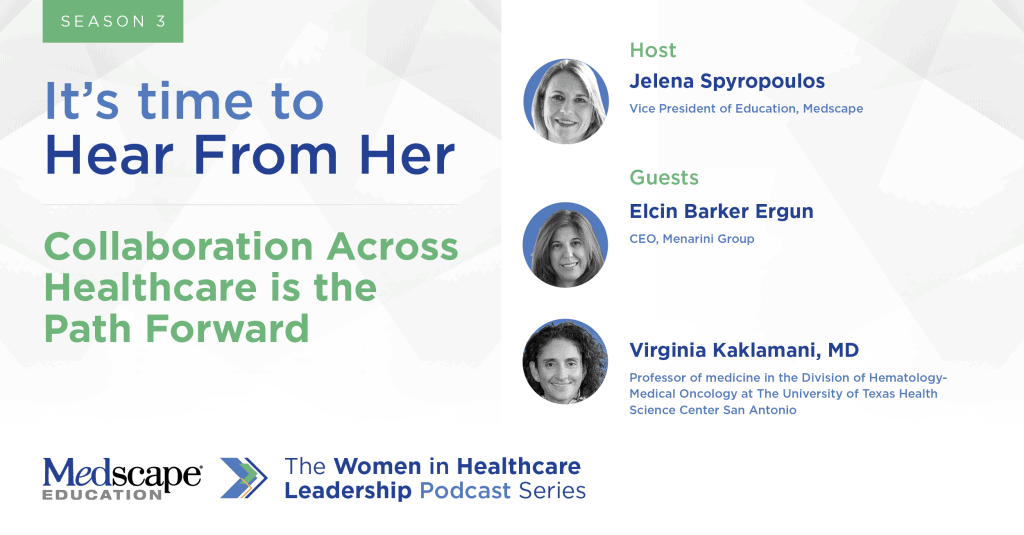
Collaboration Across Healthcare is the Path Forward
April 8, 2025 | Hear from her, Women in Leadership, podcast
How do we impress upon women that they need to prioritize their own health before providing for the people who need them? A leader in medical oncology has a few thoughts.
It’s no secret that women around the world face inequities when it comes to healthcare—be it access, quality, or outcomes of care. (If you’ve listened to previous episodes of this podcast, you’ll know that most of our esteemed guests, leaders throughout the healthcare ecosystem, have been shouting it from the rooftops.)
From gender bias in diagnosis and treatment, to gaps in research and barriers to affordability, the bottom line is, the healthcare system often falls short in meeting women’s needs.
Barriers also exist for many women who pursue a career in healthcare, and specifically oncology.
Listen to Episode 3 of Season 3 here.
Some are because life happens, says Virginia Kaklamani, MD, professor of medicine in the Division of Hematology-Medical Oncology at The University of Texas Health Science Center San Antonio, and leader of the breast cancer program at the Mays Cancer Center, home to UT Health San Antonio MD Anderson Cancer Center.
“Women have a family, have children, they take maternity leave. And they tend to have more of the burden of care for their family than their partners do—which is really an issue when you’re also trying to prioritize your job,” she says. “Women end up sometimes doing more for our family or doing more for our career,” and we always feel like we’re neglecting someone or something. “We always feel we have to make a choice. And it would be nice if we didn’t have that.”
Elcin Barker Ergun, CEO of Menarini Group, the largest pharmaceutical company in Italy, agrees that unfortunately it creates a bias against women, especially in fields like engineering (for which she holds a BSc ), science, and research. “Medicine is honestly a little bit better I think,” she says. “When you look at R and D leadership in our industry, for instance, it was generally a male role for a long time. Now we see women, but still not at the level we would want. In our company, 50% of the R and D C-suite are woman… but probably because I’m a woman, and I don’t have any bias!”
Listen to Episode 3 of Season 3 here.
Which of course is a case in point for getting more women into leadership positions throughout the entire healthcare ecosphere.
Kaklamani, though, believes we shouldn’t turn the battle for equity into a war between the sexes. “My mom (also a physician) said, ‘Men and women are not equal. They are equivalent,’” she says. “It’s not men’s fault if women don’t negotiate as well around salaries or promotions, or expect that someone else will think of her, whereas a man will ask.
“If men see us as adversaries and if we see men as adversaries, we’re not going to achieve anything,” she says. “It’s completely OK to say that women and men are not the same. If we recognize our strengths and our weaknesses, then together we’re stronger than we are separate. There’s no way women can get ahead if the men don’t buy into that process. We need to come together to be able to create a better society, be successful in our careers… and ultimately to cure cancer.”
So what can we do to improve health equity right now? Both say that we need all the stakeholders in healthcare—clinicians, advocacy groups, pharma companies—to collaborate with each other in the right way, to create awareness about the problems of access, of education, and to make sure that as many patients as possible can get their treatments and can have better, longer lives.
Listen to Episode 3 of Season 3 here.
Hosted by Jelena Spyropoulos, Vice President at Medscape Education
Follow us on LinkedIn for updates on upcoming podcasts and more insightful conversations. For more information, please contact Jelena Spyropoulos.
Catch up on Season 1 and Season 2 on:
Apple
Spotify
Medscape
About Medscape Education
Medscape Education (medscape.org) is the leading destination for continuous professional development, consisting of more than 30 specialty-focused destinations offering thousands of free accredited CME and CE courses for physicians, nurses, and other healthcare professionals.
This content was provided by Medscape Education
Company Details

Latest Content from Medscape Education
Medscape Education and M4RD: Together Caring for Rare Disease
We are excited to finally share our news-style video ' ', developed in partnership with Medics 4 Rare Diseases (M4RD) and produced by Genetic Alliance UK and ITN Business.For more information on...
The Need for and Impact of Rare Disease Education
Physicians are often told that when they hear hoofbeats, think horses, not zebras — to look for the most common cause of a patient’s symptoms first. While this advice may...
Medscape Education: Rare Diseases Fibrodysplasia Ossificans Progressiva
Rare Disease Day is on February 28.Listen to Nicky explain her daughter's journey with fibrodysplasia ossificans progressiva.Many patients face long waits for accurate diagnosis and treatment, making it critically important...
Medscape Education: Rare Diseases
It's only a few days until #RareDiseaseDay2023 on 28th February. We're taking a patient centered approach, this means understanding their journey so we can better understand how we can help to...
Together Caring for Rare Disease
Medscape Education and Medics4RareDisease are partnering on a Rare Disease Day awareness campaign. The campaign will form part of a series of short programs produced by ITN in collaboration with Genetic Alliance...
Medscape Education Wins Best Practice Award for Learner Outcomes at NAMEC
This year's winners have been announced for the National Association of Medical Education Companies (NAMEC) awards. These awards recognize best practices-ideas or processes that can be implemented by NAMEC members to...
Medscape Education and Medics4RareDisease Uncover the Education Gaps in Their Compelling Rare Disease Day Campaign
Medscape Education and Medics4RareDisease are partnering on a Rare Disease Day awareness campaign. The campaign will form part of a series of short programs produced by ITN in collaboration with Genetic Alliance...
What Does Net Promoter Score Offer in the Evaluation of Continuing Medical Education?
Net promoter Score (NPS) has been used in many fields, such as software, clinical care, and websites, as a measure of customer satisfaction since 2003. With a single question, NPS...
DIGITAL HEALTH IN PRACTICE AND OVERCOMING DIGITAL FATIGUE
During this year’s Reuters event, Pharma 2022, WebMD CMO, Dr John Whyte discussed the ways in which digital health is growing, and the importance of educating clinicians in the right...
ESMO’s New Focus on Cancer Prevention
During ESMO 2022 in Paris, John Whyte, chief medical officer at WebMD was joined by Fabrice André, MD, PhD, Chair of the scientific committee at the European Society for Medical Oncology (ESMO),...