



Evaluating the Forces Shaping Women’s Healthcare
March 6, 2024 | Leadership, Women in healthcare
Gaps in women’s healthcare go beyond access and cost. Do clinicians have the tools they need to understand women’s health?
If there are any lingering doubts about how today’s healthcare system fails many women, a 2022 study from the Kaiser Family Foundation will set the record straight. Their report revealed that close to 20 percent of all women in the U.S. ages 18 and older considered their health fair or poor. Out of a population of 168 million women, that is a shockingly large number of people who feel less than well.
Drilling down by race and ethnicity, the numbers break out to 31% of American Indian and Alaskan Native women, 25% of Hispanic women, 23% of black women, 16% of white women, and 10% of Asian Native Hawaiian and other Pacific Islander women. The same study found that 10% of all women 18 and older did not see a doctor due to cost.
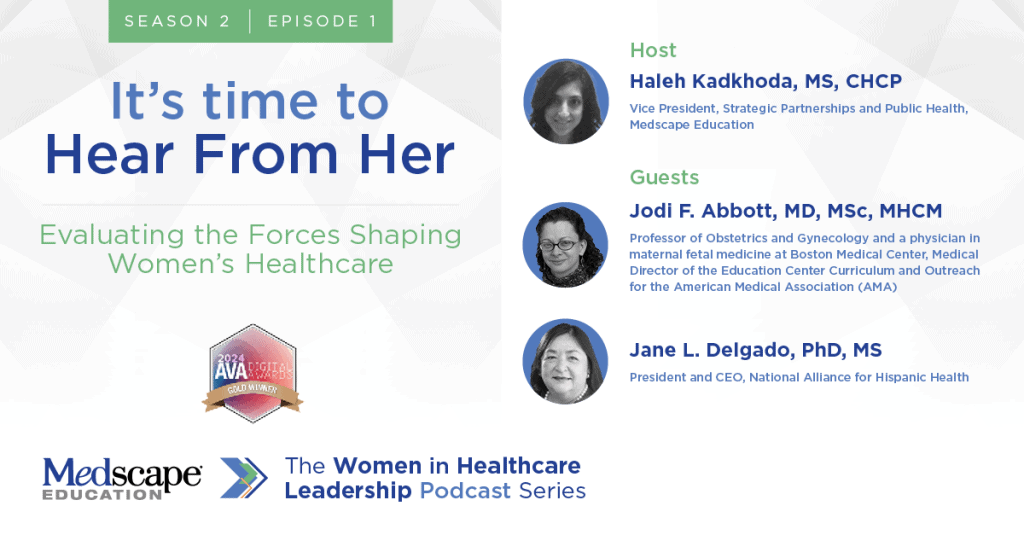
And here’s something else to consider, says Jane Delgado, clinical psychologist and President and CEO of the National Alliance for Hispanic Health. Even if you can afford it, if you have access to health insurance, “once you get through the door, does the person you see hear you? Does that person have the tools to understand women’s health? Are you getting the care you need, and does your healthcare provider have the tools and information they need?”
Not to mention the additional barriers of ethnicity and age that women often face, says Jodi Abbott, who has dual roles as Professor of Obstetrics and Gynecology and a physician in maternal fetal medicine at Boston Medical Center, and Medical Director of the Education Center, Curriculum and Outreach for the American Medical Association (AMA). Women’s complaints “are much less likely to be listened to, and they end up being underdiagnosed and undertreated for most conditions.” While you’re seeing a physician to try to feel better, “they are there to cross a disease off a list. There’s a mismatch between the hopes and expectations of many people who enter the system and how most physicians are trained. Our healthcare system is geared toward disease management, rather than addressing the elements that help keep people healthy.”
Abbott says she’s “privileged” to work at Boston Medical, which is an ACO, or accountable care organization. “The difference between that system and traditional insurance-based or fee-for-service systems is that our organization is set up to have a certain amount of money every year to keep people healthy as opposed to receiving money for how much time they spend in the hospital because of certain diagnoses. When we switched to that, it really opened the door to physicians and health care providers with the desire to widen their team—for example, to include non-physician team members—and to be able to focus on initiatives that can improve health, and not just those that identify complications.”
One example of this, says Abbott, has been a large investment in the community and in “nontraditional” mechanisms of health care, such as doulas—birth attendants who are not physicians, not nurses, “who represent the women in the communities that our patients come from. They are multilingual, and can have a personal connection, sort of a mother or auntie figure, but they also know how a hospital works and can guide people who are attending for the first time.
“There’s an important investment that needs to be made [in programs] that help keep people healthy,” Abbott says.
We need to hit our health enterprise at many different levels to really effect change, says Delgado. “From how the system includes women in every place from researcher to clinician to participant, to how women approach that system. And we need to talk to women about their total health and teach them about how to take care of themselves, not just when they’re pregnant but throughout their whole lives.”
Listen now to season two, episode 1 on Medscape, Spotify or Apple.
For more information please contact Jelena Spyropoulos (Global) or Piyali Chatterjee-Shin (US).
Hosted by Haleh Kadkhoda, MS, CHCP, Vice President, Strategic Partnerships and Public Health at Medscape Education
About Medscape Education Medscape Education (medscape.org) is the leading destination for continuous professional development, consisting of more than 30 specialty-focused destinations offering thousands of free accredited CME and CE courses for physicians, nurses, and other healthcare professionals.
This content was provided by Medscape Education
Company Details

Latest Content from Medscape Education
Shaping the Future of Hematology and Women’s Health
Changes in the healthcare world are likely to limit opportunities for young researchers, especially women.Three leaders in hematology — Belinda Avalos, Sarah O’Brien, and Marty Liggett — share the initiatives...
Are Clinicians Still Feeling the Burn? A Look at HCP Mental Health and Well-Being
One of the most critical topics to address in health care today is the mental health and well-being of physicians and other healthcare professionals. The 2020 COVID-19 pandemic shined a...
Medscape Women’s Health Joins Supporters in Sponsorship of SWHR’s 2025 Gala
Medscape Women’s Health is proud to announce its sponsorship of the Society for Women's Health Research (SWHR) 2025 Gala, which took place on Wednesday, April 30, 2025, celebrating 35 Years...
Dermatology in Focus: Medscape Sponsors SDNP’s 2025 National Conference
Medscape Education is a proud sponsor of the 2025 SDNP National Conference, taking place from April 30 to May 3 at the Renaissance Esmeralda Resort and Spa in Indian Wells,...
Medscape Education: Proud Friend of COA Sponsor at the Community Oncology Conference
Medscape Education is honored to be a Friend of COA sponsor at the Community Oncology Conference, taking place from April 28-30th in Orlando, FL. This partnership highlights our commitment to...
A Commitment to Elevating Patient Engagement and Integration
Medscape is honored to be the lead sponsor of the upcoming Measuring Patient Engagement Summit, taking place in Boston from April 29 to May 1. This event marks a pivotal...
Medscape Education Global to Join Biotechs at Swiss Biotech Day
The Medscape Education Global team is excited to announce its participation in Swiss Biotech Day, taking place in Basel from May 5-6. This marks our inaugural attendance at this event,...
Gut Check: A Game-Changing Experience at DDW 2025 with Medscape!
The countdown is on! The Medscape team is heading to San Diego for this year’s highly anticipated Digestive Disease Week (DDW) conference—and you won’t want to miss what we’ve got...
Looking Ahead: Transparency, Impact, and Instructional Design at CMEpalooza Spring 2025
Tomorrow at 2 PM ET, join Medscape for a thought-provoking Afternoon Snack Session at CMEpalooza Spring 2025, titled “Reverse Planning with Forward Thinking.” This session will spotlight how clear communication...
Vaccines Are the Most Impactful Innovation in Health Equity
As deadly as the measles outbreak in west Texas and New Mexico is the spread of vaccine conspiracy theories and misinformation. According to KFF research from November 2024, childhood vaccination...