



Pioneering Paths: Women Leadership in Rare Disease
May 15, 2024 | Women in healthcare, daretothinkrare, rare disease
Rare diseases are often thought of as affecting one in 100,000 or one in 1,000,000 people, and that is true for some conditions. But there are many rare diseases that are more common. It may surprise many to learn that a condition that’s considered rare has a prevalence of 1 in 2000 or lower, and rare diseases overall affect more than 300 million people worldwide.
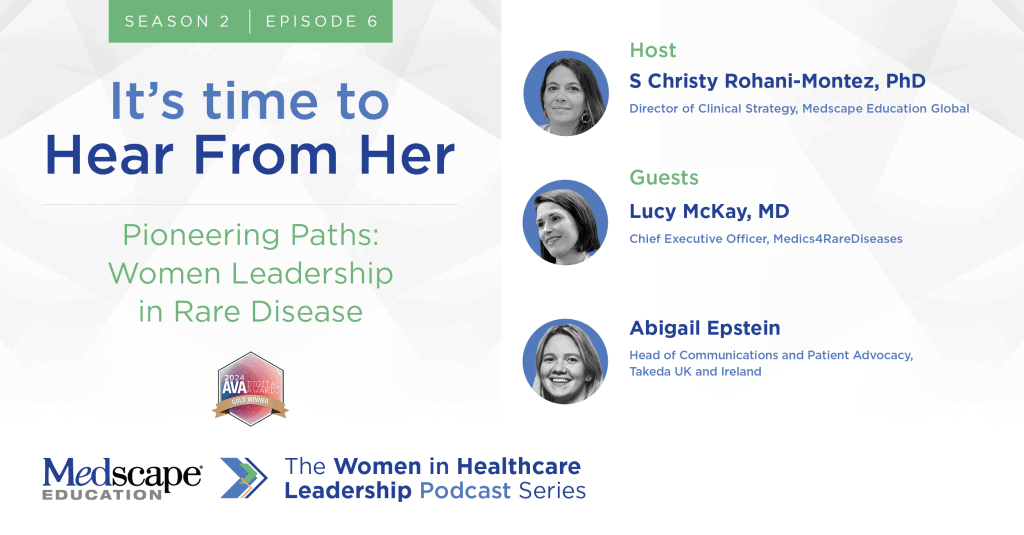
When a rare genetic condition runs in your family, when you see the impact it has, and you grow up alongside a rare disease patient advocacy group started by your parents, you gain quite a lot of lived experience, says Lucy McKay, MD. “There was so much that I learned and saw.”
As McKay made her way through medical school she was disheartened to find that medicine and the NHS [National Health Service] were not receptive to her experience and accumulated knowledge. They didn’t recognize the common challenges in rare disease, they did not include rare disease patients in medical studies, and they weren’t preparing future clinicians to support rare disease patients and their families. “It was impossible for me to stay working in that environment,” McKay says. “I could not do the career I chose.”
So what to do? If you are McKay, you grab your medical degree and start the UK-based charity Medics4RareDiseases (and also become a steering committee member of Medscape Education’s rare disease initiative).
In fact, she says, it’s not surprising that most rare disease advocacy leaders are women. “Approximately 70 to 75 percent of rare conditions present solely in childhood, and a similar proportion are genetic conditions. The caregivers are more likely to be female, see the signs earlier, and be living that experience with their child as their needs become more obviously understood.
“When women get activated, what do they get activated by? In rare disease, it’s because these needs are wholly unmet,” says McKay. “There’s no one out there coordinating this drive to help their children or to help their other loved ones.” So women step in and start making a lot of noise because they have no choice.
Abigail Epstein, head of communications and patient advocacy for Takeda UK and Ireland, may not have grown up in a family of advocates, but she is no less passionate about helping to improve the lives of everyone affected by a rare condition in a world that really doesn’t understand their needs. “I’ve taken inspiration from the community, which has this incredible ability to work together for the betterment of one another and what needs to be done—against incredibly difficult odds.
Epstein works on a campaign called I am number 17, to raise awareness of the fact that one in 17 people are affected by a rare disease at some point in their lifetime. Worldwide, rare diseases affect roughly 263 to 446 million people. That statistic, Epstein says, originated from Genetic Alliance but was not well recognized outside the rare community. “As a group,” she says, “we wanted to change that. Because though individually rare, rare conditions are collectively common.”
And things are starting to change, she says. That one in 17 statistic is now a common part of discourse when rare diseases are looked at. And now more than ever, pharmaceutical companies have a lot in the pipeline for rare diseases.
The pharmaceutical industry is also leading the way when it comes to employing and supporting women. Though women are the driving force for change in rare disease, McKay and Epstein both acknowledge that the leap from kitchen table charity work to chairing a disease conference can be a hurdle. “When you start looking at organizations that work in rare that are profit-making or anyone who’s in a decision-making role, suddenly the room starts to become more male,” McKay says. “Even though this industry was built on female advocacy.”
A 2021 workplace study from the Association of the British Pharmaceutical Industry “found that women make up more than 54% of the pharma workforce in England,” Epstein says. “At Takeda, I’m proud of the fact that 56% of the general managers across Europe and Canada are women. It’s really important to continue that momentum, encouraging women to pursue careers in science and technology, whether that be through mentorships or other opportunities, making a conscious effort to promote women into leadership.”
Hosted by Christy Rohani-Montez, PhD, Director of Clinical Strategy at Medscape Education Global
Follow us on LinkedIn for updates on upcoming podcasts and more insightful conversations.
For more information, please contact Jelena Spyropoulos (Global) or Piyali Shin (US).
To learn more about rare diseases, visit Medscape’s Pathways in Rare Disease, https://www.medscape.org/sites/advances/rare-diseases, Medics for Rare Diseases, m4rd.org, or I am Number Seventeen at iamnumber17.org.uk
About Medscape Education Medscape Education (medscape.org) is the leading destination for continuous professional development, consisting of more than 30 specialty-focused destinations offering thousands of free accredited CME and CE courses for physicians, nurses, and other healthcare professionals.
This content was provided by Medscape Education
Company Details

Latest Content from Medscape Education
Highlighting the Power of Patient-Integration
Advancing person-centered care is an important topic for the Medscape Oncology team, and no one knows this better than Dr Victoria Harvey-Jones, Associate Director of Clinical Strategy for Medscape Oncology...
Education, AI and More at ASH 2024
Medscape will showcase eight educational symposia and three posters at ASH 2024, highlighting advancements in hematology and oncology education. The presentations will reflect on the impact of last year's programs,...
Getting to the Heart of the Matter: Medscape Education at AHA 2024!
Come join Medscape Education at the American Heart Association (AHA) 2024 Scientific Sessions in Chicago, IL, from November 16-18 — a dynamic event packed with cutting-edge cardiology education that you...
Medscape Publication is Awarded Poster of Distinction at AASLD
Medscape Education is committed to disseminating the outcomes of the education programs through peer-reviewed publications and posters at leading medical conferences around the world. To this end, Medscape publishes more...
Advancing Education at AASLD 2024
Get ready for an exciting experience at AASLD 2024! The Medscape team is thrilled to be in San Diego from November 15-19 for this year’s AASLD conference, where we will...
Recognizing C diff Awareness Month in 2024
Every year, the medical community recognizes the month of November as Clostridioides difficile (C. diff) Awareness month. C. diff is a public health threat that causes around 500,000 infections every...
Medscape Education presenting at the 17th Annual European CME Forum
With a commitment to advancing the field of continuing medical education, the Medscape team will be travelling to Madrid for the 17th Annual European CME Forum and bringing with them...
Sex, Gender, and the Brain: The Women’s Brain Foundation and Medscape Education Announce Groundbreaking Learning Centre
LONDON--(BUSINESS WIRE)--The Women’s Brain Foundation (WBF), the global pioneer that has advanced the inclusion of sex- and gender-based evidence-generation in all research, drug development, and healthcare since 2017; and Medscape...
Cultivating Interest in Infectious Disease Education at ID Week 2024
IDWeek starts tomorrow, October 16, and Medscape is bringing outcomes and education! We are excited to announce Medscape is presenting six posters that highlight the significant impact of our educational...
Medscape Education Breathes Life Into Pulmonology: Showcasing Success at CHEST 2024
Medscape Education showcases its strong track record in providing high-quality education in the field of pulmonology at the annual conference of the American College of Chest Physicians in Boston, Massachusetts,...