




Planting the Seeds for Future Women Leaders in Medicine
November 28, 2023 | Leadership, Medscape, Women in healthcare, oncology
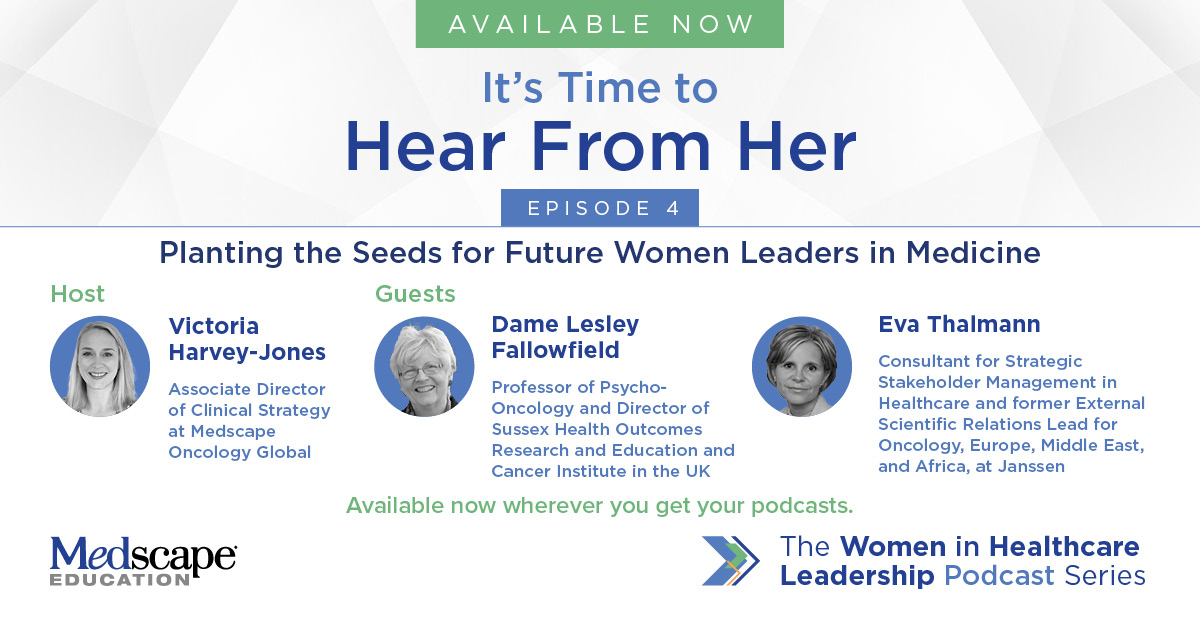
What are the qualities needed to be a leader in the medical field of oncology?
Of course, you must be a good clinician. But you also have to be wise and skillful in how you approach people without losing any of your own authority. You need to be able to see things from their perspective and be a good listener.
It’s no secret that compassion and communication are skills many women possess. And yet when you look at who’s chairing most oncology conference sessions it’s invariably a man, says Dame Lesley Fallowfield, professor of psycho-oncology and director of Sussex Health Outcomes Research and Education and Cancer Institute, known as SHORE-C, in the UK. (And guess whether men or women also ask more and longer questions at those conferences, according to a report published in The Lancet!)
So, what are the barriers facing women in oncology today? What is keeping them from rising through the ranks?
As a Psycho-Oncologist, Fallowfield says that powerful stereotypes still exist, both outside and inside the hospital setting: Women in scrubs are assumed to be nurses, not doctors, and women are often encouraged to go into branches of medicine that tend to be more traditionally female.
A European Society for Medical Oncology survey found that another “major barrier” is the work-life, or work-family balance, says Eva Thalmann, who spent 30 years at Janssen Pharmaceuticals in various senior leadership positions in oncology. But just because women may take time off to focus on a new baby or young children, “that doesn’t mean their brain stops working!” says Fallowfield.
Part of the responsibility of leaders today is to “tell young women to step up, lean in, and just try something,” says Thalmann. “If you fail, you fail. Lean in to do things even if you’re not sure you can completely master it” — because your male colleague wouldn’t hesitate!
For more of the conversation — including Fallowfield and Thalmann’s thoughts on the types of leadership training skills needed for the next generation; the resources that exist today and those that are missing; and how women themselves are sometimes partially to blame for the inequity that exists — check out Episode 4 of Medscape’s Women in Healthcare Leadership podcast series. Click here to listen on Apple Podcasts or head straight to Medscape.
Hosted by Victoria Harvey-Jones, Associate Director of Clinical Strategy at Medscape Oncology Global
Follow us for updates on upcoming podcasts and more insightful conversations.
For more information, please contact Jelena Spyropoulos (Global) or Piyali Shin (US).
About Medscape Education
Medscape Education (medscape.org) is the leading destination for continuous professional development, consisting of more than 30 specialty-focused destinations offering thousands of free CME and CE courses for physicians, nurses, and other healthcare professionals.
This content was provided by Medscape Education
Company Details

Latest Content from Medscape Education
Leading with Heart: Why Vulnerability is a Force Multiplier
In a world that often prizes "macho" decisiveness, Dr. Lobna Salem (CMO at Viatris) and Dr. Amrit Ray (Board Chairman and former Pfizer executive) are advocating for a more human...
Cardiology Education in the Age of AI: Join Medscape at ACC 2026
As medical knowledge now doubles every 73 days, the challenge for cardiology clinicians has shifted from finding information to mastering precision. At the American College of Cardiology (ACC) 65th...
Medscape Launches “Where Public Health Meets Practice” Learning Center to Translate Public Health Strategies into Patient Care
The Medscape Division of Public Health announced the launch of the "Where Public Health Meets Practice" Learning Center, a dedicated educational destination on Medscape.org. The new center serves as...
Data, Evidence, Education: Tackling the Global Multi‑Trillion‑Dollar Rare Disease Burden
Rare diseases are individually uncommon, yet together they affect an estimated 300 million+ people worldwide and touch the lives of over one billion when families and caregivers are included. For...
#ShortenTheJourney
For the millions of people living with a rare disease, the path to a diagnosis (if ever received) is often a long and frustrating odyssey. This delay is frequently driven...
Why We Must Stop Normalizing the “Pregnancy Itch”
In the world of rare diseases, success is often measured by the speed of diagnosis. However, for women facing rare liver conditions like Intrahepatic Cholestasis of Pregnancy (ICP), the medical...
The Greatest Form of Caring: Medscape’s Commitment to Advancing Cardiovascular Health
A February Focus on the Heart While February is known as the month of love, it is also National Heart Month, a time for highlighting the importance of cardiovascular health....
AI, Agility, and Connected Impact at Alliance 2026
Join the Medscape team in Atlanta, February 16–19, 2026, as Alliance celebrates 50 years of excellence in continuing education for health professionals. We’re bringing our 3 decades of experience in...
Why Sleep Health is the Missing Link in Women’s Wellness
While obstructive sleep apnea (OSA) affects approximately 32% of US adults—nearly 80 million people—it remains an "epidemic hiding in plain sight". Perhaps most staggering is that 90% of women with...
The Heart and Mouth Connection Every Woman Needs to Know
For decades, modern medicine has treated the mouth and the body as separate entities. But for Dr. Nieca Goldberg, a renowned cardiologist, and Dr. Maria Ryan, Chief Clinical Officer at...