



Realizing the Potential of Virtual Patient Simulation With Real-World Outcomes
September 18, 2024 |
We’re celebrating Healthcare Simulation Week 2024 by highlighting the transformative power of our multi-award-winning medical simulation programs, which have proven impact in delivering significant improvements in clinical skills and outcomes.
In this latest article we dive into the growth of virtual patient simulations and share insights from our Chief Impact Officer, Katie S Lucero. Discover how integrating real-world outcomes tools is enhancing healthcare providers’ experiences and driving better patient care.
Simulation is a vital component of medical education and is increasingly being used in postgraduate settings for practicing clinicians who are training and certifying learners to assess their knowledge, skills, and confidence in real-life healthcare settings and ultimately, improve patient outcomes.
Spurred on by the COVID-19 pandemic, an increased focus on patient safety, the growing demand for minimally invasive treatments, and advancements in technology, the demand for virtual patient simulation continues to grow. By 2028, the virtual simulation market is expected to reach 8.97 billion.

Although virtual simulation programs can provide education evaluators with valuable data about learners’ actions, including areas where they made improvements and where learning gaps remain, real-world outcomes are a critical aspect that should be integrated into any program.
“We know that programs measure impact using real-world outcomes are one of the few ways to understand whether knowledge, skills, and/or self-efficacy learners have acquired is being applied in the real world, ultimately leading to better patient outcomes,” according to Katie Lucero, PhD, Chief Impact Officer, Medscape Education.
The Importance of Real-World Outcomes
Virtual patient simulation has a number of use cases and allows practicing healthcare professionals an opportunity to interview and examine patients, order tests and exams, deliver interventions, and observe the patient’s response to therapy in real time.
Research also shows that virtual patient simulation can improve clinical decision-making. In fact, according to a 2022 systematic review and meta-analysis, nursing students and nurses who utilized virtual simulation demonstrated a significant improvement in clinical reasoning based on applied knowledge and clinical performance compared to learners in the control group.
Outcome measurements derived from virtual simulation programs can provide rich quantitative and qualitative data, including correct and incorrect responses, pre- and post-intervention assessments, and learner evaluations tied to specific educational objectives.
Although these data allow supervising physicians to quickly and easily understand the impact of the program by comparing learners’ baseline knowledge to improvements after interventions are delivered, they only capture short-term outcomes. “To determine the long-term efficacy of the program, education evaluators must examine how learners applied their newfound knowledge in clinical practice,” Lucero said.
Affecting Behavior Change With Medscape Real-World Outcomes
Real-World Outcomes, an advanced Medscape assessment approach, works by analyzing learners’ behaviors in the real world before and after they participate in the education activity. The tool can determine if the knowledge they acquired has been applied in the real world to ensure a positive impact on patients over a longer period of time.
Our research shows while learners may answer questions correctly after completing a module, for example, fewer learners are exhibiting behavior change in the real world. “While this doesn’t mean that the education was ineffective, it may reveal insights into what worked for whom and and why to inform education strategy over time,” Lucero said. Our MedSims virtual patient simulation solution and Real-World Outcomes tool have been shown to positively affect behavior change. In fact, a 2023 studyin the journal JMIR Medical Education, which aimed to evaluate the effect of the MedSims VPS platform on the real-world selection of glucagon-like peptide-1 receptor agonists (GLP-1 RAs) for type-2 diabetes, found the CME resulted in a 29 percentage point increase in correct decisions from pre to post feedback. The study also found that the learners were 4 times more likely to select guideline-based treatment for patients after CME than the control group.
What’s more, a 2020 instructional design studyby the Calibre Institute for Quality Medical Education found 5 activities representing various therapeutic areas in the MedSims solution have a high potential to engage physicians and lead to improvements in practice.
At Medscape Education, we not only deliver impact, we guarantee it. Our virtual patient simulation programs have been proven in multiple studies to improve care and drive better decision-making. With the backing of Real-World Outcomes methods, we know MedSims has the power to change patient care.
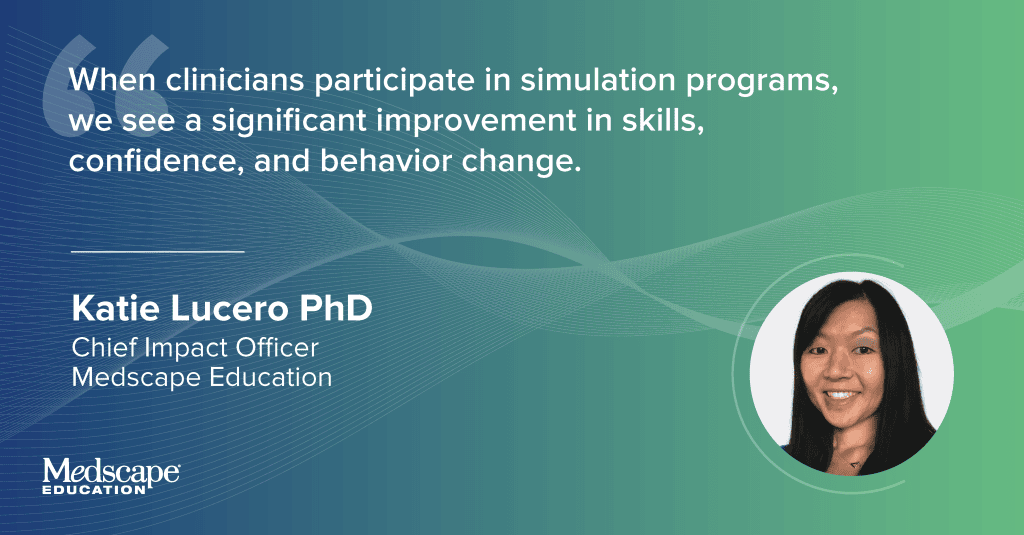
“When clinicians participate in simulation programs, we see a significant improvement in skills, confidence, and behavior change,” according to Lucero. “With Real-World Outcomes, we have a powerful set of data that we’re leveraging to evolve our programs and advance our outcomes research which will only improve the education we can provide clinicians.”
For more information on MedSims and Real-World Outcomes, contact your local Medscape representative or one of our team leads:
For the US please contact: Piyali Chatterjee-Shin , Jess Dropkin, David Anderson or Chris Carey
For OUS please contact: Peter Schoonheim or Jelena Spyropoulos
This content was provided by Medscape Education
Company Details

Latest Content from Medscape Education
Cardiology Education in the Age of AI: Join Medscape at ACC 2026
As medical knowledge now doubles every 73 days, the challenge for cardiology clinicians has shifted from finding information to mastering precision. At the American College of Cardiology (ACC) 65th...
Medscape Launches “Where Public Health Meets Practice” Learning Center to Translate Public Health Strategies into Patient Care
The Medscape Division of Public Health announced the launch of the "Where Public Health Meets Practice" Learning Center, a dedicated educational destination on Medscape.org. The new center serves as...
Data, Evidence, Education: Tackling the Global Multi‑Trillion‑Dollar Rare Disease Burden
Rare diseases are individually uncommon, yet together they affect an estimated 300 million+ people worldwide and touch the lives of over one billion when families and caregivers are included. For...
#ShortenTheJourney
For the millions of people living with a rare disease, the path to a diagnosis (if ever received) is often a long and frustrating odyssey. This delay is frequently driven...
Why We Must Stop Normalizing the “Pregnancy Itch”
In the world of rare diseases, success is often measured by the speed of diagnosis. However, for women facing rare liver conditions like Intrahepatic Cholestasis of Pregnancy (ICP), the medical...
The Greatest Form of Caring: Medscape’s Commitment to Advancing Cardiovascular Health
A February Focus on the Heart While February is known as the month of love, it is also National Heart Month, a time for highlighting the importance of cardiovascular health....
AI, Agility, and Connected Impact at Alliance 2026
Join the Medscape team in Atlanta, February 16–19, 2026, as Alliance celebrates 50 years of excellence in continuing education for health professionals. We’re bringing our 3 decades of experience in...
Why Sleep Health is the Missing Link in Women’s Wellness
While obstructive sleep apnea (OSA) affects approximately 32% of US adults—nearly 80 million people—it remains an "epidemic hiding in plain sight". Perhaps most staggering is that 90% of women with...
The Heart and Mouth Connection Every Woman Needs to Know
For decades, modern medicine has treated the mouth and the body as separate entities. But for Dr. Nieca Goldberg, a renowned cardiologist, and Dr. Maria Ryan, Chief Clinical Officer at...
Uncovering Inequities in Alzheimer’s Disease Screening and Care
On December 5, MAPS hosted an educational webinar exploring recent research in Alzheimer’s disease (AD) screening, testing, and treatment. Experts from Komodo Health and Medscape shared findings from their...