



Shaping the Future of Hematology and Women’s Health
May 12, 2025 | Hear from her, Women in Leadership, hematology, podcast
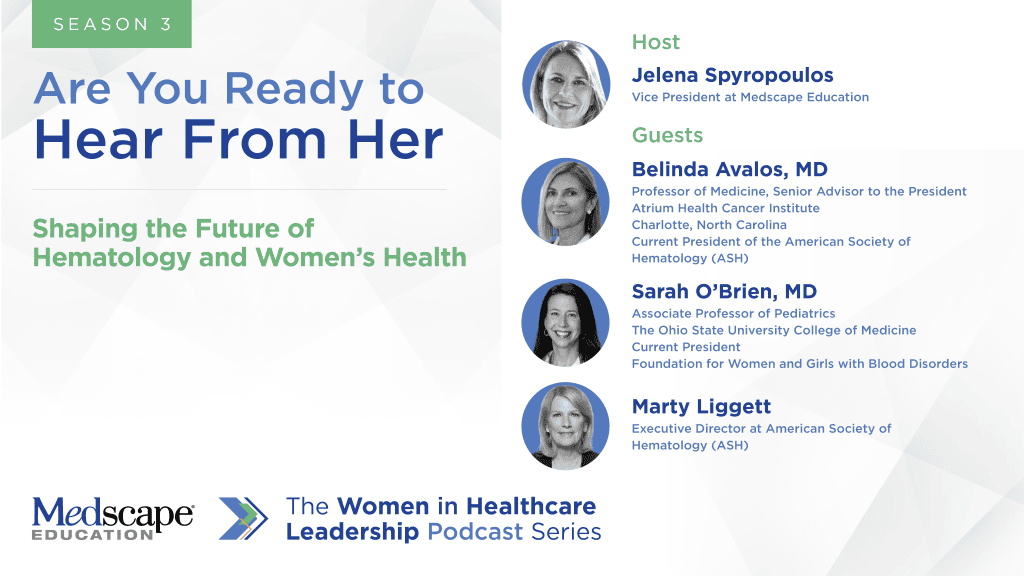
Changes in the healthcare world are likely to limit opportunities for young researchers, especially women.Three leaders in hematology — Belinda Avalos, Sarah O’Brien, and Marty Liggett — share the initiatives they’re taking to mentor the next generation of hematologists during these challenging times.
How does curiosity and a love of detective work inspire a career path?
“Growing up I always knew I wanted to do something with children, so pediatrics was a natural fit,” says Sarah O’Brien, MD, Associate Professor of Pediatrics at The Ohio State University College of Medicine and Current President of the Foundation for Women and Girls with Blood Disorders. “In pediatrics we trained for hematology and oncology at the same time, and it struck me that for oncology, our patients had all of these detailed protocols to follow. And for our hematology patients, we were just flying by the seat of our pants. I saw immediately how research could influence practice patterns in classical hematology. Plus, I really like the detective work of hematology. Most of my practice is seeing new patients with bleeding symptoms and figuring out what underlying bleeding disorder they might have.”
Listen to Episode 5 of Season 3 here.
Belinda Avalos, MD, Professor of Medicine, Senior Advisor to the President AtriumHealth Cancer Institute in Charlotte, North Carolina, and President of ASH, says that she, too, loves solving problems. Avalos knew from an early age that she wanted to become a physician, inspired by her father, a surgeon who came to the U.S. from Mexico in his 30s, and his passion for medicine and commitment to his patients.
“I always thought science was so interesting,” she says. “I did a year of research in biochemistry, and I was hooked.” The beauty of research, she says, is moving from the patient to the lab and then being able to go back to an extremely ill patient with a therapy and tell them there’s a good chance of a cure. “I love what I do and I think it’s really important to provide healthcare to people no matter where they live and no matter what their resources are.”
Listen to Episode 5 of Season 3 here.
For physicians, researchers, and healthcare executives, a detective spyglass is a great tool to have in your back pocket these days.
“Right now is a challenging time for hematology research and patient care,” says Marty Liggett, Executive Director at ASH. There’s a lot of concern about cutbacks to research, and what that’s going to mean. “We’re especially concerned about those who are in early career positions, where any cutbacks in funding could require a career change. It’s a time when ASH as an organization can—and will—step up to be helpful.
One of the ways they’re doing that is to step up the organization’s mentoring initiatives, to find new ways to help people connect with each other “so that a woman, a young hematology female researcher, for example, doesn’t feel like there aren’t mentors there to support her, “ Liggett says.
“We’re also putting together a series of initiatives to promote hematology research through advocacy and education, to protect the pipeline of hematology researchers. In a normal year, we give out $15 million worth of awards, and we are going to increase that in the near term. We’re working hard to make sure that, again, we do all we can to preserve the pipeline for hematologists.”
Hosted by Jelena Spyropoulos, PhD, Director of Clinical Strategy at Medscape.
Follow us on LinkedIn for updates on upcoming podcasts and more insightful conversations. For more information, please contact Jelena Spyropoulos.
Listen to Episode 5 of Season 3 here.
About Medscape Education
Medscape Education (medscape.org) is the leading destination for continuous professional development, consisting of more than 30 specialty-focused destinations offering thousands of free accredited CME and CE courses for physicians, nurses, and other healthcare professionals
This content was provided by Medscape Education
Company Details

Latest Content from Medscape Education
#ShortenTheJourney
For the millions of people living with a rare disease, the path to a diagnosis (if ever received) is often a long and frustrating odyssey. This delay is frequently driven...
Why We Must Stop Normalizing the “Pregnancy Itch”
In the world of rare diseases, success is often measured by the speed of diagnosis. However, for women facing rare liver conditions like Intrahepatic Cholestasis of Pregnancy (ICP), the medical...
The Greatest Form of Caring: Medscape’s Commitment to Advancing Cardiovascular Health
A February Focus on the Heart While February is known as the month of love, it is also National Heart Month, a time for highlighting the importance of cardiovascular health....
AI, Agility, and Connected Impact at Alliance 2026
Join the Medscape team in Atlanta, February 16–19, 2026, as Alliance celebrates 50 years of excellence in continuing education for health professionals. We’re bringing our 3 decades of experience in...
Why Sleep Health is the Missing Link in Women’s Wellness
While obstructive sleep apnea (OSA) affects approximately 32% of US adults—nearly 80 million people—it remains an "epidemic hiding in plain sight". Perhaps most staggering is that 90% of women with...
The Heart and Mouth Connection Every Woman Needs to Know
For decades, modern medicine has treated the mouth and the body as separate entities. But for Dr. Nieca Goldberg, a renowned cardiologist, and Dr. Maria Ryan, Chief Clinical Officer at...
Uncovering Inequities in Alzheimer’s Disease Screening and Care
On December 5, MAPS hosted an educational webinar exploring recent research in Alzheimer’s disease (AD) screening, testing, and treatment. Experts from Komodo Health and Medscape shared findings from their...
Where Are We Today With Artificial Intelligence (AI) in Rare Disease Diagnosis and Care?
Discover how AI-powered tools are transforming rare disease diagnosis, patient care, and clinical decision-making.
Does Rare Disease Education Work?
For a child with a rare disease, a doctor’s continuing education can end a years-long diagnostic odyssey and unlock access to vital care.
From Genetic Puzzles to Precision Therapeutics
How was a new rare disease discovered through Singapore’s Undiagnosed Disease Program? And how will technology allow us to change how we discover rare diseases in the future? Read more...