



The Power Dynamics of Women and Cancer
March 8, 2024 | Leadership, Women in healthcare, oncology
Women, Power, and Cancer: a Lancet commission, studied the interaction of women and cancer through a social justice and equity lens. What does ‘power’ mean when it comes to cancer care?
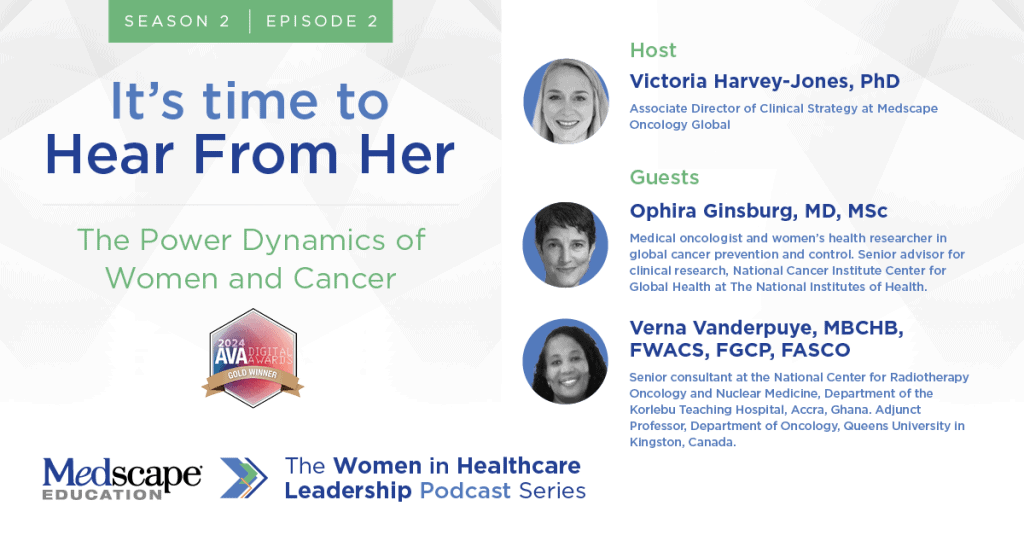
“The origins of our commission, Women, Power, and Cancer, date back to a 3-part series of articles in the Lancet called Health, Equity, and Women’s Cancers that I was privileged to have led,” says Dr. Ophira Ginsburg, Senior Advisor for Clinical Research at the National Cancer Institute Center for Global Health, National Institutes of Health.
For the series, 40 people from 18 countries came together to focus on breast and cervical cancer—diseases that we have adequate knowledge about how to prevent, control, and in many cases cure, Ginsburg says. And yet there were huge national and, more importantly, global health disparities with these two cancers in terms of women accessing essential information.
The articles, published online in 2016, drew attention to the social issues that prevent women from accessing care in different settings.
Several years later, The Lancet’s editor in chief asked Ginsburg if she thought enough progress had been made around women accessing vital healthcare. “Of course, the answer was no!” Ginsburg says. That led to the idea for a broader study, not just around cervical and breast cancer but across the cancer continuum, in terms of women understanding their risks; having the agency, the right, and the opportunity to prevent cancer from occurring in the first place; and being able to seek and obtain quality, respectful care.
As you’ll hear in this insightful episode, the commission studied the interaction of women and cancer “through a social justice and equity lens” to highlight the global inequities that women face with respect to cancer care and control.
The “power” in the title refers to control in 3 domains: decision-making, knowledge, and economics, Ginsburg says. She, co-chair Verna Vanderpuye, and the other commissioners were stunned to find that cancer ranks in the top 3 causes of premature mortality among women in almost all countries worldwide. They found that of the 2.3 million women who died prematurely from cancer in 2020, 1.5 million such deaths could have been prevented if every woman had access to what we already know regarding primary prevention and early detection.
In 2020 alone, 1 million children lost their mothers to cancer. “And that number obviously is horrifying,” Ginsburg says.
Listeners of this episode will learn the 10 priority actions the committee identified for moving forward. “That may sound like a lot,” Vanderpuye says, “but the scope of the problem is so huge it’s the only way to make sure we can leverage our findings with what should happen in real life.”
Vanderpuye, senior consultant at the National Center for Radiotherapy Oncology and Nuclear Medicine in Accra, Ghana, and adjunct professor in the Department of Oncology at Queens University in Kingston, Canada, also touches on a theme that surfaces throughout all the conversations with women leaders in healthcare: “We need more women CEOs of hospitals all the way down to medical schools, to deans, to leaders in medical oncology, boards in oncology, societies, academic research.” Fewer women in leadership roles, she says, means funding and women-specific healthcare needs and issues get overshadowed.
Listen now to season 2, episode 2 on Medscape, Spotify or Apple.
Follow us on LinkedIn for updates on upcoming podcasts and more eye-opening conversations.
For more information, please contact Jelena Spyropoulos (Global) or Piyali Shin (US).
About Medscape Education Medscape Education (medscape.org) is the leading destination for continuous professional development, consisting of more than 30 specialty-focused destinations offering thousands of free accredited CME and CE courses for physicians, nurses, and other healthcare professionals.
This content was provided by Medscape Education
Company Details

Latest Content from Medscape Education
Rare Diseases on Medscape Education: Long-Chain Fatty Acid Oxidation Disorder
Rare Disease Day may be over but our committment to advancing outcomes for patients continues. Listen to a mother explain her daughter's journey with a long-chain fatty acid oxidation disorder.To...
Medscape Expands Global Reach with Acquisition of Health Information Platform Grupo SANED
WebMD Health Corp., an Internet Brands company and a leader in health information services for physicians, other healthcare professionals and consumers, today announced that it has acquired Grupo SANED, Spain's leader in...
Medscape Oncology: Delivering Impact at ASH
You can read more information on Medscape Oncology at ASH here, or please reach out to Chris Carey or Steve Dunn who can tell you more about how Medscape can help to...
Medscape Oncology: Delivering Impact at ASH
Medscape Oncology was on-site in New Orleans at ASH 2022. During the 4-day conference, Medscape Oncology hosted educational symposia, interacted with clinicians at our booth, and worked with leading faculty...
Medscape Education: Rare Diseases PAH
Today is Rare Disease Day, February 28.Hear from Helen as she describes in her own words what it’s like to live with PAH, and her perspective as a patient. To learn...
Medscape Education and M4RD: Together Caring for Rare Disease
We are excited to finally share our news-style video ' ', developed in partnership with Medics 4 Rare Diseases (M4RD) and produced by Genetic Alliance UK and ITN Business.For more information on...
The Need for and Impact of Rare Disease Education
Physicians are often told that when they hear hoofbeats, think horses, not zebras — to look for the most common cause of a patient’s symptoms first. While this advice may...
Medscape Education: Rare Diseases Fibrodysplasia Ossificans Progressiva
Rare Disease Day is on February 28.Listen to Nicky explain her daughter's journey with fibrodysplasia ossificans progressiva.Many patients face long waits for accurate diagnosis and treatment, making it critically important...
Medscape Education: Rare Diseases
It's only a few days until #RareDiseaseDay2023 on 28th February. We're taking a patient centered approach, this means understanding their journey so we can better understand how we can help to...
Together Caring for Rare Disease
Medscape Education and Medics4RareDisease are partnering on a Rare Disease Day awareness campaign. The campaign will form part of a series of short programs produced by ITN in collaboration with Genetic Alliance...