




Surrogate endpoints in HTA: Reflections on my HTAi panel discussion
July 2, 2024 | HTA, HTAi annual meeting, Health Economics, health technology assessment, surrogate endpoints
Calum Jones (Associate Director – Health Economics, Mtech Access) shares his experience of speaking at the 2024 HTAi Annual Meeting. Calum participated in the panel discussion: ‘Surrogate Endpoints in Health Technology Assessment (HTA): From Trials to Economic Evaluations’.
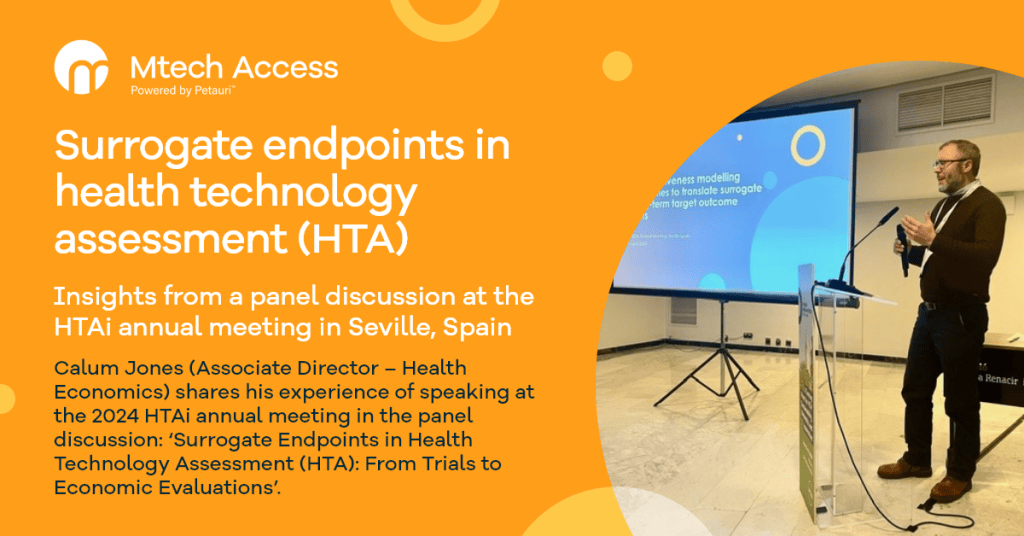
On 18th June, I had the distinct pleasure of participating in an expert panel at the HTAi annual meeting held in the picturesque city of Seville, Spain. The session, titled ‘Surrogate Endpoints in Health Technology Assessment (HTA): From Trials to Economic Evaluations’, was very much a collaborative endeavour. Orchestrated by Professor Rod Taylor (Professor of Population Health Research, University of Glasgow), I was joined on stage by fellow panellists:
- Professor Oriana Ciani (Centre for Research on Health and Social Care Management, SDA Bocconi School of Management, Milan, Italy)
- Professor Marissa Lassere (St George Hospital and School of Population Health, The University of New South Wales, Sydney, Australia)
- Professor Dalia Dawoud (Science, Evidence and Analytics Directorate, Science Policy and Research Programme, NICE, London, UK)
It was an honour to share the stage with such distinguished colleagues and contribute to a lively and engaging discussion. The session was attended by approximately 60 HTA stakeholders, all eager to delve into key considerations regarding appropriately validating and using surrogate endpoints for addressing HTA-related objectives.
Setting the stage: An academic perspective
Our session began under the experienced guidance of Professor Oriana Ciani, who laid the groundwork by providing a comprehensive academic perspective. Oriana’s presentation focused on the critical aspects of validating surrogate endpoints to ensure that these accurately predict final clinically relevant outcomes. Her insights set a robust foundation for the subsequent discussions, emphasising the importance of rigorous validation processes in maintaining the integrity of HTAs.
Bridging theory and practice: A clinical standpoint
Professor Marissa Lassere then provided a fascinating overview of the history and evolution of surrogate endpoint validation frameworks, dating back to the 1980s. Marissa’s ability to contextualise these frameworks within both historical and modern contexts enriched the session, offering a bridge between theoretical research and practical application in clinical settings.
My contribution: Key considerations when using surrogate endpoints within HTA models
When it was my turn to speak, I focused on the critical role of surrogate endpoints in economic evaluations for HTA, highlighting three fundamental pillars:
- Using the best possible evidence: I stressed the enduring preference of sourcing evidence from randomised controlled trials (RCTs) that report final, patient relevant outcomes. Whilst the pressure to expedite approval and reimbursement processes often leads to reliance on surrogate endpoints for final outcomes, it is crucial to establish that the candidate surrogate endpoint has been robustly validated as such. This should be through use of meta-analysis methodologies to establish trial-level and arm-level correlations for the surrogate endpoint and final outcome, as well as biological plausibility for the assumed surrogate–final outcome predictive relationship
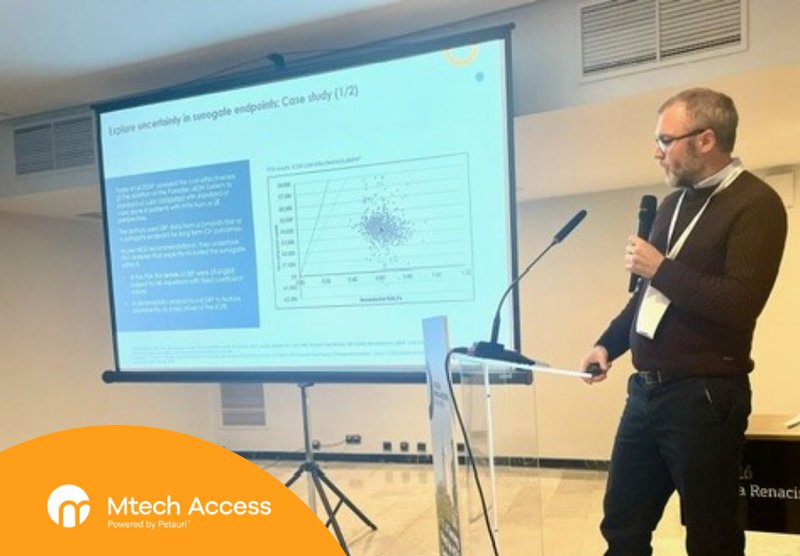
- Systematic assessment of uncertainty: assessing the uncertainty inherent in the relationship between surrogate and final outcomes is essential. I advocated for following NICE guidance on the use of Monte Carlo simulation methods in probabilistic sensitivity analyses to robustly evaluate the stability of results when using surrogate endpoints for final outcomes. This was illustrated using the context of a case study based on a cost-effectiveness analysis of endovascular ultrasound renal denervation in patients with resistant hypertension using systolic blood pressure as a surrogate endpoint to predict final cardiovascular outcomes
- Transparent reporting: transparency is paramount when reporting the use of surrogate endpoints. I recommended detailed documentation reporting why and how surrogate endpoints are used, as well as the methodologies employed to test uncertainty
To illustrate these points, I presented a compelling case study to showcase how this works practically.
Concluding insights and audience engagement
The session concluded with Professor Dalia Dawoud providing an insightful and engaging overview of the latest NICE HTA methods guidance on surrogate endpoint validation and use. Dalia highlighted the importance of collaborations between HTA bodies and regulators, advocating for the establishment of cross-party agreement on best practices for validating and using surrogate endpoints.
Reflecting on the experience
Participating in this panel was a rewarding experience, showcasing the combined expertise of all members and highlighting the collaborative spirit necessary to advance HTA practices relating not only to the validation and use of surrogate endpoints, but for all areas. The discussion reaffirmed the significant potential role of surrogate endpoints in HTA, and the need for ongoing research and collaborative dialogue to refine their validation and application.
As we look ahead, I am excited about the potential for further advancements in this field and the role that we can play in shaping the future of HTA in this regard. Stay connected with us for more insights and updates on our work as we continue to lead the conversation in HTA.
For more information on the use of surrogate endpoints in HTA and how these can support your market access strategy, email info@mtechaccess.co.uk.
More insights on surrogate endpoints:
- On-demand webinar: Surrogate endpoints – Overcoming reimbursement and validation challenges
- ISPOR poster: The Assessment of Surrogate Endpoints and their Impact on HTA Recommendations and accompanying author interview
This article was originally published at: https://mtechaccess.co.uk/htai-pannel-surrogate-endpoints-in-hta/
This content was provided by Petauri Evidence