



Digital options to enhance your local market access materials
December 12, 2023 | Digital, Market Access, Payers, communication, healthcare
How can a digital approach enhance local customer communication, particularly when tools are adapted from existing global materials? What are the options? How can we build in efficiencies whilst meeting the needs of each local affiliate?
How can a digital approach enhance local customer communication, particularly when tools are adapted from existing global materials? What are the options? How can we build in efficiencies whilst meeting the needs of each local affiliate?
Earlier this year, we published an article exploring some of the challenges market access teams face when adapting globally-produced evidence, value propositions, and communication materials for use in local healthcare systems. Charlotte Harding (Consultant – Market Access) wrote: ‘6 questions to ask when adapting global market access materials for local markets’. Here, Iain Shield (Senior Consultant – Market Access) returns to this topic, to explore how a digital approach can add value, drive efficiencies, and offer solutions.
Preparing to win: local considerations when developing global materials
Developing a strategy for the rollout and adoption of globally-prepared value communication materials by local affiliates is key. There will be pivotal choices to make, even if you deploy the materials to just a few markets.
The approach to demonstrating value in one market won’t necessarily work in another, due to variations in pricing, pathways, policies, competitors, etc. For example, a budget impact model in one market may need to be based around capacity, whilst another may need to focus on budget. Charlotte explores this in more detail here.
One of the best ways to enable local markets to efficiently adapt tools is to ensure that the original global materials are designed and developed with this in mind.
Be it a budget impact model, value proposition, or other visual aid, there will likely be differences across markets that require small (or significant) adaptations. Without a clear strategy, these can be challenging to manage, and could result in local affiliates disengaging. So, how can Global teams mitigate these risks?
1) Speak to local affiliates and involve them in the development of the global model
The best global materials are those developed with input from local affiliates. Great communication with Local Market Access teams should be a top priority. Local teams understand their markets and can provide customer and system insights. In her article, Charlotte outlined some of the key considerations that you should explore with affiliates, from a messaging and evidence perspective. Here are some things to consider from a design and technical perspective:
- How are Local teams using their current materials? Do existing tools work for them? Can new materials align? If they aren’t working, what is the challenge and how can we overcome this?
- Do all the Local teams have access to the same resources and platforms? Some customer relationship management (CRM) systems, that also deliver field team materials, require user licenses. Do all local affiliates have access? Will you need to ensure that the tool is compatible with several platforms? If the field team is a third party, will central management of materials be possible?
- Are multiple future updates anticipated? Maintaining only one version of a tool can simplify updates, but is not always feasible. How will efficient updates be managed?
- What technologies do Local field teams and healthcare customers use? Does the tool need to work for mobile and web? Should the tool be able to run offline?
Exploring these questions will give you the opportunity to understand the local nuances and challenges, and build adaptability into the original tool. Talking to your affiliates and the approvals/Signatory team during the initial design and development phases will reveal many of these hurdles ahead of time.
2) Be flexible and build in adaptability
With a bit of forward thinking and flexibility, it is possible to develop options that suit your situation and the needs of the local markets.
For example, we often recommend the use of placeholders for products. This can be a great way to build in flexibility and help future-proof a tool. Another option is to build a more comprehensive tool, where components can be switched off or reinstated to meet the needs of different markets. In general, simplifying elements wherever possible will make downstream adaptation easier.
There is a trade-off between developing an extensive, complex tool that can handle differences between markets, and developing a more basic tool that requires bespoke adaptation. How far you go, when to draw the line, and which specific requirements can be split into separate pieces of work, depends on many parameters. It can be a hard decision to make, although keeping it simple is always a useful guiding principle.
Digital options for market access communication tools
In order to effectively build in adaptability, work flexibly, and meet the needs of multiple local affiliates, many of our Pharmaceutical and Medtech clients turn to digital solutions.
‘Digital’ means different things to different people. In this context, we mean a software solution. In contrast to a Microsoft Office document like a Word dossier or PowerPoint presentation, a digital solution delivers enhanced design and functionality. Put simply, it can look and feel much more professional and deliver better results!
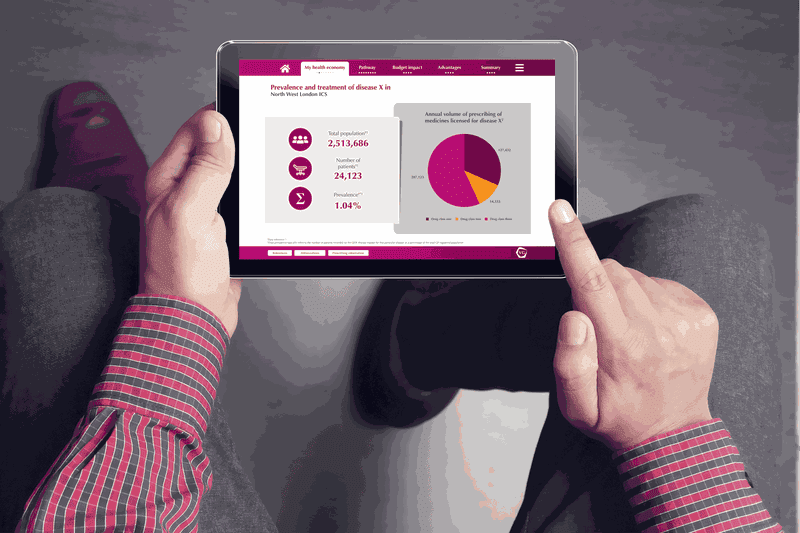
Digital options can also help solve some common challenges around managing distribution, withdrawal, updates, and compliance. They can also offer solutions for field teams on the move. There are several options to consider, with different benefits and drawbacks:
1) Customer Relationship Management (CRM) platforms
CRM platforms, such as Veeva CRM, offering closed-loop marketing (CLM) presentations have built-in features that you and your teams will be able to use. Your teams may already be used to the platform, so it will be an easy step for them to use new materials that are integrated with it. CRM platforms offering CLM have the functionality to:
- Easily distribute materials to multiple devices – distribution is often based around permissions, which allows you to make materials available to field teams wherever they are, and gives you the flexibility to turn on/off different features for certain users or devices
- Enable centralised withdrawal and updates – you can easily pull materials to keep teams compliant. Features to push out new versions are also convenient when compared with the alternative of a file-based system
- Provide usage statistics – these can be used to inform future improvements and development
- Integrate effectively with your CRM system – can also be integrated with existing information and consent capture policies
When a CRM is already embedded within a business, it’s the obvious choice (although, as stated above, it is important to check that all Local field teams have access). Whilst these systems are quite flexible, there is often a defined approach; working with this approach rather than working around it is advisable.
2) Stand-alone software
Stand-alone apps distributed by mobile device managers (MDMs) can be a great alternative option. The MDM enables some of the functionality offered by a CLM platform: tools can still be available offline, and distribution can also be automated; however, you are creating something new that stands alone. There may not be a set process for review and approvals. You may run into complications as different teams get to grips with the process. Enabling an early dialogue between those developing the tool, those reviewing it, and those distributing it can be an enormous help. Establishing an end-to-end test environment is also important. As is early communication for how distribution packages can be securely passed between teams.
3) Web-based approach
A web-based solution can be a great option for a companion piece to augment core communication material delivered through another channel. This omnichannel approach can deliver the best of both worlds.
It is logical to think that a bespoke web application can solve all technology hurdles for market access materials; however, a web-based approach can present a barrier for tools that need to run offline.
Overall, web technologies are an ideal choice for developing materials (even if they aren’t delivered via a traditional client-server approach). Mtech Access adopt web technologies as a common code base and develop wrappers to deliver the materials across a range of devices and channels. This allows costs to be contained and development time can also be minimised, as code can be reused.
Enhancing your local market access tools with digital
Your rollout strategy needs to be as strong and considered as the materials themselves. Your strategy can impact how well the materials will be used and, ultimately, how successful your campaign will be. Digital has many features to offer and can help you get materials out there, as well as aid in delivering the narrative.
Mtech Access can help you navigate the options and maximise a successful launch. We do this by developing the materials, managing changes across markets, advising on the best digital strategy, and then delivering on it. To speak to our experts about your requirements, email info@mtechaccess.co.uk.
This content was provided by Petauri Evidence