




Drive, Discover, Dive_OPEN Health
May 17, 2023 |
Learn how to unlock the power of simplicity in complex omnichannel healthcare communications.
Written by Dominic Marchant, Chief Creative Officer, OPEN Health
“Simple can be harder than complex: you have to work hard to get your thinking clean to make it simple. But it’s worth it in the end because once you get there, you can move mountains”. One of my favorite Steve Jobs quotes. Why? Because we tend to make things complicated quickly when, in fact, we should be looking at defining the problem as simply as possible before even beginning to think about solutions.
And omnichannel is an area of healthcare communications that is, if you are to believe the many LinkedIn articles from omnichannel experts, a discipline riddled with complexity. We talk about personas (why not personae?), digital integration, user experience, snackable content – all good stuff, but it is somewhat overwhelming to the uninitiated.
Broadly speaking the issue is, how can we get our wonderful content to the healthcare professionals in the right channels, in the right format, at the right time. Move away from simply pushing a message to understanding what healthcare professionals (HCPs) are looking for and where and then delivering content appropriately. And, for many, omnichannel is about that trade-off between consistency and personalization – that we say the same thing, albeit tweaked for the channel/format and for that audience type.
Let’s make it even simpler. What if we look at omnichannel through the lens of attention: the attention of our audience? How much time can we feasibly ask from our time-starved specialist/GP to get them to listen to our new data/brand message? Maybe we don’t look at delivering the whole enchilada (in terms of messaging) in the first touchpoint with them?
Here’s a diagram to illustrate the point:
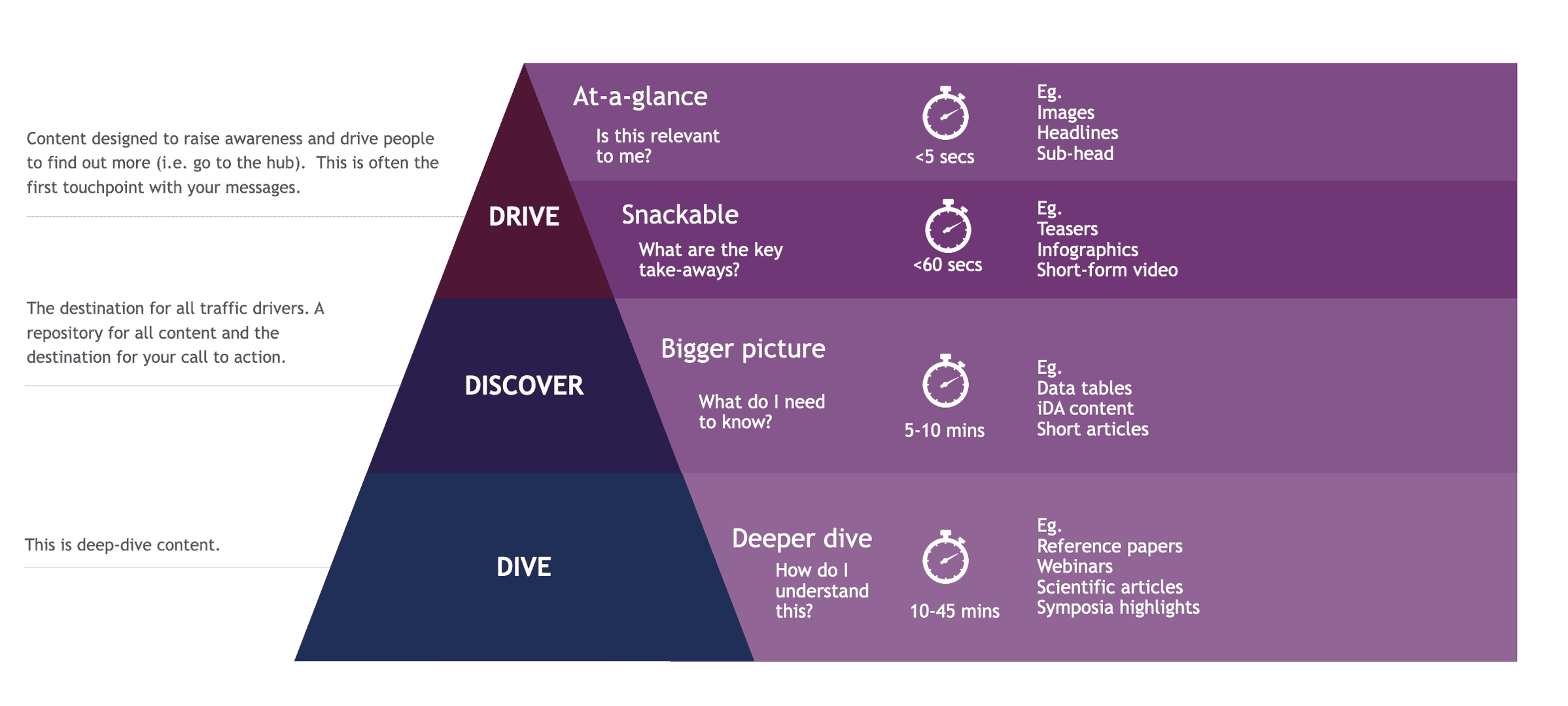
The time, indicated by the stopwatch, is the amount of attention we are asking from our HCPs. This is the crux of our omnichannel engagement plan. So when we think about putting out some ground-breaking content, we think backwards from the whole enchilada: what is it we want (ultimately) our audience to see? Then, how can we create something in stages that asks a little bit less each time in terms of their attention until we end up with the smallest entry point to that big message?
Now, just to test the theory, let’s play that forwards. The triangle starts at the sharp point (the smallest point) and gets wider and bigger as you move down, reflecting our user journey in terms of message and attention – everything gets bigger the more you move towards the ultimate destination (the deep dive content).
Simples.
I’m not suggesting that this now “solves” omnichannel but it is an effective way of looking at how we can take folk on a content journey with a new focus. Attention.
Visit our website to learn more about how we unlock possibilities in creative communications.
This content was provided by OPEN Health
Company Details
Latest Content from OPEN Health
What is adult learning theory and how can it be used to help maximise your team’s potential?
Written by Briony Frost, OPEN Health
Empowering and equipping medical affairs teams to embrace an ever-expanding remit
Written by Jess Ingram and Francisca Costa, OPEN Health
The role of medical affairs in positive and appropriate engagement with patient advocacy groups
Written by Gavin Jones, Dr Alexandra Safronova & Professor Peter Rutherford, OPEN Health
OPEN Health’s response to the FDA’s guidance on long term follow up post gene therapy
Written by Gavin Jones, OPEN Health
OPEN Health expands offering with the launch of a new Learning & Development specialist team
Enhanced expertise to deliver impactful internal training programmes for healthcare clients
Spotlight interview: 15 minutes on healthcare communications in gene therapy
Gavin Jones, Director of Rare Disease, OPEN Health takes 15 minutes to answer some key questions on healthcare communications in gene therapy
OPEN Health becomes sponsor of MedComms Networking
New for 2020, OPEN Health is pleased to announce its sponsorship of MedComms Networking
OPEN Health Graduate Programme: from OPEN VIE to OPEN Health Medical Communications
Isobel Owens shares her experience of the OPEN Health Graduate Programme from OPEN VIE to OPEN Health Medical Communications
Spotlight interview: 15 minutes on digital in medical communications
Gemma Allen, Head of Digital Communications, OPEN Health takes 15 minutes to answer some key questions on digital in medical communications
Generating data on long-term outcomes with gene and other advanced therapies
Gene therapy and advanced cell-based therapies offer patients hope and the potential to make them ‘chronically well’.