



Its Know Your Numbers week
September 11, 2019 | awareness, blood pressure
Do you know yours?
Most people are aware that high blood pressure is to be avoided in the same way we know that being overweight or unfit is unhealthy, but what does it really mean and why is it so important?
There is a danger that we have become de-sensitised to the warnings. Why? Could it be because we are bombarded with swathes of conflicting messages, especially when it comes to food and diet. While one TV advert shamelessly entices us to indulge in a death-by-chocolate, melt-in-the-middle fondant bomb, another hammers home the risks of heart disease, strokes and diabetes.
Yet blood pressure is so important. A sustained high blood pressure is not only a red flag for future life-threatening health conditions, it is also asymptomatic, with some people suffering for years without knowing it until serious health issues become apparent.
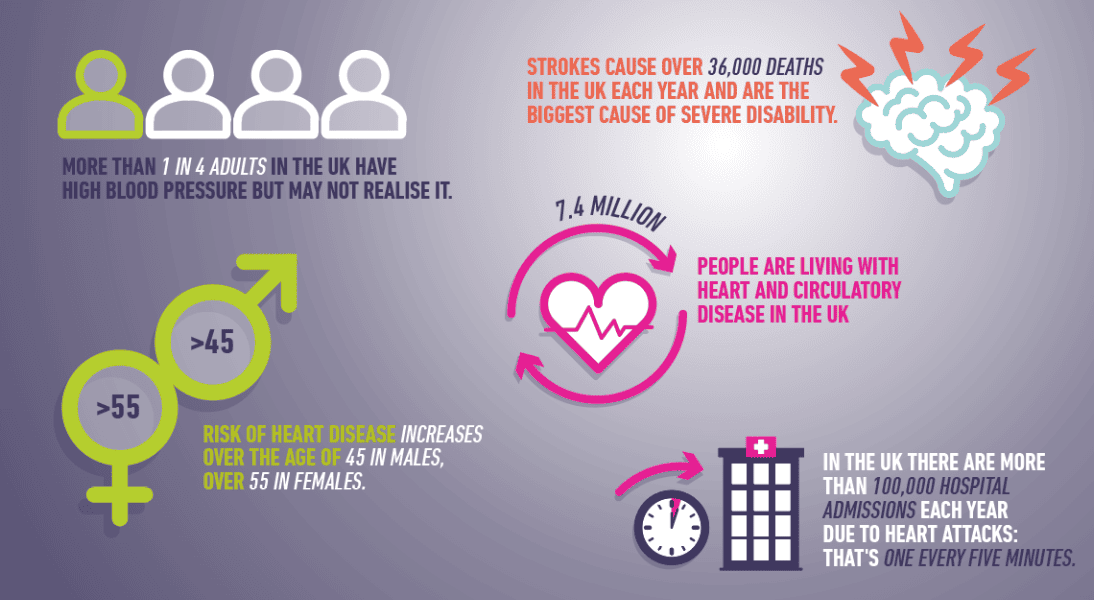
One in 4 adults in the UK has high blood pressure so the risk of developing heart disease, heart attacks, strokes, kidney disease and vascular dementia are very real. More than 100,000 hospital admissions each year are due to heart attacks: that’s one every five minutes.1
Blood pressure is the force exerted by blood against the arteries when the heart pumps. It is measured using an automatic device with sensors and digital displays. A cuff is placed around the upper arm, which inflates until the circulation is temporarily cut off. The pressure is then released, deflating the cuff and allowing the blood to pulse through the arteries again. The pressure is recorded at two points and measured in millimetres of mercury (mmHg). Firstly, a systolic reading is taken as the blood pulses through, and secondly, the diastolic reading is taken when the heart rests between beats. A healthy blood pressure reading should be 120/80mmHg or below. A high blood pressure reading is classed as 140/90mmHg or above, but it would need to be taken several times in order to confirm a diagnosis of high blood pressure.2
Blood pressure can naturally go up and down, for example, after exercise or drinking caffeine without causing any problems. However, high blood pressure becomes dangerous when it is sustained over many months or years, causing blood vessels to weaken and putting a strain on the heart and other organs.3
The NHS recommends that all adults over 40 years of age have their blood pressure tested at least every 5 years. However, if you are in a high-risk group, it should be taken at least once a year. Factors that can increase your risk of developing high blood pressure are:
- Age – the risk of developing high blood pressure increases with age
- A family history of high blood pressure
- A diet with too much salt
- Lack of exercise
- Being overweight
- Chronic Kidney Disease
- Regularly drinking large amounts of alcohol
- Smoking
- Long term sleep deprivation
- Long periods of stress
The good news is, you can get your blood pressure tested very easily at a number of places including your local GP surgery, some pharmacies or even at home, as digital devices are readily available to purchase online.
At Page & Page we take our employees’ health very seriously, so everyone is having their blood pressure tested today in the office today. Wish us luck!

Senior Creative Paul Hunt having his BP check up.
References 1-3:
NHS [online]. Available at https://www.nhs.uk/conditions/high-blood-pressure-hypertension/. Accessed 10/9/19.
Author: Michelle Burt
This content was provided by Page & Page Health
Company Details

Latest Content from Page & Page Health
Rediscovering the human touch in healthcare
The landscape of our healthcare system is ever evolving. But it is under threat from the diminishing time allowances our healthcare professionals have to spend with each patient. With little...
Remote Patient Monitoring
The COVID-19 pandemic has brought into sharp focus the need to harness and leverage digital tools and technology for remote patient monitoring (RPM). With the onset of lockdown, and a...
The power of communication: Engaging diverse groups in healthcare
Humans are diverse and communications to engage us need to be inclusive. It’s no longer about talking to a group, a cohort or an imagined section of society - especially...
How a design mindset can lead to better medical outcomes
By adopting a design philosophy, healthcare companies can develop communications that allow healthcare professionals (HCPs) to better meet the needs of their patients. Imaginatively designed content combined with patient insights...
How to design better medical outcomes: Combining patient insights and empathetic design
By adopting a design-led, solutions-based approach to communications, companies can help healthcare professionals (HCPs) to better meet the needs of their patients through their communications. While now may not feel...
Is communication killing the COVID-19 vaccine’s chance at success?
Against the challenging backdrop of of misinformation, communications specialists are working to educate the public, change the minds of millions and fight to return to some sense of normality in...
Healthcare agency Page & Page and Partners welcomes wave of new talent
Page & Page and Partners has welcomed six new joiners across its Creative and Client Services teams.
Good design saves lives
Good design and creative thinking are essential if we are to improve on existing problems in new ways, which is why design and creativity within healthcare is vital. Health is...
Creative med affairs and bridging the healthcare gap
Within the healthcare industry, any patient-facing activity has traditionally been the domain of marketing teams – be that brand marketing or marketing individual products. Recently, however, a trend has emerged...
Senior team at Page & Page become Partners
Page & Page and Partners are announcing the appointment of their senior management team to partners in the agency. The new partners will be actively involved in shaping the future...