



Its Know Your Numbers week
September 11, 2019 | awareness, blood pressure
Do you know yours?
Most people are aware that high blood pressure is to be avoided in the same way we know that being overweight or unfit is unhealthy, but what does it really mean and why is it so important?
There is a danger that we have become de-sensitised to the warnings. Why? Could it be because we are bombarded with swathes of conflicting messages, especially when it comes to food and diet. While one TV advert shamelessly entices us to indulge in a death-by-chocolate, melt-in-the-middle fondant bomb, another hammers home the risks of heart disease, strokes and diabetes.
Yet blood pressure is so important. A sustained high blood pressure is not only a red flag for future life-threatening health conditions, it is also asymptomatic, with some people suffering for years without knowing it until serious health issues become apparent.
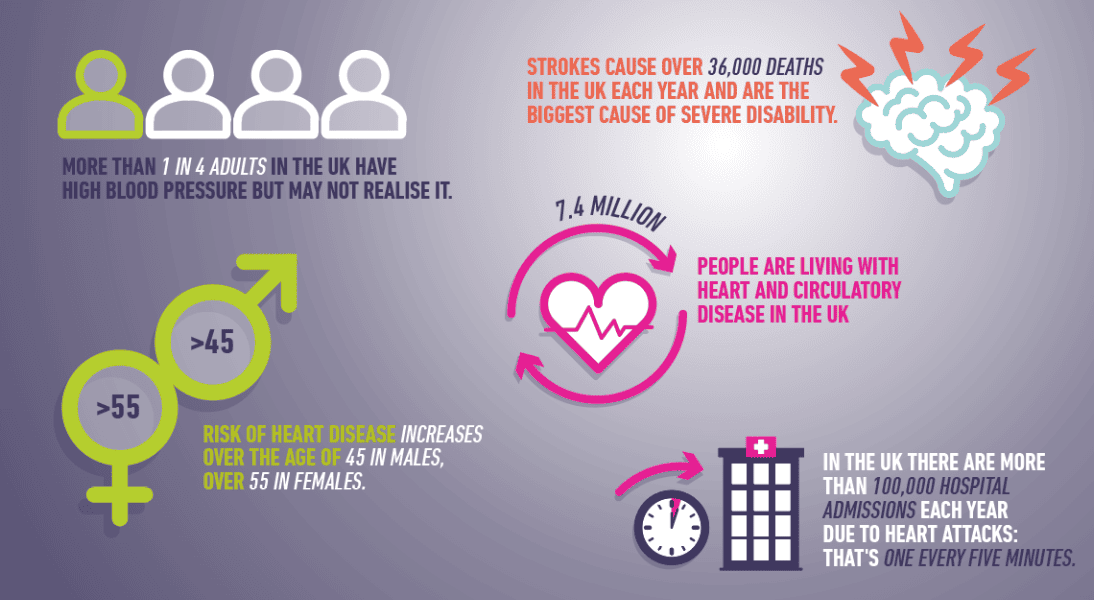
One in 4 adults in the UK has high blood pressure so the risk of developing heart disease, heart attacks, strokes, kidney disease and vascular dementia are very real. More than 100,000 hospital admissions each year are due to heart attacks: that’s one every five minutes.1
Blood pressure is the force exerted by blood against the arteries when the heart pumps. It is measured using an automatic device with sensors and digital displays. A cuff is placed around the upper arm, which inflates until the circulation is temporarily cut off. The pressure is then released, deflating the cuff and allowing the blood to pulse through the arteries again. The pressure is recorded at two points and measured in millimetres of mercury (mmHg). Firstly, a systolic reading is taken as the blood pulses through, and secondly, the diastolic reading is taken when the heart rests between beats. A healthy blood pressure reading should be 120/80mmHg or below. A high blood pressure reading is classed as 140/90mmHg or above, but it would need to be taken several times in order to confirm a diagnosis of high blood pressure.2
Blood pressure can naturally go up and down, for example, after exercise or drinking caffeine without causing any problems. However, high blood pressure becomes dangerous when it is sustained over many months or years, causing blood vessels to weaken and putting a strain on the heart and other organs.3
The NHS recommends that all adults over 40 years of age have their blood pressure tested at least every 5 years. However, if you are in a high-risk group, it should be taken at least once a year. Factors that can increase your risk of developing high blood pressure are:
- Age – the risk of developing high blood pressure increases with age
- A family history of high blood pressure
- A diet with too much salt
- Lack of exercise
- Being overweight
- Chronic Kidney Disease
- Regularly drinking large amounts of alcohol
- Smoking
- Long term sleep deprivation
- Long periods of stress
The good news is, you can get your blood pressure tested very easily at a number of places including your local GP surgery, some pharmacies or even at home, as digital devices are readily available to purchase online.
At Page & Page we take our employees’ health very seriously, so everyone is having their blood pressure tested today in the office today. Wish us luck!

Senior Creative Paul Hunt having his BP check up.
References 1-3:
NHS [online]. Available at https://www.nhs.uk/conditions/high-blood-pressure-hypertension/. Accessed 10/9/19.
Author: Michelle Burt
This content was provided by Page & Page Health
Company Details

Latest Content from Page & Page Health
The secret nobody told you about how to go viral
How to create content people actually want to read and share online
Cultivating authenticity in healthcare communications: breaking through the conventional shackles
The ever-evolving landscape of healthcare communication is shifting. Hear eight strategies to enhance authenticity in healthcare communications.
AI in healthcare communication, today and tomorrow.
Advances in AI technology have meant that agencies can now provide genuine utility to healthcare communications.
Empowering Employees: Unleashing Potential for a Bright Future
We believe that true empowerment is not just giving a person a voice, but the freedom and ability to act.
Whitepaper: Closing the gap with compelling healthcare communications
Want to learn how to close the distance between a person’s current health and their healthiest possible self?
ChatGPT AI copywriter: Looming threat or opportunity to evolve?
Even as someone who makes a living working in healthcare communications, I can still spend many hours copywriting without much progress – it is the nature of the beast [come...
You’re sitting on a time bomb, so think harder and give more!
A new philosophy for a new age?
Can Artificial Intelligence Solve the Healthcare Crisis?
Healthcare systems around the world are already struggling to meet the demands of an ageing population, the rising incidence of chronic diseases, escalating healthcare costs and a deficit of healthcare...
What constitutes a great creative brief?
We asked, you answered, and the results are in… what really does go into a great creative brief?