




Playing Mind Games
May 24, 2019 | Brief writing, Share of mind
To give a brief strong direction, we need to ascertain how the brand intends to win attention, how it will engage, what its call to action will be and how to build up trust with the audience. It is a chance to take your brand story and archetypes and decide precisely what and how you want to communicate to the outside world.
To give a brief strong direction, we need to ascertain how the brand intends to win attention, how it will engage, what its call to action will be and how to build up trust with the audience. It is ideas that count here. These ideas can take the form of messages, visuals or tactics or a combination of all three. It is a chance to take your brand story and archetypes and decide precisely what and how you want to communicate to the outside world.
At P&P, we use the share-of-mind wheel. The four areas that you will look at are:
- Feelings/ Instincts
What will win the target audience’s attention against the backdrop of a busy day and hefty media bombardment?
- Rational/ Benefits
What claim or benefit can be made that will maintain their attention and achieve engagement?
- Priorities
How will the target audience react, given the things they have top of mind?
- Values/ Beliefs/ Mission
Why should they believe it’s OK to trust your brand?
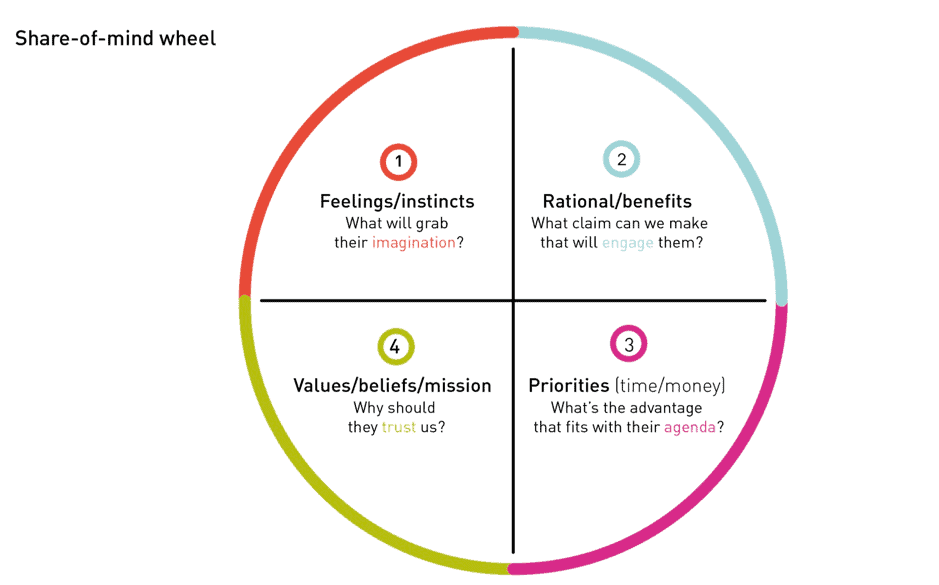
The exercise will differ depending on whether it is for the campaign or one specific piece of communication.
If the brief is being written for a campaign and you are thinking in terms of tactics, the share-of-mind wheel can be viewed as a journey with different media and tactics used to fulfil the four different criteria. For example, by developing something interactive like a game app for phones and tablets, you might win attention and generate curiosity. This will encourage players to follow a link, which leads to engaging information on a website with a clear call-to-action. They can then request further information by email. Slowly they become more involved with the brand as they learn to trust through experience.
This content was provided by Page & Page Health
Company Details

Latest Content from Page & Page Health
Are we losing sight of what the democratisation of healthcare really looks like?
We have a core responsibility as healthcare communicators to consistently drive for better inclusion, engagement and compliance. What does the ‘democratisation of healthcare’ really look like?
Be Patient
Awareness raising is key to boosting patient involvement and engendering trust.
Time to improve healthcare outcomes
We live in an era of robust and thorough evidence and there is no place for historical biases and that requires everyone involved to look beyond women’s reproductive cycle and…
Embrace mental health first aiders for better work wellbeing
Mental health first aid can work as a vital steppingstone to instilling good mental health practices into wider company culture and ensure everyone knows what to be looking out for…
What does the future hold for clinical trial recruitment?
The past couple of years have raised several aspects of healthcare in the public’s consciousness – and one of the leading ones has been the role of clinical trials in…
Why big pharma needs to be braver
The last few years have seen the pharmaceutical industry undergo a rapid metamorphosis in the face of unprecedented change, but communications are one area that still needs an injection of…
How scientific storytelling can help Pharma cut through the noise
Rather than being afraid of storytelling, pharmaceutical firms should be embracing it. Because what scientific storytelling allows us to do is to communicate quickly and efficiently. It provides a shortcut…
How can Pharma help HCPs face Dr. Google?
A correct diagnosis can sometimes take time and patients often look for online support groups and communities to help so improving communications around health and wellbeing is the most effective…
The power of communication: Engaging diverse groups in healthcare
Humans are diverse and communications to engage us need to be inclusive. It’s no longer about talking to a group, a cohort or an imagined section of society – especially…