



From joint clinical assessment to coordinated pricing: what’s next for European market access?
November 17, 2026 | HTA, JCA, Market Access
By Craig Tallentire

Europe has traditionally been characterized by a fragmented market access landscape, with the responsibility for pricing, reimbursement and access decisions sitting with individual countries. However, European markets are becoming increasingly interconnected, with initiatives such as the Joint Clinical Assessment (JCA), Beneluxa and the Nordic Pharmaceutical Forum, as well as the widespread use of international reference pricing, strengthening links between national decision-making processes.1-8
With Europe increasingly assessing evidence collectively, greater coordination in value assessment may follow, but pricing and reimbursement are likely to remain national. What would that mean for pharmaceutical companies preparing for the future of European market access?
Could JCA become the foundation for a more coordinated health technology assessment (HTA) system?
The JCA framework represents a significant shift in how evidence is assessed across Europe, creating a shared understanding of relative clinical effectiveness and comparative evidence through a common assessment undertaken by participating countries.1,9 However, the JCA does not create a shared value judgement, willingness to pay or aligned budgets.
A possible evolution of the JCA framework could thus be that it becomes the foundation for a more coordinated European HTA process. To achieve this, several aspects of the current country HTA processes would require alignment.
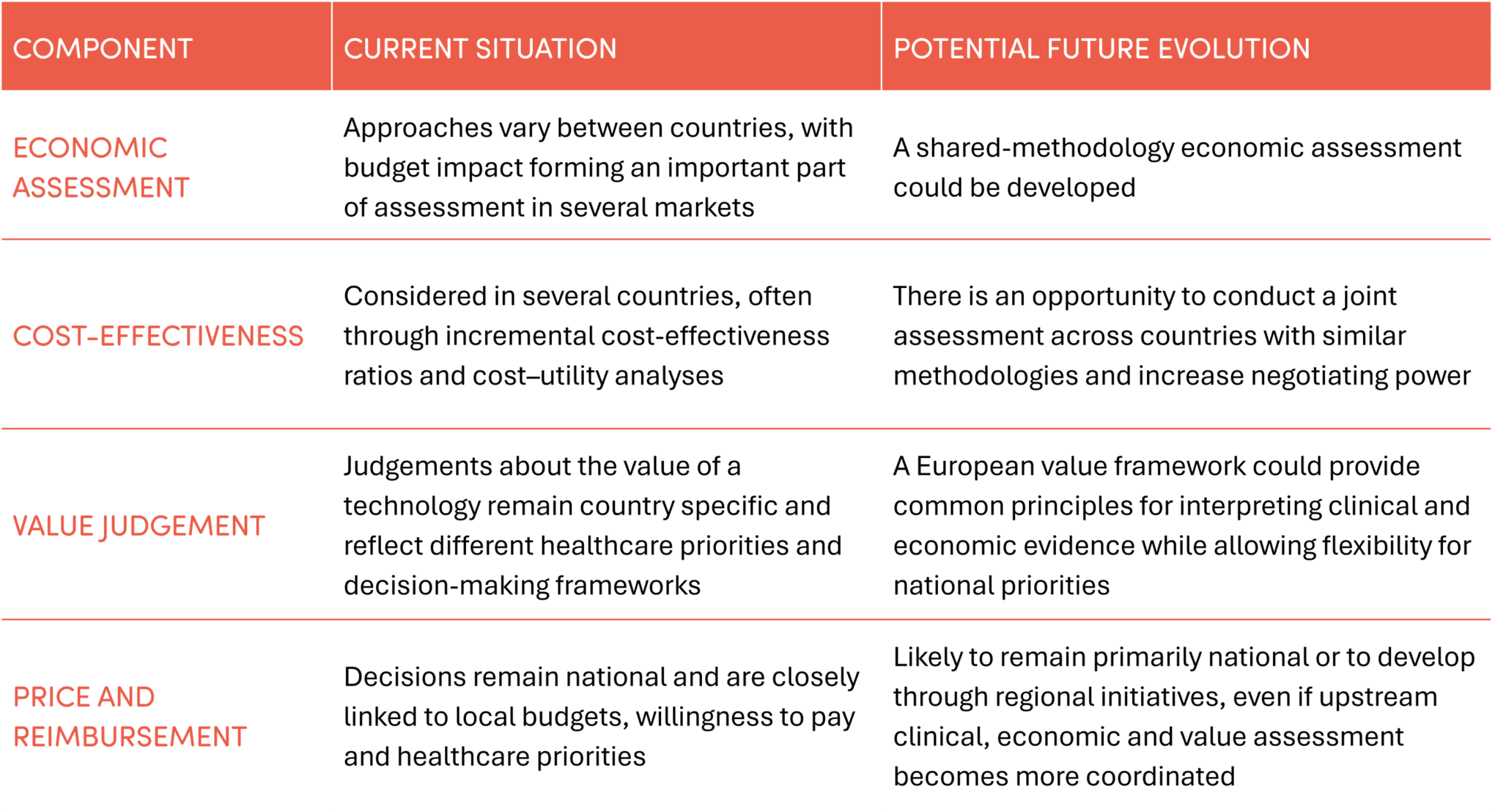
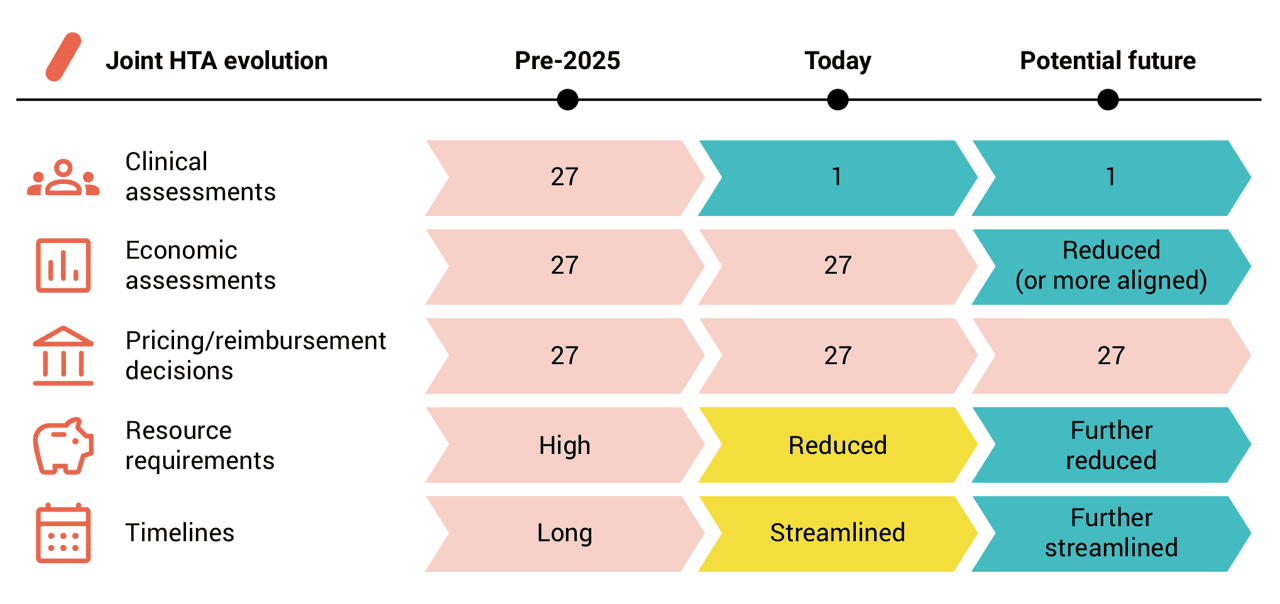
While certain aspects of the HTA process, such as assessment methodologies, aligned frameworks and joint/regional initiatives aimed at strengthening negotiating power, are achievable as the next step in joint HTA evolution, pricing and reimbursement decisions will likely remain a national responsibility. This would mean that increasingly, countries may be requesting and examining the same evidence, with the main variable being price. Even with individualized pricing decisions, a common European value framework and aligned methodologies could help to streamline HTA timelines and reduce duplication of the evidence that manufacturers are currently being asked to provide.
Would one evidence strategy be enough?
A more joined-up HTA could facilitate broader access across multiple markets, but evidence uncertainties identified during a coordinated review, combined with increased transparency between markets, could negatively influence access in several countries simultaneously. Thus, a more consolidated European assessment framework may encourage earlier development of a common European evidence strategy, focusing on development programmes addressing the common definition of value, and it will require evidence that can withstand scrutiny across numerous markets.
However, a common assessment framework is unlikely to eliminate national evidence needs entirely, particularly if differences remain in the way countries interpret the evidence. While evidence needs may become increasingly centralized, treatment pathways, comparator use and eligible populations may still require adaptation to national contexts.10,11 Thus, a likely outcome is a European evidence package complemented by country-specific evidence needs.
Could one HTA eventually support one European price?
If countries increasingly rely on a common assessment of clinical value, it is reasonable to consider whether pricing and reimbursement processes might also become more closely coordinated over time.8
Several future models are conceivable. The most likely outcome has countries retaining national pricing and reimbursement decisions. A more ambitious model could involve coordinated negotiation approaches or pricing corridors, whereby countries agree broad pricing parameters while retaining flexibility to reflect local circumstances. At the furthest end of the spectrum would be a single European price, supported by a common assessment of clinical value and potentially shared reimbursement discussions. The latter option presents several obstacles, namely, that European healthcare systems differ substantially in economic circumstances, healthcare spending and available resources for funding new technologies;10 even if countries reach similar conclusions regarding clinical value, they may continue to differ in their assessment of affordability and budget impact.11 As such, there is currently no indication that Europe is considering such an evolution.
The debate also extends beyond Europe; similar discussions have emerged internationally through mechanisms such as Most Favored Nation pricing, which seeks to anchor prices to those achieved elsewhere. This reflects a broader trend towards increasing interdependence between healthcare markets and growing interest in how pricing decisions made in one jurisdiction influence outcomes in another.12
The future of European coordination is unlikely to be a simple choice between today’s fragmented system and a fully harmonized model. Instead, a range of intermediate approaches may emerge as countries seek to balance efficiency, consistency and national autonomy.
What does this mean for pharmaceutical companies?
Whether or not Europe ultimately moves towards a joint HTA, the direction of travel appears to be greater interconnectedness between markets. This increased transparency with stronger links between national decisions is a double-edged sword. It could simplify how companies plan evidence generation, launch sequencing and pricing across Europe, but it could also expose evidence gaps and inadequate data to greater scrutiny in more countries. Getting the initial evidence package and value proposition right will be even more important, as conclusions reached through a common assessment may influence discussions in multiple countries simultaneously. Clinical development, evidence planning and value communication may therefore need to be considered increasingly from a European rather than a national perspective.
Greater coordination could also influence market access timelines; a common European HTA framework may provide a clearer and more predictable starting point for national decision making and more streamlined evidence package needs. However, with pricing and reimbursement decisions remaining largely national, the key challenge for manufacturers may be in identifying which activities can be managed through a common European strategy and which will continue to require adaptation to national requirements.
The future of European market access may therefore be one of increasing convergence. As evidence assessment becomes more coordinated, manufacturers will need to plan their European evidence strategy earlier while retaining the flexibility to respond to national requirements.
References
- European Commission. Joint Clinical Assessments for medicinal products. 2026. Available at: https://health.ec.europa.eu/health-technology-assessment/implementation-regulation-health-technology-assessment/joint-clinical-assessments-medicinal-products_en (accessed October 2026).
- Beneluxa Initiative on Pharmaceutical Policy. Beneluxa initiative. 2026. Available at: https://beneluxa.org/collaboration (accessed October 2026).
- Nordic Pharmaceutical Forum. Welcome to Nordic Pharmaceutical Forum. 2025. Available at: https://nordicpharmaceuticalforum.com/ (accessed October 2026).
- Watt A. International reference pricing (IRP) 2024: a year in review. 2025. Available at: https://www.pharmaceutical-technology.com/analyst-comment/international-reference-pricing-irp-2024/?cf-view (accessed October 2026).
- World Health Organization. WHO guideline on country pharmaceutical pricing policies. 2020. Available at: https://iris.who.int/server/api/core/bitstreams/92f7b2d6-633b-4ac7-bf86-c0bf4d584ad2/content (accessed October 2026).
- World Health Organization. Making medicines more affordable. 2026. Available at: https://health.ec.europa.eu/medicinal-products/legal-framework-governing-medicinal-products-human-use-eu/pharmaceutical-strategy-europe/making-medicines-more-affordable_en (accessed October 2026).
- European Commission. Ensuring the availability of supplies and equipment. Available at: https://commission.europa.eu/strategy-and-policy/coronavirus-response/public-health/ensuring-availability-supplies-and-equipment_en (accessed October 2026).
- Skowron R, Grioui N, Koćwin A et al. Recent developments in European voluntary cross-border collaborations in joint HTA, drug pricing, procurement, and readiness for EU HTA implementation. Value Health 2024;27(12 Suppl):S295 (abst HPR103).
- Johns A, Andrade A, Johal S et al. EU Joint Clinical Assessment: a framework for optimising use with cost-effectiveness decision-making. J Mark Access Health Policy 2025;13:52.
- Hofmarcher T, Charalambous A, Normanno N et al. Access to novel cancer medicines in Europe: inequities across countries and their drivers. ESMO Open 2025;10:105810.
- Pichon-Riviere A, Rodríguez-Cairoli F, Drummond M et al. Affordability decision rules: a systematic review and framework for categorising budget impact thresholds across health systems. Lancet Glob Health 2025;13:e2027-40.
- Avissar J. Navigating the new Most Favored Nation (MFN) reality: are pharma companies ready? 2026. Available at: https://amiculum.biz/insights/navigating-the-new-most-favored-nation-mfn-reality-are-pharma-companies-ready/ (accessed October 2026).
This content was provided by Amiculum
Company Details

Latest Content from Amiculum
Key takeaways from MedAffairs Transformation: creating a high-value medical affairs organization in the age of AI
What does a high-value medical affairs organization look like in a world of constrained resources, increasingly capable artificial intelligence (AI) and easier access to scientific information? For medical affairs leaders…
What the Most Favored Nation (MFN) policy means for UK Pharma
By Jed Avissar and Manca Povsic
Amiculum joins Bionow: supporting collaboration across the life sciences sector in the North of the UK
We’re delighted that Amiculum has become a member of Bionow, joining a collaborative community that plays an important role in bringing together life sciences organizations across the North of the…
PharmaQuest returns: EPA perspectives, through a rare disease lens
By Lottie Sequerra and Emily Morton-West
Amiculum reaffirms presence in Dundee with new office and continued academic partnership
Amiculum is pleased to announce the relocation of its Dundee team to a new, state-of-the-art facility at the Dundee Life Sciences Innovation Hub, an environment designed to accelerate scientific progress…