




Thinking creatively about patient involvement in publications
March 7, 2023 | healthcare comms, medical publication professionals, patient involvement in medcomms
Bedrock’s freethinking spirit to reimagine publications is on course to include patients in the full end to end of the publication process.
The International Society for Medical Publication Professionals (ISMPP) 2023 European meeting theme was ‘Fueling Creativity’, and the various topics covered across the 2 days certainly got the Bedrock team thinking. How can we be creative in our approach to delivering compelling and impactful publications and medical communications? One clear area of focus at the meeting was patient involvement in publications, and our team have been reflecting on this and what it means for us as healthcare communication professionals.
Plain language summaries (PLS) have been a hot topic of ISMPP meetings for several years. The value of creating publication content tailored to non-specialist audiences (e.g. time-poor specialists/generalists, payers/policy makers, healthcare professionals [HCPs] with English as a second language, allied HCPs, lay audiences including patients and carers) is now widely recognised by publication professionals; it is becoming increasingly common to see a PLS developed alongside the publication of clinical trial data or as a standalone PLS (plain language summary of a publication). What remains less clear is how patient partners can be effectively engaged and involved throughout the entire end-to-end publication planning and development process.
Good Publication Practice (GPP) 2022 guidance recognises patients as experts who can provide important input into publications at various stages, including during publication planning, as authors and in the development of PLS (see figure below):1
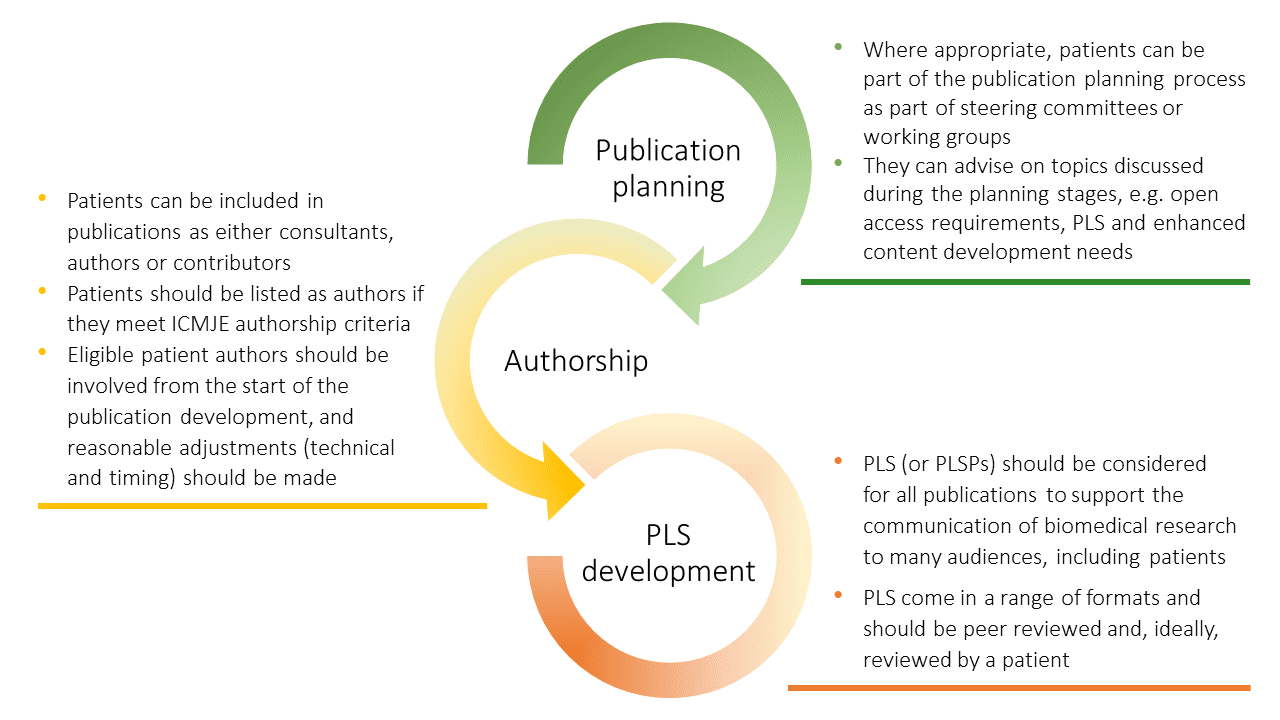
ICMJE, International Committee of Medical Journal Editors; PLS, plain language summary; PLSP, plain language summary of a publication.
Patient involvement in end-to-end publication planning and development has the potential to add huge value through improving accessibility of clinical trial data to non-specialist audiences. However, it is clear that challenges remain and publication professionals need to adopt a more proactive, creative and agile approach to early engagement with patients in the process. Discussion during the ISMPP 2023 meeting brought up some interesting and thought-provoking topics and questions for us to consider moving forwards:
- Identifying the right patient partners is a challenge – how and where can we find patients?
- Appropriate compensation for patients’ time in supporting publication activities is permitted, though remains somewhat controversial – how should/can we navigate this?
- There are many practical things to consider when involving patients in publications to ensure optimal contribution – how can we best make adjustments to processes and timelines to accommodate this?
- Best-practice sharing will support the industry to progress in effective patient involvement in publications – how can we better collaborate and share key learning and information?
- Tools and resources exist to help advocate and coordinate patient involvement in publications and to support development of PLS – how can we raise awareness and better standardise the quality of content?
Overall, great progress has been made over recent years towards involving patients in publications and much of this has focused on PLS development, which has enabled better engagement of non-specialists in healthcare. How can we, as publication and medical communications professionals, contribute to improving patient involvement in the full end-to-end publication process?
As part of our commitment to ‘reimagining publications’, Bedrock is looking at how we can address the key challenges outlined above alongside our patient focused sister agency, Origins. Bedrock and Origins are collaborating to think creatively and compliantly about engagement of patients in the entire publication process. To talk to us about our work in publications and medical communications, and how we improve patient involvement and focus throughout the entire clinical development and lifecycle management process, please contact Louise Adamson louiseadamson@bedrock-health.com
Reference:
- DeTora LM, et al. Ann Intern Med. 2022;175(9):1298–304.

Company Details

Latest Content from Bedrock Healthcare Communications
The playbook of a ‘reluctant creative’
Are we all capable of being creative?
The story behind Chloe Mitchell
From patient safety to a rising star in the Medical Communications world
Bedrock keep it in the family
Recent filming project really is a family affair
Bedrock celebrate inspirational women
The company is keen to champion its women’s achievements
Bedrock strengthens Scientific Services team
The appointment of a Head of Scientific Services will reinforce the company’s core medical communications offering
Bedrock supports international kidney charity Transplant Links Community (TLC) with its major fund-raising activities
Bedrock Healthcare Communications, through its 2018 pro-bono charity support programme is actively working with important international charity Transplant Links Community to spread the word about its celebrity supported Art Auction,...
Bedrock scoops top prizes at Digital Awards
Bedrock scoops top prizes at PM Society Digital Awards 2018 recognising creativity in medical education, corporate communications and film making
In Memory
In Memory is a pioneering new short film that exemplifies Bedrock Multimedia’s industry leading approach to healthcare edutainment. It provides a captivating example of how film can be used to...
Millefeuille
This story of hope charts Élodie’s physical and mental struggles with psoriasis and psoriatic arthritis. With a little encouragement from her friend Holly, she regains the confidence to live a...