



Emotional Intelligence and Blended Learning in Healthcare
February 19, 2018 | Sales training, blended learning, blooms taxonomy, educational goals, emotional intelligence, flipped classroom, training
EI and emotional selling are rising up the agenda when it comes to healthcare training. This article outlines how blended learning approaches can help put them into action.
You’ll no doubt be aware of the intensely competitive healthcare landscape, placing ever increasing pressure on new treatments to become a market success and reach the patients that need them most. As well as expertise in product features, clinical data, patient benefits and competitive intelligence; we’ve found that sales representatives are also developing their sensitivity and understanding of the unique needs, challenges and goals of their customers.
Emotional Intelligence (EI), popularly defined as ‘the ability to monitor one’s own and other people’s emotions, and to use emotional information to guide thinking and behaviour’ helps sales teams empathise and place themselves in the shoes of their customers, carers and crucially, patients. From working with our clients, we know that EI is already starting to appear on sales training agendas and it is filtering down into specific emotional selling techniques for even better customer relationships.
We’ve also found that old sales training formats are being redesigned to allow these new skills and competencies to be developed. In line with this shift, blended learning is an opportunity offering flexibility and space to experiment with EI and putting new methods into practice.
“Blended learning is the thoughtful integration of classroom face-to-face learning experiences with online learning experiences.”
Garrison and Kanuka, 2004
Blended learning uses the most effective and engaging communications tools for each stage on the training journey and this sometimes challenges traditional teaching methods. In the past, training might have been ‘lecture style’ to a relatively passive audience. Today, this learning can happen away from the training environment – through digital channels. Similarly, traditional ‘home study’ activities can take place in a face-to-face setting with the trainer. This switch is called the ‘Flipped Classroom’.
The Flipped Classroom
The flipped classroom (Figure 1) ensures that the trainer’s time is not taken up ‘delivering’ information which could as easily and more effectively be shared digitally. Instead, their time is prioritised for rich, interactive face to face sessions where they add real value and focus on developing skills of the learners. Making use of both face to face and digital communications, the flipped classroom aligns perfectly with blended learning approaches.

Figure 1
We’ve found Bloom’s Taxonomy (Figure 2), an educational goals model, useful when recommending communications tools within training journeys.
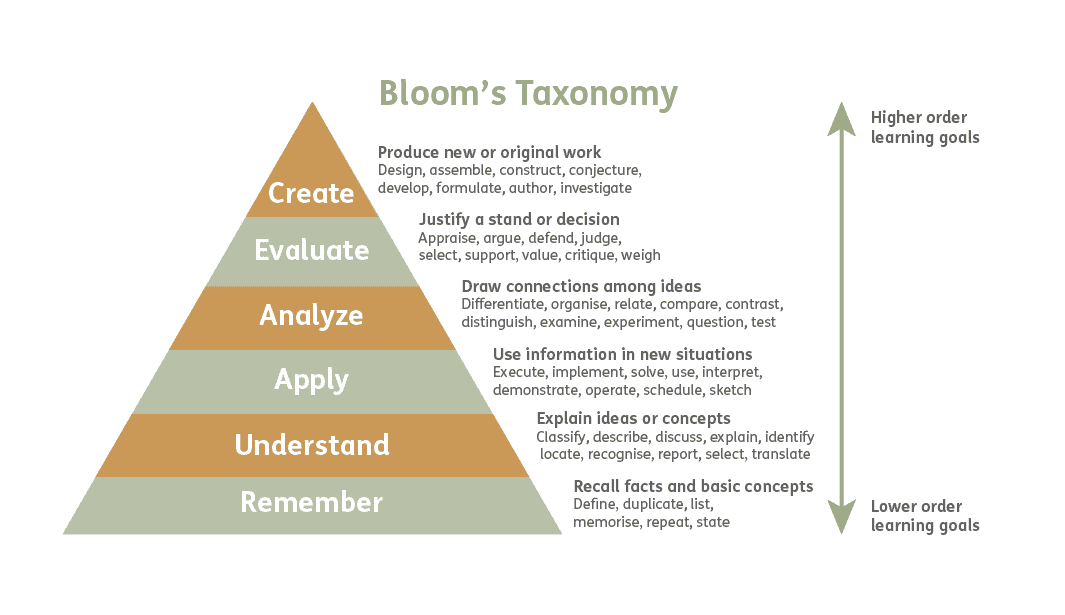
Figure 2
Source: https://cft.vanderbilt.edu/guides-sub-pages/blooms-taxonomy/
Lower order learning goals
Product information and clinical data can be remembered and understood (the first two goals in Bloom’s model) remotely using digital channels such as video or animation. The learner can learn at their own pace and in a location of their choice. They also have the chance to re-watch part or all of the content to check, recap or reinforce the information.
Higher order learning goals
Group face-to-face sessions with the trainer can focus on higher order learning goals such as applying, analysing, evaluating and creating. Interactive sessions often include games, role-plays, and group work activities, which may be verbal, visual, physical or completed using digital tools. During these tasks, the trainer facilitates, challenges and develops the learning taking place.
In line with our clients’ strategies we craft tasks that develop EI and support emotional selling to meet unique customer needs. This might be through analysis of customer profiles, evaluation of effective openings, active listening techniques, applying different sales styles and/or creating complete customised communication approaches that suit each customer.

Summary
When it comes to training in healthcare, EI and emotional selling are rising up the agenda and there are a number of tried and tested methods from the classroom to be explored. By combining EI and sound educational theory, we have an opportunity to explore new ways of connecting people, using methods that always put people first. After all, positive impact on patient’s lives is a primary goal for all sales calls.
Benefits of Blended Learning
Preparation
With materials being reviewed up front, learners are better prepared, and this preparation brings many of them to a similar level of knowledge and understanding before an active session takes place.
Flexibility
Blended learning environments are flexible allowing learners to self-pace and learn at times and in locations to suit their circumstances, using purposeful technology to enable this. This flexibility is particularly beneficial for sales teams who are typically spread nationally and internationally with a wide range of work experience.
Time efficiency
Blended learning makes the best use of the learner’s and the trainer’s time. Less time is spent talking or lecturing to a passive audience and more time is spent working interactively with the learners on practical applications and sales techniques.
Differentiation
With more time for discussion, questions and activity in the class, the trainer has more time to personalise the learning for individuals and groups making the learning more learner-centric.
Learning styles
As with any training or learning materials, it is vital to consider different learning styles to ensure the materials are accessible to all. The main learning styles are Kinaesthetic, Auditory or Visual. Across a blended learning journey, communications are produced across multiple media options ensures that all learning needs are met.

Get in touch to find out how we can work together on your training programmes
letstalk@cuttsyandcuttsy.com

Company Details

Latest Content from Cuttsy + Cuttsy
Cuttsy+Cuttsy achieves Platinum accreditation from Investors in People
Cuttsy+Cuttsy is proud to have achieved a Platinum accreditation from Investors in People, placing them among the top 2% of organisations assessed globally.
Cuttsy+Cuttsy awarded Gold EcoVadis sustainability rating
Cuttsy+Cuttsy proudly announces their Gold Medal achievement from EcoVadis for 2024, placing them among the top 5% of companies assessed and within the 97th percentile, a testament to their unwavering...
Age is not just a number when it comes to clinical trials
In this blog we look at the critical underrepresentation of older adults in clinical trials, emphasising the need for inclusive trial designs and targeted strategies to ensure safe and effective...
How to boost clinical trial access and make patients health-empowered
Clinical research is becoming more patient-centric, but there's still more that needs to be done to make clinical trials available to everyone. This could include wider participation.
Closing the loop: Why clinical trial results matter to participants
Discover why sharing clinical trial results with participants is crucial for respect, informed health decisions, and fostering strong researcher-participant partnerships.
Unveiling the truth: A journey into women’s representation in clinical trials
We explore the historical exclusion of women from clinical trials, its consequences on medical research and treatment efficacy and the ongoing efforts to ensure their representation.
Clarity in clinical trials
Discover how transparent, empathetic communication and health literacy principles can empower patients and enhance engagement in clinical trials, transforming participants into active partners in their healthcare journey.
Caring for patients’ mental health in clinical trials
We look at why ensuring continuous mental health support for patients in clinical trials is essential to enhance their overall well-being and trial engagement.
Driving equitable healthcare: The role of DE&I in clinical trials
Diversity, equity and inclusion (DE&I) is becoming a bigger topic of conversation and meaningful action within clinical trials. And for good reason, too. Find out why we embrace this and...
Empowering patients through more accessible clinical trial information
Senior Medical Writer, Scott Palmer explores the challenges and solutions in enhancing patient engagement in clinical trials, from the pivotal role of healthcare professionals, to the importance of user-friendly trial...