




Where it all began – why we developed The Experience Gap
June 1, 2026 | Participant engagement, clinical trials, communication
Learn how The Experience Gap was developed to help sponsors, CROs and site teams improve clinical trial participation by identifying friction points, enhancing patient experience, and driving better recruitment and retention outcomes.
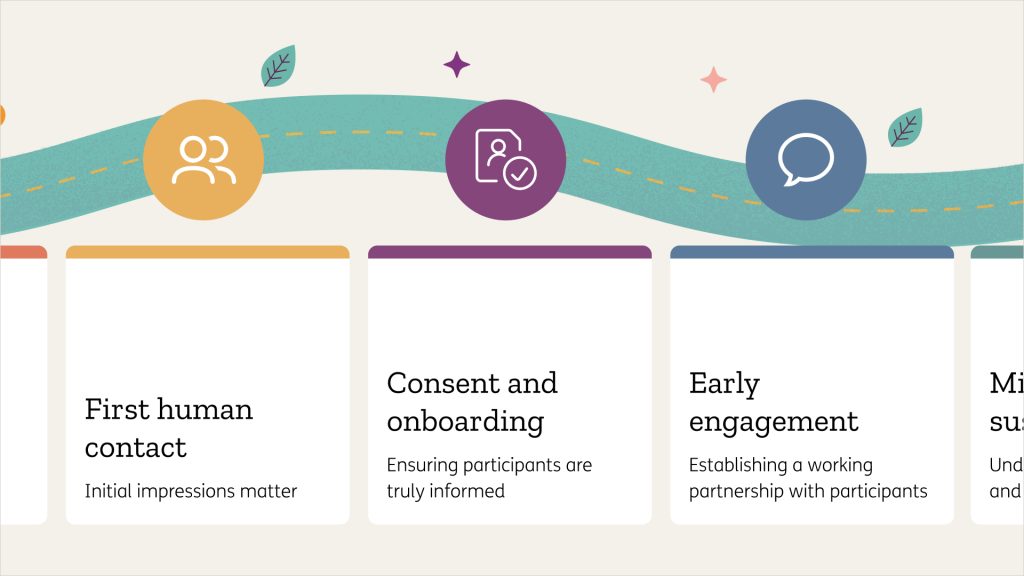
When we launched The Experience Gap, the response reflected something we hear time and again across the clinical trial community: everyone recognises participation challenges exist, yet turning that understanding into meaningful change remains a real challenge.
There is no shortage of insight. For years, sponsors, sites and patients have been pointing to the same pressures: recruitment is getting harder, retention is fragile, and site burden continues to intensify. Connecting all of these challenges is one defining factor: experience. Because when trial experiences feel fragmented, inconsistent or difficult, participation becomes harder to start – and even harder to sustain.
But insight alone does not drive progress. And that is exactly why we created The Experience Gap.
The foundations for this work began with The Participation Equation – a simple but important shift in perspective. Rather than viewing participation as a single decision point, we saw it as a system shaped by every interaction across the trial journey.
Because participation is influenced by far more than protocol design or recruitment drives. Communication, operational processes, emotional burden, trust and consistency all shape how people experience a trial. Every interaction matters.
That thinking became the lens through which we approached our later research.
Across our first two reports — including The Site Factor — recurring patterns began to emerge. Sponsors were investing heavily in engagement, yet sites were often carrying disproportionate operational and emotional pressure. Patients, meanwhile, were navigating fragmented journeys that rarely felt joined up. Intentions were good, of course, but lived reality frequently looked very different.
Most importantly, these were not isolated findings. The same tensions surfaced repeatedly across conversations, interviews and research. What became clear was that the challenge facing many trial teams was not a lack of awareness, but uncertainty around what to do next.
Teams increasingly recognise that experience matters, but many still struggle to operationalise it. Where should interventions happen? Which moments matter most? How do you prioritise change when resources, timelines and delivery pressures are already stretched?
That gap between understanding and action is what The Experience Gap was designed to address.
From the outset, the aim was to create more than a research report. We wanted to build a practical roadmap that could help teams identify participation friction, prioritise improvements and make more confident decisions across the trial journey.
The roadmap is grounded in lived experience and informed by the realities faced by patients, sites and sponsors alike. It is designed to support practical decision-making, while remaining flexible enough to work across different trial types, phases and operational models.
For us, this is where experience work becomes genuinely valuable – when it informs real-world decisions rather than sitting passively as insight alone.
Closing the experience gap requires more than isolated fixes. Participation is shaped across an interconnected ecosystem of patients, sites and sponsors – which means improving outcomes depends on understanding how experiences connect across the entire trial journey.
That is exactly what The Experience Gap was built to support.
Clinical trials are growing more complex. Competition for both patients and sites continues to intensify, while expectations around support, communication and accessibility are rising fast. Experience is no longer a secondary consideration – it is increasingly becoming a defining factor in whether trials succeed.
But improving experience takes more than isolated initiatives or good intentions alone. It requires clear direction, practical frameworks and the ability to translate insight into meaningful action.
That is ultimately why we created The Experience Gap. Not to add more noise to the conversation, but to help teams navigate it more clearly, and to provide a practical starting point for designing better participation experiences across the clinical trial journey.
Explore The Experience Gap roadmap and discover how insight can be turned into action across every stage of participation.
This content was provided by Cuttsy + Cuttsy
Company Details

Latest Content from Cuttsy + Cuttsy
Patient engagement changes people’s lives…
Find out how one family’s experience of CF led to the development of a game which made essential physio a positive experience for everyone involved.
Health literacy… it’s not just plain English
In this day and age, you would think that clear communication would be second nature to us all, but this is not so. In our digital world misunderstanding and confusion…
Health Literacy Explained
Hear from Dr Elizabeth Walder, author of a series of patient-focused e-books in plain english and why health literacy is so important.
So how do you really engage with patients?
The most valuable insights from patient engagement are the most unexpected ones. Simple things, which may seem unimportant to you, may be the key to making patients’ lives easier and…