




Why pharma website projects stall long before compliance becomes the problem
April 16, 2026 | ABPI, Digital, Marketing, Website, compliance, governance, pharma website
Pharma teams often blame compliance when digital projects slow down. In reality, the bigger issue is usually weaker ownership, unclear review models and content structures that were never designed for governed change.
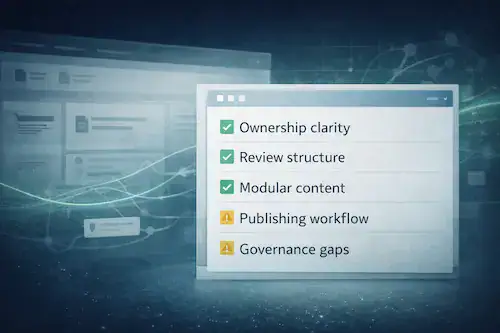
When a pharma website project starts to drift, the explanation usually comes quickly.
Compliance is slowing things down.
Medical, legal and regulatory review is taking too long.
The process is simply more complex in a regulated environment.
That story sounds plausible, which is one reason it survives. It also lets everyone off the hook a little too easily.
Compliance is real. It matters. It should shape how websites, content and digital journeys are planned. But in many teams, compliance is not the root cause of delay. It is simply the point where deeper operational weaknesses become impossible to ignore.
By the time review feels painful, the real problems have often been in place for weeks or months.
- The brief was vague.
- Ownership was never properly assigned.
- Too many stakeholders were invited in without clear decision rights.
- The website structure made routine changes harder than they should be.
- Different teams were working from different versions of the same content.
That is not really a compliance problem. It is a governance problem.
Why compliance gets the blame
Compliance is visible. Governance usually is not.
Medical, legal and regulatory review tends to happen at a formal stage in the process. It is documented, time-bound and easy to point to. Governance issues are more diffuse. They show up as hesitation, duplication, rework, conflicting feedback and serial rounds of review that nobody has properly designed.
So teams say the project is delayed because of compliance, when the more honest answer is that the work was not structured well enough to move efficiently under scrutiny.
That distinction matters. Once an organisation starts treating delay as the unavoidable price of regulation, it stops fixing the things that are actually within its control.
The governance issues that slow projects down
In practice, the same patterns appear again and again.
A website project stalls when there is no single accountable owner with the authority to resolve competing views.
It stalls when every stakeholder is treated as though they have veto rights.
It stalls when teams do not distinguish properly between higher-risk content and routine content, so everything gets pushed through the same heavy process.
It stalls when comments are gathered across multiple documents, email chains and review rounds, with no clear source of truth.
It stalls when content is built page by page in large blocks rather than as structured, reusable components.
And it stalls when launch planning gets all the attention, but nobody has thought hard enough about how the site will be updated afterwards.
These are operational choices. They may be understandable, but they are still choices.
Why content structure matters more than teams think
One of the biggest mistakes in regulated digital delivery is treating governance as a people problem only.
It is also a structure problem.
If the website has not been designed for controlled change, review will always feel heavier than it needs to be. That is especially true when prescribing information, safety language, claims or other regulated statements are repeated manually across multiple pages. One change then triggers unnecessary rechecking and unnecessary risk.
This is where modular content becomes commercially useful, not just theoretically attractive.
Used properly, modular content allows teams to manage smaller approved components instead of rewriting and reassessing full pages every time something changes. The benefit is not just efficiency. It is better control, better consistency and a clearer route through review.
The same applies to publishing workflow. Not every site needs to wait for every page to be signed off before anything goes live. In some cases, a clearer governance model allows approved sections to be published in stages, reducing the bottleneck created by unrelated pages that are still in review.
Better governance is not more process
Good governance is not about adding more layers, more meetings or more sign-off theatre.
It is about adding more clarity.
That usually means one accountable platform owner. Clearer decision rights across digital, brand, medical, legal and regulatory teams. A more explicit risk-based review model. Structured content and stronger template logic. A single source of truth for approved content. And a post-launch governance model, not just a launch sign-off plan.
The teams that move more effectively in regulated environments are not bypassing compliance. They are making compliant delivery easier to manage.
That is a very different mindset.
Why this is a commercial issue, not just a delivery issue
When governance is weak, the consequences do not stay inside the project team.
- Launches drift.
- Campaign activity gets delayed.
- Budget gets eaten by avoidable rework.
- Teams become cautious about future changes because every update feels too hard to push through.
- The website stays static for longer than it should, even when the business around it is changing.
That is why this matters commercially.
For many pharma teams, the website is not just a communications asset. It is part of product visibility, corporate credibility, stakeholder engagement and ongoing content operations. If the governance model behind it is weak, the organisation pays for that repeatedly.
There is also a strategic cost. Once delay becomes normalised, ambition tends to fall with it. Teams stop asking how to improve the way digital work is governed and start focusing only on how to survive the next review cycle.
That is not a sign of a well-run regulated content operation. It is a sign that the model around the work needs attention.
A better question to ask
So when the next website project begins to slow down, the useful question is probably not, why is compliance taking so long?
It is this:
Have we built a governance model and content structure that make compliant delivery workable?
That tends to be a much more revealing conversation.
Website Governance Checklist
For teams that want a quick sense-check, we have created a free Pharma Website Governance Checklist. It is designed to help regulated teams assess whether the real bottleneck sits in compliance, governance, structure or workflow.
This content was provided by Genetic Digital
Company Details

Latest Content from Genetic Digital
New benchmark reveals significant digital maturity gap across UK POM companies’ product-information estates
A new benchmark maps 100 UK prescription medicine companies across five maturity bands and finds a market at very different stages of digital development
Why pharma website projects stall long before compliance becomes the problem
Pharma teams often blame compliance when digital projects slow down. In reality, the bigger issue is usually weaker ownership, unclear review models and content structures that were never designed for…
EpilepsyMeds receives Highly Commended recognition at Excellence in Healthcare Partnership Awards 2026
EpilepsyMeds received Highly Commended recognition at the Excellence in Healthcare Partnership Awards 2026, celebrating the collaboration between Desitin Pharma, ChangeMed and Genetic Digital in advancing epilepsy care.
Genetic Digital Wins Silver at PM Society Digital Awards for Epilepsy Meds Clinical Support App
Genetic Digital wins Silver at the PM Society Digital Awards for Epilepsy Meds, a clinical support app developed with Desitin and ChangeMed to aid patient-specific prescribing in epilepsy care.
Genetic Digital Shortlisted for PM Society Digital Award for Epilepsy Meds App
Genetic Digital has been shortlisted for a PM Society Digital Award for Epilepsy Meds, a mobile-first app that helps healthcare professionals make safer, patient-specific prescribing decisions in epilepsy care. The…
Smarter, Compliant Engagement: Why Pharma is Warming Up to Chat-Based Solutions
Pharma marketers are embracing chat-based tools to engage HCPs and patients faster, simplify PI sharing, and gain real-time insights — all while staying ABPI and GDPR compliant. When aligned with…
Why Pharma’s Digital PI Compliance Problem Needs a Cross-Functional Fix
In many pharma teams, the responsibility for keeping prescribing information (PI) up to date online falls into a grey area. > Regulatory signs it off. > Marketing publishes it. >…
Web Design Strategies for Pharma & Life Sciences in 2025
As we approach 2025, healthcare and life sciences SMEs face an increasingly digital world. A seamless, mobile-friendly website that harnesses AI-driven personalisation and intuitive design elements isn’t just a luxury…
Leveraging the ABPI QR Code Update: Enhancing Prescribing Information Through Best Practices
ABPI’s recent update permits QR codes in printed pharmaceutical materials for prescribing information. By ensuring visibility, providing clear instructions, linking directly, and keeping content current, companies can enhance accessibility, ensure…
Pi 360 – A Smarter, Automated Solution for Digital Prescribing Information (PI) & QR Code Compliance
Life sciences digital agency Genetic Digital has launched Pi 360, a cutting-edge web application designed to help pharmaceutical companies automate the creation, management and distribution of Prescribing Information (PI) while…
- 1
- 2