



Ensuring a seamless transition from design to development: Strategies for successful collaboration
March 12, 2024 | Development, Digital pharma, UX and UI design
When designing digital products and services, the process of transitioning from design to development plays a critical role in bringing concepts to life.
Our Design Lead, Edward Hart, explains why this process is so important, and the strategies you can put in place to ensure it runs smoothly.
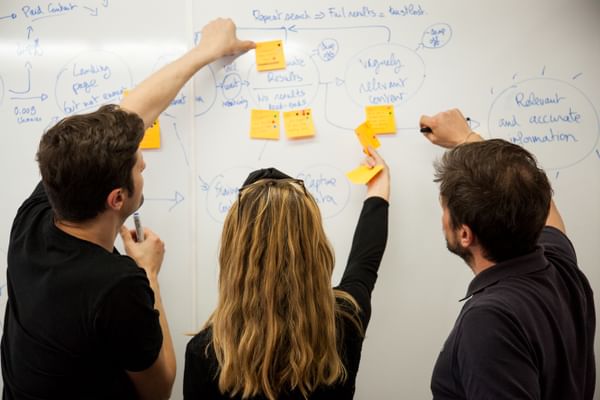
In the world of digital pharma products, where innovation and precision are paramount, the process of transitioning from design to development plays a critical role in bringing concepts to life.
As a specialist design agency partnering with pharmaceutical and healthcare clients, we understand the concerns that can arise during this transition phase. Our experience has allowed us to establish a robust set of strategies to ensure a seamless collaboration with development teams, enabling us to effectively guide the translation of designs into functional products.
This article explores the importance of collaboration, identifies common challenges, and outlines strategies that have proven pivotal to our success.
Importance of collaboration between design and development teams
Designers conceptualise user experiences, while development teams transform these concepts into functional realities. When creating digital products and services in pharma and healthcare, close collaboration and a strong partnership between design and development teams is crucial. These are 3 reasons why:
- Harmonising creativity and feasibility: Collaboration bridges the gap between imaginative design and practical execution. By uniting design insights with technical expertise, we ensure that innovative concepts come to life in ways that are both creative and achievable.
- Early problem solving: Collaborating early highlights potential obstacles. Gaining developers’ insights into technical feasibility allows for swift adjustments to product designs, preventing issues from escalating and saving valuable time and resources.
Holistic user-centric approach: Joint efforts create a holistic approach to user-centric design. Developers, attuned to technical intricacies, contribute to an experience that not only looks great but also functions seamlessly, enhancing user experiences.
Common challenges in the transition process
The design-to-development transition presents certain common challenges that require strategic planning in order to avoid.
-
Misalignment and ambiguity: Divergent interpretations of design intent can lead to misalignment and confusion. Ambiguity around design elements compounds these issues.
-
Balancing creativity and constraints: Bridging the gap between design vision and technical reality requires careful balance to ensure that innovation isn’t compromised by constraints.
-
Communication breakdown: Transparent communication is vital. A lack thereof can lead to misunderstandings and rework, hampering progress.
-
Scope and feature creep: Undefined scopes or added features disrupt the transition. Maintaining a clear scope and avoiding feature creep is crucial.
Navigating the transition successfully
Recognising the role of collaboration and being aware of potential challenges sets the stage for a productive partnership between design teams and technical development teams. By actively addressing these challenges and implementing strategies that foster effective communication, clarify design, and leverage cross-functional expertise, we can ensure the seamless transformation of visionary designs into impactful pharmaceutical products.These are 3 strategies for mitigating challenges and ensuring a seamless transition:
Documentation
Communication
Feedback loops and iteration
Feedback loops within the design-to-development process establish an iterative cycle of improvement. Development teams can provide insights into the feasibility of design elements, while designers can contribute solutions to technical challenges. This iterative approach ensures that design refinements are guided by real-world technical considerations.
The benefits of a smooth transition
A successful transition from design to development offers a range of benefits that extend beyond process efficiency:
- Enhanced quality: Clear communication and thorough documentation will lead to a more accurate translation of design into the final product, resulting in high quality digital products and services that meet the need and expectations of both your product stakeholders, and your customers.
- Accelerated time-to-market: Minimised misunderstandings and need for design revisions expedite the product development timeline, enabling faster product launches.
- Optimised user experience: When designs seamlessly translate into functional applications, the intended user experience is preserved, resulting in higher user satisfaction. When you’ve invested in early-stage user research and testing to inform your digital designs, this is particularly important.
Cost efficiency: Efficient collaboration and reduced revisions lead to streamlined resource utilisation and cost savings. With technical development usually the most costly phase in a digital product build, it’s important to get it right first time and ensure the process runs smoothly.
Accelerate launch timelines and ensure quality
This content was provided by Graphite Digital
Company Details

Latest Content from Graphite Digital
How to successfully manage change and enable digital transformation within pharma
Change is an essential aspect of any business, and learning to manage it effectively will be key for long-term success. Getting your team on board with change and digital transformation...
How Design Systems enable streamlined regulatory approval in digital pharma
The strict compliance guidelines that exist within pharma can mean that digital content and platforms can take a long time to be approved and involve lots of back and forth...
Ensuring a seamless transition from design to development: Strategies for successful collaboration
When designing digital products and services, the process of transitioning from design to development plays a critical role in bringing concepts to life. Our Design Lead, Edward Hart, explains why...
Is your pharma brand site meeting HCP expectations? Our checklist of common mistakes
Here’s 8 things you can check your brand site for today to ensure it’s delivering, and engaging HCPs.
How user research will help you create better digital products, whatever stage you’re at
User research provides valuable insight that will help you create better digital products and services, whatever stage you’re at.
Advancing digital engagement in pharma and healthcare: 2024 focus areas
6 areas for pharma and healthcare organisations to focus efforts in 2024 to drive better digital engagement amongst patients, HCPs and other users
Building trust with HCPs: 6 takeaways from our industry webinar
Key takeaways from the perspectives of industry experts across medical, commercial and digital on the issue of trust in pharma and how this impacts HCP engagement.
Is trust the key factor in digital HCP engagement? New whitepaper from Graphite Digital
Based on research with HCPs in the UK, USA and France, Graphite Digital’s latest whitepaper sheds light on HCP perceptions of pharma-owned digital channels, and what organisations should be prioritising...
What are design systems and how can they help you elevate your digital products?
Design Systems aren’t new, but the potential to utilise them to improve the way in which teams produce digital products is still untapped for many in the pharmaceutical and healthcare...
The impact of mindset on digital product success: Download our new whitepaper
Six months on from releasing our research report, we reflect on the themes raised and offer practical advice on how contradictions can be overcome to enable digital success in pharma...