




Ensuring a seamless transition from design to development: Strategies for successful collaboration
March 12, 2024 | Development, Digital pharma, UX and UI design
When designing digital products and services, the process of transitioning from design to development plays a critical role in bringing concepts to life.
Our Design Lead, Edward Hart, explains why this process is so important, and the strategies you can put in place to ensure it runs smoothly.
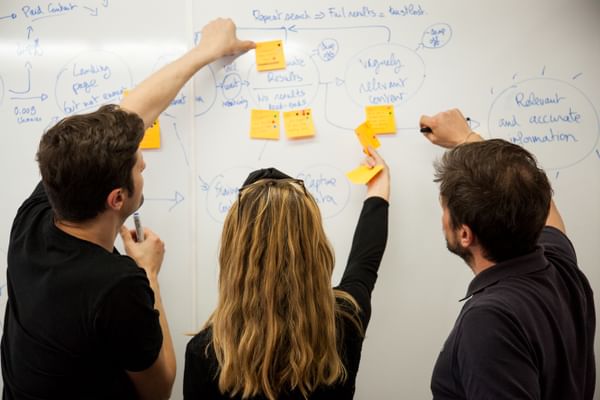
In the world of digital pharma products, where innovation and precision are paramount, the process of transitioning from design to development plays a critical role in bringing concepts to life.
As a specialist design agency partnering with pharmaceutical and healthcare clients, we understand the concerns that can arise during this transition phase. Our experience has allowed us to establish a robust set of strategies to ensure a seamless collaboration with development teams, enabling us to effectively guide the translation of designs into functional products.
This article explores the importance of collaboration, identifies common challenges, and outlines strategies that have proven pivotal to our success.
Importance of collaboration between design and development teams
Designers conceptualise user experiences, while development teams transform these concepts into functional realities. When creating digital products and services in pharma and healthcare, close collaboration and a strong partnership between design and development teams is crucial. These are 3 reasons why:
- Harmonising creativity and feasibility: Collaboration bridges the gap between imaginative design and practical execution. By uniting design insights with technical expertise, we ensure that innovative concepts come to life in ways that are both creative and achievable.
- Early problem solving: Collaborating early highlights potential obstacles. Gaining developers’ insights into technical feasibility allows for swift adjustments to product designs, preventing issues from escalating and saving valuable time and resources.
Holistic user-centric approach: Joint efforts create a holistic approach to user-centric design. Developers, attuned to technical intricacies, contribute to an experience that not only looks great but also functions seamlessly, enhancing user experiences.
Common challenges in the transition process
The design-to-development transition presents certain common challenges that require strategic planning in order to avoid.
-
Misalignment and ambiguity: Divergent interpretations of design intent can lead to misalignment and confusion. Ambiguity around design elements compounds these issues.
-
Balancing creativity and constraints: Bridging the gap between design vision and technical reality requires careful balance to ensure that innovation isn’t compromised by constraints.
-
Communication breakdown: Transparent communication is vital. A lack thereof can lead to misunderstandings and rework, hampering progress.
-
Scope and feature creep: Undefined scopes or added features disrupt the transition. Maintaining a clear scope and avoiding feature creep is crucial.
Navigating the transition successfully
Recognising the role of collaboration and being aware of potential challenges sets the stage for a productive partnership between design teams and technical development teams. By actively addressing these challenges and implementing strategies that foster effective communication, clarify design, and leverage cross-functional expertise, we can ensure the seamless transformation of visionary designs into impactful pharmaceutical products.These are 3 strategies for mitigating challenges and ensuring a seamless transition:
Documentation
Communication
Feedback loops and iteration
Feedback loops within the design-to-development process establish an iterative cycle of improvement. Development teams can provide insights into the feasibility of design elements, while designers can contribute solutions to technical challenges. This iterative approach ensures that design refinements are guided by real-world technical considerations.
The benefits of a smooth transition
A successful transition from design to development offers a range of benefits that extend beyond process efficiency:
- Enhanced quality: Clear communication and thorough documentation will lead to a more accurate translation of design into the final product, resulting in high quality digital products and services that meet the need and expectations of both your product stakeholders, and your customers.
- Accelerated time-to-market: Minimised misunderstandings and need for design revisions expedite the product development timeline, enabling faster product launches.
- Optimised user experience: When designs seamlessly translate into functional applications, the intended user experience is preserved, resulting in higher user satisfaction. When you’ve invested in early-stage user research and testing to inform your digital designs, this is particularly important.
Cost efficiency: Efficient collaboration and reduced revisions lead to streamlined resource utilisation and cost savings. With technical development usually the most costly phase in a digital product build, it’s important to get it right first time and ensure the process runs smoothly.
Accelerate launch timelines and ensure quality
This content was provided by Graphite Digital
Company Details

Latest Content from Graphite Digital
What do HCPs want from pharma medical information sites in 2026?
At Graphite, we regularly carry out first-hand research with healthcare professionals (HCPs) to understand how they interact with digital experiences in practice. When you combine those conversations with wider sector…
Bridging the value gap: The systems, teams and mindsets that matter
In pharma, the challenge is no longer understanding what HCPs want from digital. It’s delivering it consistently. In this webinar, we explored what needs to change inside organisations to make…
Webinar: What do HCPs really want from pharma digital in 2026?
Our research shows that healthcare professionals are not disengaging from pharma digital. They are becoming more selective about the experiences that earn their attention. To explore what this means for…
The strategic role of AI in scaling Design Systems across channels
How can pharma teams scale AI safely across channels? In this session, Ed Hart and Nicolas Barcza explore why strong Design Systems are the foundation for making AI operational, compliant…
What HCPs want from digital pharma in 2026: The value gap
We’re proud to share Graphite’s 2026 research report. An in-depth look at how healthcare professionals experience digital engagement with life sciences today, and where the value gap is widening.
First impressions matter: Why getting your onboarding right is key for digital engagement
As pharma organisations invest extensively in creating engaging content, the onboarding process must not be overlooked. Seamless onboarding is the key to ensuring that HCPs not only meet regulatory standards,…
Pharma’s digital dilemma: Finding the balance between speed, scale, and experience
What’s holding pharma back from true digital transformation? At NEXT Pharma 2025, Our CEO Rob Verheul and Roeland van der Heiden (AstraZeneca) argued it starts with design systems. This quick…
Redefining digital ROI: Engagement, experience, and the new metrics of success
Clicks and engagement only tell part of the story. In this webinar, pharma leaders discuss how to move beyond traditional KPIs to measure real impact and ROI from digital and…
5 key digital CX challenges in pharma, and how to start solving them
Creating great digital experiences in pharma isn’t easy, but progress doesn’t always need to come from big projects or budgets. Here are 5 common challenges that leading digital teams are…
The digital reality check: How pharma measures up in 2025
Download your copy of our latest pharma white paper, exploring the latest digital trends, challenges and opportunities in pharma.