



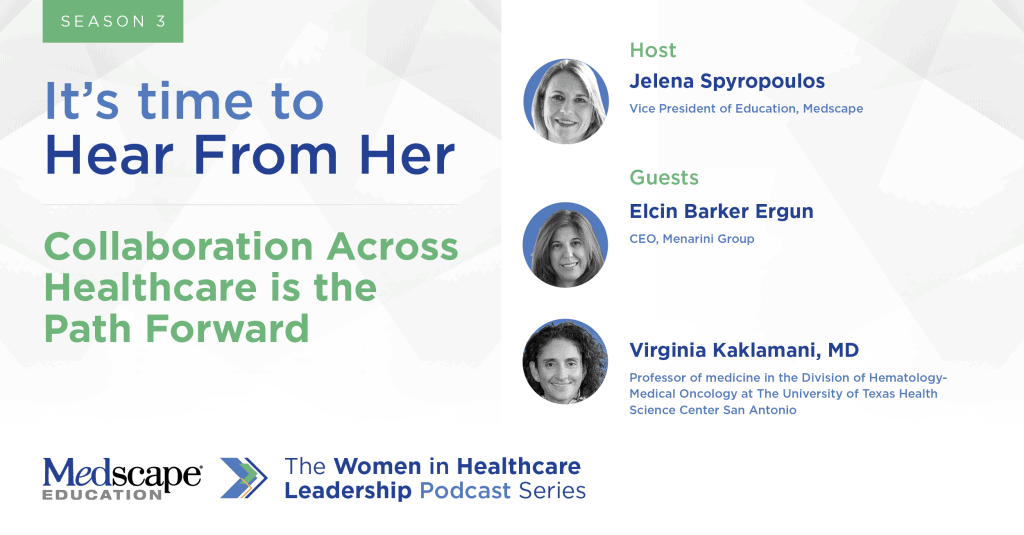
Collaboration Across Healthcare is the Path Forward
April 8, 2025 | Hear from her, Women in Leadership, podcast
How do we impress upon women that they need to prioritize their own health before providing for the people who need them? A leader in medical oncology has a few thoughts.
It’s no secret that women around the world face inequities when it comes to healthcare—be it access, quality, or outcomes of care. (If you’ve listened to previous episodes of this podcast, you’ll know that most of our esteemed guests, leaders throughout the healthcare ecosystem, have been shouting it from the rooftops.)
From gender bias in diagnosis and treatment, to gaps in research and barriers to affordability, the bottom line is, the healthcare system often falls short in meeting women’s needs.
Barriers also exist for many women who pursue a career in healthcare, and specifically oncology.
Listen to Episode 3 of Season 3 here.
Some are because life happens, says Virginia Kaklamani, MD, professor of medicine in the Division of Hematology-Medical Oncology at The University of Texas Health Science Center San Antonio, and leader of the breast cancer program at the Mays Cancer Center, home to UT Health San Antonio MD Anderson Cancer Center.
“Women have a family, have children, they take maternity leave. And they tend to have more of the burden of care for their family than their partners do—which is really an issue when you’re also trying to prioritize your job,” she says. “Women end up sometimes doing more for our family or doing more for our career,” and we always feel like we’re neglecting someone or something. “We always feel we have to make a choice. And it would be nice if we didn’t have that.”
Elcin Barker Ergun, CEO of Menarini Group, the largest pharmaceutical company in Italy, agrees that unfortunately it creates a bias against women, especially in fields like engineering (for which she holds a BSc ), science, and research. “Medicine is honestly a little bit better I think,” she says. “When you look at R and D leadership in our industry, for instance, it was generally a male role for a long time. Now we see women, but still not at the level we would want. In our company, 50% of the R and D C-suite are woman… but probably because I’m a woman, and I don’t have any bias!”
Listen to Episode 3 of Season 3 here.
Which of course is a case in point for getting more women into leadership positions throughout the entire healthcare ecosphere.
Kaklamani, though, believes we shouldn’t turn the battle for equity into a war between the sexes. “My mom (also a physician) said, ‘Men and women are not equal. They are equivalent,’” she says. “It’s not men’s fault if women don’t negotiate as well around salaries or promotions, or expect that someone else will think of her, whereas a man will ask.
“If men see us as adversaries and if we see men as adversaries, we’re not going to achieve anything,” she says. “It’s completely OK to say that women and men are not the same. If we recognize our strengths and our weaknesses, then together we’re stronger than we are separate. There’s no way women can get ahead if the men don’t buy into that process. We need to come together to be able to create a better society, be successful in our careers… and ultimately to cure cancer.”
So what can we do to improve health equity right now? Both say that we need all the stakeholders in healthcare—clinicians, advocacy groups, pharma companies—to collaborate with each other in the right way, to create awareness about the problems of access, of education, and to make sure that as many patients as possible can get their treatments and can have better, longer lives.
Listen to Episode 3 of Season 3 here.
Hosted by Jelena Spyropoulos, Vice President at Medscape Education
Follow us on LinkedIn for updates on upcoming podcasts and more insightful conversations. For more information, please contact Jelena Spyropoulos.
Catch up on Season 1 and Season 2 on:
Apple
Spotify
Medscape
About Medscape Education
Medscape Education (medscape.org) is the leading destination for continuous professional development, consisting of more than 30 specialty-focused destinations offering thousands of free accredited CME and CE courses for physicians, nurses, and other healthcare professionals.
This content was provided by Medscape Education
Company Details

Latest Content from Medscape Education
The Power of Patient Insights to Improve Cancer Care
Two global patient advocacy groups—The Lymphoma Coalition and Lung Cancer Europe— are compiling data from their communities on the real-world experience of living with cancer. What the data reveals sometimes...
Medscape Education Continues Its Patient-Centric Mission at EHA 2024
Anticipation is building at Medscape Education as the team prepares for the EHA 2024 Congress. Medscape Education is excited to announce a significant presence during the congress including a Medscape...
Getting in-sync with Public Health at SYNC 2024
Medscape Education is bringing its public health efforts to Washington, DC for the SYNC conference on HIV, HCV, STIs, Harm Reduction, and LGBTQ health. During the conference, Lindsey will present...
Medscape Education and KDIGO Nephrology Collaboration Accelerates Improvements to Patient Care
Ahead of the 61st European Renal Association (ERA) Congress, Medscape Education and KDIGO (Kidney Disease: Improving Global Outcomes) announce an educational collaboration through a series of webinars to improve anemia-related...
Medscape Brings Impact and Data to ESPGHAN
The ESPGHAN Congress in Milan was full of impact as Medscape Education Global presented 5 scientific posters examining the outcomes of their education. The posters detailed the impact Medscape Education...
Empowering Nurses Through Education
Nurse education is powerful and makes an impact.
Pioneering Paths: Women Leadership in Rare Disease
Rare diseases are often thought of as affecting one in 100,000 or one in 1,000,000 people, and that is true for some conditions. But there are many rare diseases that...
TRANSFORMING CME IMPACT: MEDSCAPE’S GAME-CHANGING APPROACH
It’s time for the CME industry to evolve. During recent years, access to data, modern technologies, and methodologies have allowed for deeper analysis of data and a better understanding of...
Why Women in Medicine Should Embrace Social Media
Of course social media has its downside. But online platforms are a powerful tool for women in medicine in terms of forming communities, fighting misinformation, amplifying one another, and galvanizing...
Exceptional Impact Presented at ECCMID 2024
The ECCMID conference in Barcelona, Spain marked the start of Medscape’s publication season in Europe. With three posters being presented at the conference, Medscape shared highlights from the powerful impact...