




Moving Beyond the 10%: A New Era in Preterm Birth Prevention
July 1, 2026 | #HearFromHer #PretermBirth
For decades, the rate of spontaneous preterm birth in the United States has hovered stubbornly around 10%. Despite advancements in other areas of medicine, prematurity remains the second leading cause of death for neonates, carrying a heavy toll of lifelong health complications, developmental disabilities, and a staggering $25 billion annual cost to the healthcare system.
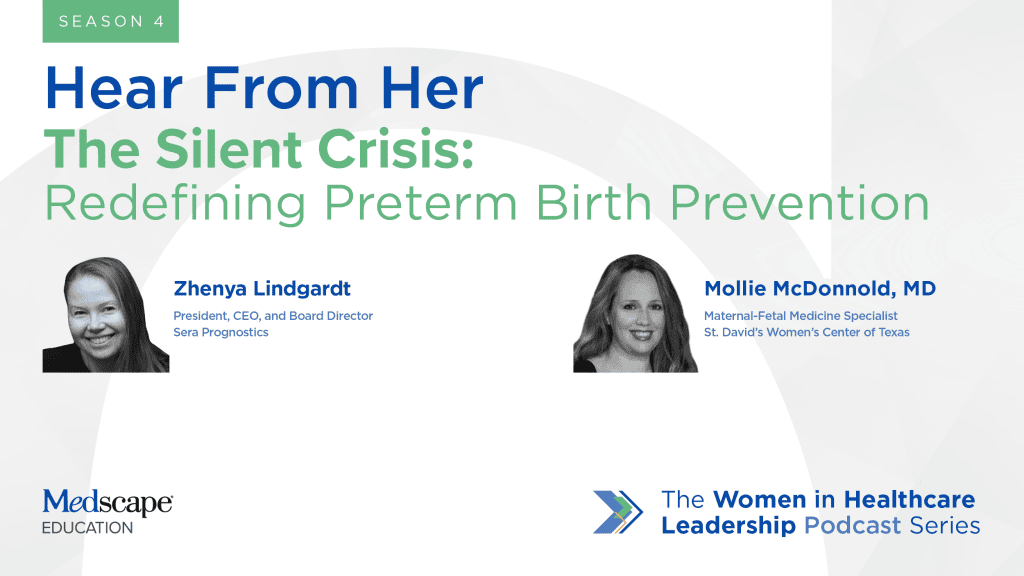
Listen to the full episode here.
As discussed in the latest Hear From Her podcast, the challenge has always been prediction. “Prior to this, we had very few tools to help predict who is at risk,” explains Dr. Mollie McDonnold, a Maternal-Fetal Medicine specialist. Traditionally, doctors relied on a patient’s history of previous preterm births, but the majority of cases occur in women with no prior history.
The Biomarker Breakthrough
The conversation highlights a shift toward personalized medicine through the use of biomarkers. By analyzing proteins from the placenta via a simple blood draw early in pregnancy, clinicians can now identify high-risk patients with much greater sensitivity than traditional methods.
Listen to the full episode here.
The Power of the “Bundle”
Identification is only half the battle; prevention is the goal. Zhenya Lindgardt, CEO of Sera Prognostics, shares results from the “Prime Study,” which utilized a protocol designed with the Society for Maternal-Fetal Medicine. When high-risk women were treated with a “preventive bundle”—consisting of low-dose aspirin, vaginal progesterone, and weekly nurse check-ins—the results were “spectacular”:
- A 20% reduction in severe neonatal morbidity.
- A 52% reduction in births before 32 weeks.
- One out of five babies avoided the NICU entirely.
Listen to the full episode here.
A Tailored Future
The future of maternal health lies in moving away from a “one size fits all” approach. By stratifying care, healthcare providers can funnel intensive resources—like cervical length monitoring and specialized nurse support—to those who need it most, while providing peace of mind to those at low risk. As Lindgardt notes, the goal is to ensure every pregnancy receives the specific level of care it requires to thrive.
This content was provided by Medscape Education
Company Details

Latest Content from Medscape Education
New Outcomes Are a Breath of Fresh Air at ERS
ERS 2023 will mark the new release of outcomes data by Medscape Education Global. During the poster hall sessions on September 12, the Medscape team will present a poster that…
Medscape Education Launches 20th Older Driver Safety Educational Program
Education Supported by the National Highway Traffic Safety Administration
Protecting the Heart Through Education at ESC 2023
Medscape Education Global is joining cardiology professionals from across Europe for ESC 2023 in Amsterdam. This year’s congress theme is “Joining Forces to Protect the Heart,” and Medscape will be…
Medscape’s Rare Disease Learning Center Has Reached 1 Million Learners
The Pathways in Rare Disease Learning Center celebrates a momentous achievement – engaging one million learners in its educational initiatives. This milestone signifies a profound impact on clinician confidence in…
Continuing Medical Education Outcomes are Much More Than Statistical Significance
At Medscape Education, we hold ourselves to the highest standards when it comes to analysing our programs. Our approach is unparalleled, employing a precise paired method that ensures we measure the…
The Most Important Person in the Room—A Look at Patient -Centricity at EHA
Across all of healthcare, a greater focus is being placed on patient centricity in order to improve outcomes and enhance patients’ quality of life. Although patient centricity is necessary in…
Innovation in Education Leads to Positive Outcomes at EAN 2023
The Medscape team recently returned from the 9th Annual Congress of the European Academy of Neurology (EAN) in Budapest, Hungary. Among the various highlights of the congress, the team showcased…
The Lasting Impact of Cytomegalovirus Education
Education on the signs, symptoms, and potential complications of cytomegalovirus (CMV) is in need of constant development, as this common disease affects nearly 1 in 3 children by age 5…
Medscape Education Publishes the Results of Multinational, Multispecialty Survey of Physicians on Rare Disease Educational Needs
Medscape Education has published the results of a global survey of its kind, assessing the educational needs of physicians on rare diseases. This survey of 978 clinicians worldwide across 16…
Medscape Showcases Outcomes in Austria for EASL Congress
Medscape recently attended the EASL Congress in Austria, where they successfully showcased the outcomes of their Wilson Disease education program. One of their achievements was presenting a poster on “Online…