




Moving Beyond the 10%: A New Era in Preterm Birth Prevention
July 1, 2026 | #HearFromHer #PretermBirth
For decades, the rate of spontaneous preterm birth in the United States has hovered stubbornly around 10%. Despite advancements in other areas of medicine, prematurity remains the second leading cause of death for neonates, carrying a heavy toll of lifelong health complications, developmental disabilities, and a staggering $25 billion annual cost to the healthcare system.
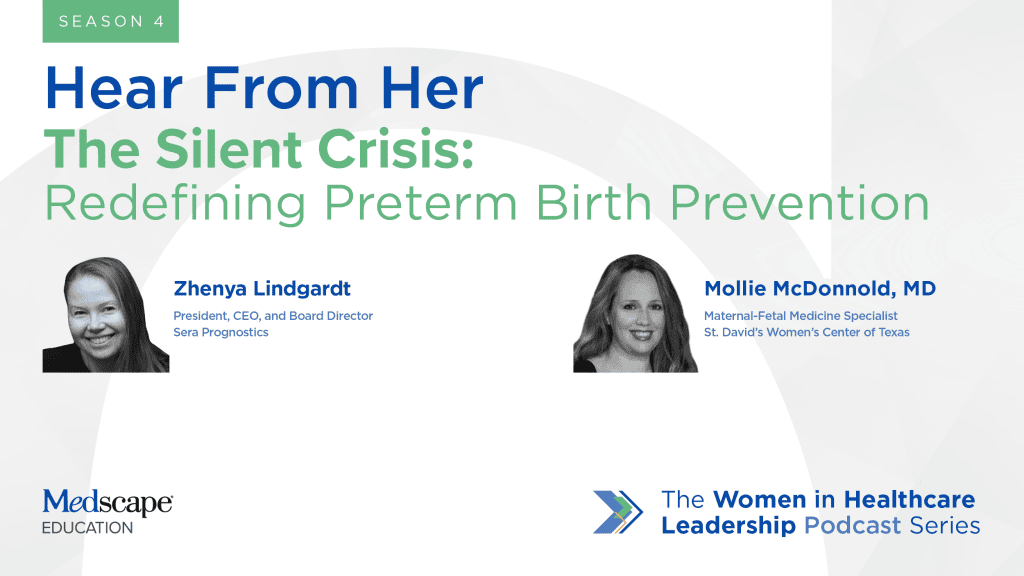
Listen to the full episode here.
As discussed in the latest Hear From Her podcast, the challenge has always been prediction. “Prior to this, we had very few tools to help predict who is at risk,” explains Dr. Mollie McDonnold, a Maternal-Fetal Medicine specialist. Traditionally, doctors relied on a patient’s history of previous preterm births, but the majority of cases occur in women with no prior history.
The Biomarker Breakthrough
The conversation highlights a shift toward personalized medicine through the use of biomarkers. By analyzing proteins from the placenta via a simple blood draw early in pregnancy, clinicians can now identify high-risk patients with much greater sensitivity than traditional methods.
Listen to the full episode here.
The Power of the “Bundle”
Identification is only half the battle; prevention is the goal. Zhenya Lindgardt, CEO of Sera Prognostics, shares results from the “Prime Study,” which utilized a protocol designed with the Society for Maternal-Fetal Medicine. When high-risk women were treated with a “preventive bundle”—consisting of low-dose aspirin, vaginal progesterone, and weekly nurse check-ins—the results were “spectacular”:
- A 20% reduction in severe neonatal morbidity.
- A 52% reduction in births before 32 weeks.
- One out of five babies avoided the NICU entirely.
Listen to the full episode here.
A Tailored Future
The future of maternal health lies in moving away from a “one size fits all” approach. By stratifying care, healthcare providers can funnel intensive resources—like cervical length monitoring and specialized nurse support—to those who need it most, while providing peace of mind to those at low risk. As Lindgardt notes, the goal is to ensure every pregnancy receives the specific level of care it requires to thrive.
This content was provided by Medscape Education
Company Details

Latest Content from Medscape Education
Rare Diseases on Medscape Education: Long-Chain Fatty Acid Oxidation Disorder
Rare Disease Day may be over but our committment to advancing outcomes for patients continues. Listen to a mother explain her daughter’s journey with a long-chain fatty acid oxidation disorder.To…
Medscape Expands Global Reach with Acquisition of Health Information Platform Grupo SANED
WebMD Health Corp., an Internet Brands company and a leader in health information services for physicians, other healthcare professionals and consumers, today announced that it has acquired Grupo SANED, Spain’s leader in…
Medscape Oncology: Delivering Impact at ASH
You can read more information on Medscape Oncology at ASH here, or please reach out to Chris Carey or Steve Dunn who can tell you more about how Medscape can help to…
Medscape Oncology: Delivering Impact at ASH
Medscape Oncology was on-site in New Orleans at ASH 2022. During the 4-day conference, Medscape Oncology hosted educational symposia, interacted with clinicians at our booth, and worked with leading faculty…
Medscape Education: Rare Diseases PAH
Today is Rare Disease Day, February 28.Hear from Helen as she describes in her own words what it’s like to live with PAH, and her perspective as a patient. To learn…
Medscape Education and M4RD: Together Caring for Rare Disease
We are excited to finally share our news-style video ‘ ‘, developed in partnership with Medics 4 Rare Diseases (M4RD) and produced by Genetic Alliance UK and ITN Business.For more information on…
The Need for and Impact of Rare Disease Education
Physicians are often told that when they hear hoofbeats, think horses, not zebras — to look for the most common cause of a patient’s symptoms first. While this advice may…
Medscape Education: Rare Diseases Fibrodysplasia Ossificans Progressiva
Rare Disease Day is on February 28.Listen to Nicky explain her daughter’s journey with fibrodysplasia ossificans progressiva.Many patients face long waits for accurate diagnosis and treatment, making it critically important…
Medscape Education: Rare Diseases
It’s only a few days until #RareDiseaseDay2023 on 28th February. We’re taking a patient centered approach, this means understanding their journey so we can better understand how we can help to…
Together Caring for Rare Disease
Medscape Education and Medics4RareDisease are partnering on a Rare Disease Day awareness campaign. The campaign will form part of a series of short programs produced by ITN in collaboration with Genetic Alliance…