



Moving Beyond the 10%: A New Era in Preterm Birth Prevention
July 1, 2026 | #HearFromHer #PretermBirth
For decades, the rate of spontaneous preterm birth in the United States has hovered stubbornly around 10%. Despite advancements in other areas of medicine, prematurity remains the second leading cause of death for neonates, carrying a heavy toll of lifelong health complications, developmental disabilities, and a staggering $25 billion annual cost to the healthcare system.
Listen to the full episode here.
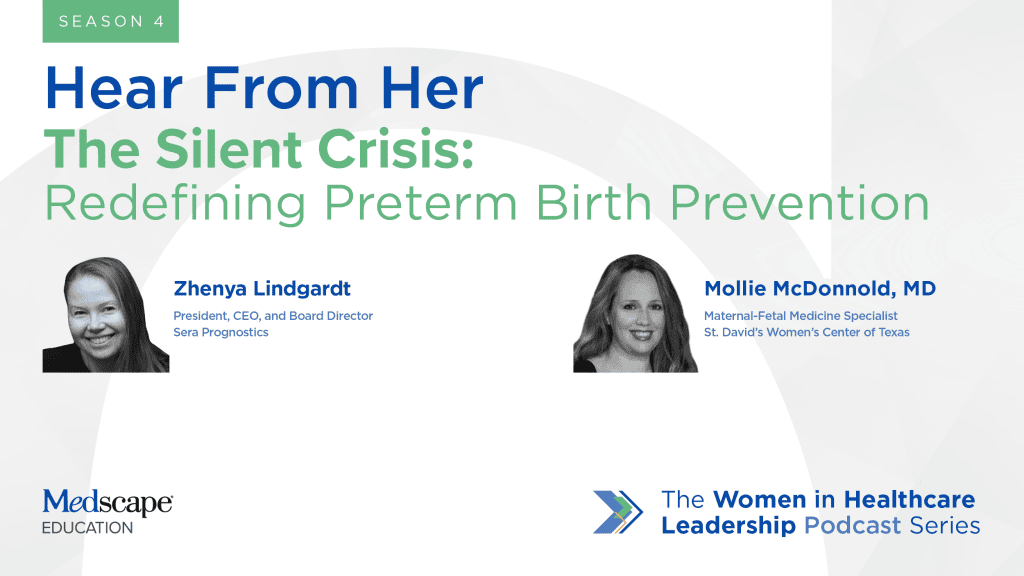
As discussed in the latest Hear From Her podcast, the challenge has always been prediction. “Prior to this, we had very few tools to help predict who is at risk,” explains Dr. Mollie McDonnold, a Maternal-Fetal Medicine specialist. Traditionally, doctors relied on a patient’s history of previous preterm births, but the majority of cases occur in women with no prior history.
The Biomarker Breakthrough
The conversation highlights a shift toward personalized medicine through the use of biomarkers. By analyzing proteins from the placenta via a simple blood draw early in pregnancy, clinicians can now identify high-risk patients with much greater sensitivity than traditional methods.
Listen to the full episode here.
The Power of the “Bundle”
Identification is only half the battle; prevention is the goal. Zhenya Lindgardt, CEO of Sera Prognostics, shares results from the “Prime Study,” which utilized a protocol designed with the Society for Maternal-Fetal Medicine. When high-risk women were treated with a “preventive bundle”—consisting of low-dose aspirin, vaginal progesterone, and weekly nurse check-ins—the results were “spectacular”:
- A 20% reduction in severe neonatal morbidity.
- A 52% reduction in births before 32 weeks.
- One out of five babies avoided the NICU entirely.
Listen to the full episode here.
A Tailored Future
The future of maternal health lies in moving away from a “one size fits all” approach. By stratifying care, healthcare providers can funnel intensive resources—like cervical length monitoring and specialized nurse support—to those who need it most, while providing peace of mind to those at low risk. As Lindgardt notes, the goal is to ensure every pregnancy receives the specific level of care it requires to thrive.
This content was provided by Medscape Education
Company Details
Latest Content from Medscape Education
“Humanizing Healthcare, Humanizing Education: The Power of Patient Integration”
Victoria Harvey-Jones, PhD, Clinical Strategist (Oncology) and Worldwide Patient Integration Lead to Present at the 2025 Patient Centricity & Engagement Conference
Driving Impact in Diabetes Care: Medscape to Present 11 Publications at ADA’s 85th Scientific Sessions
Medscape Education is proud to present 11 publications at the American Diabetes Association 85th Scientific Sessions, taking place June 20–23 in Chicago. These presentations reflect our commitment to advancing diabetes care…
Medscape Education Celebrates 30 Years of Impact with Launch of The Center of Excellence for Instructional Design
Medscape Education, a global leader in healthcare education, proudly announces the official launch of its Center of Excellence for Instructional Design—a central hub of expertise and strategic capability, dedicated to…
Medscape at the American Diabetes Association’s 85th Scientific Sessions: Your Sweet Spot for Innovation!
The American Diabetes Association’s 85th Scientific Sessions is almost here, and Medscape is ready to make an impact in the world of diabetes care! With two groundbreaking symposia, 11 dynamic…
Sharing Educational Outcomes at EHA 2025
Medscape Hematology will be at EHA 2025 to showcase the power of education impact through online abstracts, posters, and 4 symposia.
30 Years of Innovation in Education at HLTH Europe
The Medscape Education Global team will be travelling to Amsterdam for the HLTH Europe 2025 conference to showcase the power and value of CME. As pioneers in clinician education for…
Medscape Online Continuing Medical Education Led to New Diagnoses in Alzheimer’s Disease
Medscape Education has recently published a study looking at the real-world impact of online continuing medical education on Alzheimer’s disease diagnosis. Read the full article here. The study, published in…
Medscape Oncology at ASCO 2025: Driving Innovation, Education & Better Patient Outcomes
Medscape Oncology is making a powerful impact at ASCO 2025, bringing seven high-impact symposia, new research insights, and the return of the Medscape Fellows Program—all aimed at educating the next…
Medscape Celebrates Eight Groundbreaking Publications at ATS 2025 International Conference
Medscape Education is proud to announce the presentation of eight innovative educational research publications at the American Thoracic Society (ATS) 2025 International Conference, held May 16–21 in San Francisco, CA….
The Future of CME in the Virtual World
The future of CME is here—and it’s personal, powerful, and primed for impact. In an era where clinician time is stretched thin, AI and digital innovation are transforming continuing medical…