




Planting the Seeds for Future Women Leaders in Medicine
November 28, 2023 | Leadership, Medscape, Women in healthcare, oncology
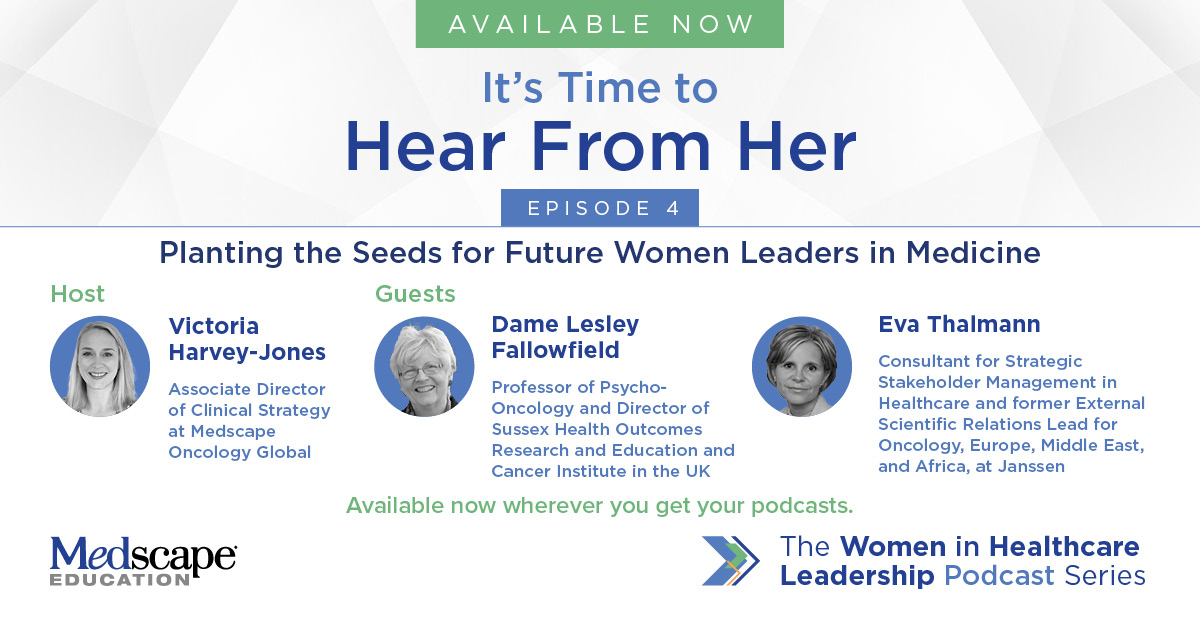
What are the qualities needed to be a leader in the medical field of oncology?
Of course, you must be a good clinician. But you also have to be wise and skillful in how you approach people without losing any of your own authority. You need to be able to see things from their perspective and be a good listener.
It’s no secret that compassion and communication are skills many women possess. And yet when you look at who’s chairing most oncology conference sessions it’s invariably a man, says Dame Lesley Fallowfield, professor of psycho-oncology and director of Sussex Health Outcomes Research and Education and Cancer Institute, known as SHORE-C, in the UK. (And guess whether men or women also ask more and longer questions at those conferences, according to a report published in The Lancet!)
So, what are the barriers facing women in oncology today? What is keeping them from rising through the ranks?
As a Psycho-Oncologist, Fallowfield says that powerful stereotypes still exist, both outside and inside the hospital setting: Women in scrubs are assumed to be nurses, not doctors, and women are often encouraged to go into branches of medicine that tend to be more traditionally female.
A European Society for Medical Oncology survey found that another “major barrier” is the work-life, or work-family balance, says Eva Thalmann, who spent 30 years at Janssen Pharmaceuticals in various senior leadership positions in oncology. But just because women may take time off to focus on a new baby or young children, “that doesn’t mean their brain stops working!” says Fallowfield.
Part of the responsibility of leaders today is to “tell young women to step up, lean in, and just try something,” says Thalmann. “If you fail, you fail. Lean in to do things even if you’re not sure you can completely master it” — because your male colleague wouldn’t hesitate!
For more of the conversation — including Fallowfield and Thalmann’s thoughts on the types of leadership training skills needed for the next generation; the resources that exist today and those that are missing; and how women themselves are sometimes partially to blame for the inequity that exists — check out Episode 4 of Medscape’s Women in Healthcare Leadership podcast series. Click here to listen on Apple Podcasts or head straight to Medscape.
Hosted by Victoria Harvey-Jones, Associate Director of Clinical Strategy at Medscape Oncology Global
Follow us for updates on upcoming podcasts and more insightful conversations.
For more information, please contact Jelena Spyropoulos (Global) or Piyali Shin (US).
About Medscape Education
Medscape Education (medscape.org) is the leading destination for continuous professional development, consisting of more than 30 specialty-focused destinations offering thousands of free CME and CE courses for physicians, nurses, and other healthcare professionals.
This content was provided by Medscape Education
Company Details

Latest Content from Medscape Education
The Pulse of AI Innovation: From More Data to Better Care
At the European Society of Cardiology (ESC) Congress, two of cardiology’s most influential voices sat down to talk about artificial intelligence at Medscape’s ‘The Pulse of AI Innovation’ event: Professor…
Next-Level Clinical Practice, Real-World Impact: Evolving Patient Simulation with the Clinical Readiness Studio
Healthcare is changing rapidly, bringing unprecedented data and complex treatment pathways to the point of care. Clinical mastery requires active experience, the confidence to make decisions when real patient outcomes…
Medscape Sponsors The John Ritter Foundation’s “Evening From the Heart”
When independent, evidence-based education directly connects with clinicians at the point of care, clinical practice changes. Driven by this vital mission, Medscape Education was proud to sponsor The John Ritter…
From Booth to Bavaria: A Recap of Impact at ESC 2026
We have officially wrapped up another year at ESC. For Medscape Education, 4 days on the ground confirmed what 3 decades of cardiovascular education have already shown: when independent, evidence-based…
Why Modern Dermatology Demands Curiosity Over Precision
In the high-stakes world of healthcare research and product development, success has long been measured by rigid definitions of precision and predictable trajectories. However, as Dr. Hawa Dumbuya, Director of…
The Heart of the Matter: Medscape Education’s Cardiology Footprint at ESC 2026
For more than 30 years, Medscape Education has built independent, accredited cardiovascular education designed around one goal: improved patient outcomes. This year at the European Society of Cardiology Congress (ESC…
More Than Pink Walls: What Women-Centric Care Actually Requires
The phrase “patient-centered care” is tossed around freely in healthcare corporate boardrooms. Yet, for more than half the population, that promise routinely fractures. In the latest episode of the Hear…
Women in Healthcare Leadership Have a Lot to Say. Medscape’s Hear From Her Wins an APEX Grand Award.
Medscape Education has been honoured with the prestigious APEX Grand Award for Publication Excellence at…
Moving Beyond the 10%: A New Era in Preterm Birth Prevention
For decades, the rate of spontaneous preterm birth in the United States has hovered stubbornly around 10%. Despite advancements in other areas of medicine, prematurity remains the second leading cause…
Medscape Education to Showcase the Impact of Neurology CME at EAN 2026
Medscape Education, the leading global provider of continuing medical education (CME), has announced its agenda for the upcoming 12th Congress of the European Academy of Neurology (EAN) 2026 in Geneva,…