




Moving Beyond the 10%: A New Era in Preterm Birth Prevention
July 1, 2026 | #HearFromHer #PretermBirth
For decades, the rate of spontaneous preterm birth in the United States has hovered stubbornly around 10%. Despite advancements in other areas of medicine, prematurity remains the second leading cause of death for neonates, carrying a heavy toll of lifelong health complications, developmental disabilities, and a staggering $25 billion annual cost to the healthcare system.
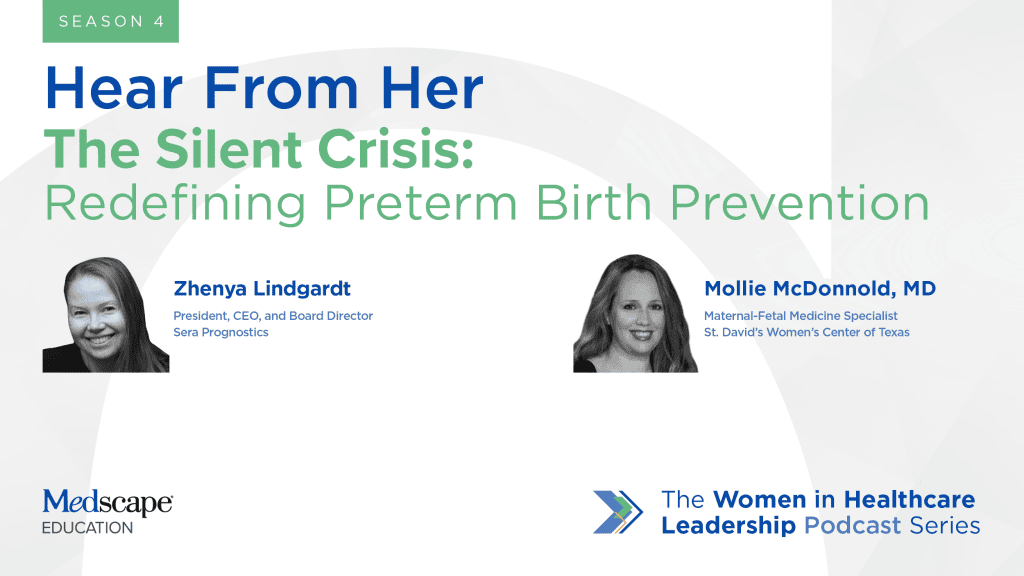
Listen to the full episode here.
As discussed in the latest Hear From Her podcast, the challenge has always been prediction. “Prior to this, we had very few tools to help predict who is at risk,” explains Dr. Mollie McDonnold, a Maternal-Fetal Medicine specialist. Traditionally, doctors relied on a patient’s history of previous preterm births, but the majority of cases occur in women with no prior history.
The Biomarker Breakthrough
The conversation highlights a shift toward personalized medicine through the use of biomarkers. By analyzing proteins from the placenta via a simple blood draw early in pregnancy, clinicians can now identify high-risk patients with much greater sensitivity than traditional methods.
Listen to the full episode here.
The Power of the “Bundle”
Identification is only half the battle; prevention is the goal. Zhenya Lindgardt, CEO of Sera Prognostics, shares results from the “Prime Study,” which utilized a protocol designed with the Society for Maternal-Fetal Medicine. When high-risk women were treated with a “preventive bundle”—consisting of low-dose aspirin, vaginal progesterone, and weekly nurse check-ins—the results were “spectacular”:
- A 20% reduction in severe neonatal morbidity.
- A 52% reduction in births before 32 weeks.
- One out of five babies avoided the NICU entirely.
Listen to the full episode here.
A Tailored Future
The future of maternal health lies in moving away from a “one size fits all” approach. By stratifying care, healthcare providers can funnel intensive resources—like cervical length monitoring and specialized nurse support—to those who need it most, while providing peace of mind to those at low risk. As Lindgardt notes, the goal is to ensure every pregnancy receives the specific level of care it requires to thrive.
This content was provided by Medscape Education
Company Details

Latest Content from Medscape Education
Why Modern Dermatology Demands Curiosity Over Precision
In the high-stakes world of healthcare research and product development, success has long been measured by rigid definitions of precision and predictable trajectories. However, as Dr. Hawa Dumbuya, Director of…
The Heart of the Matter: Medscape Education’s Cardiology Footprint at ESC 2026
For more than 30 years, Medscape Education has built independent, accredited cardiovascular education designed around one goal: improved patient outcomes. This year at the European Society of Cardiology Congress (ESC…
More Than Pink Walls: What Women-Centric Care Actually Requires
The phrase “patient-centered care” is tossed around freely in healthcare corporate boardrooms. Yet, for more than half the population, that promise routinely fractures. In the latest episode of the Hear…
Women in Healthcare Leadership Have a Lot to Say. Medscape’s Hear From Her Wins an APEX Grand Award.
Medscape Education has been honoured with the prestigious APEX Grand Award for Publication Excellence at…
Moving Beyond the 10%: A New Era in Preterm Birth Prevention
For decades, the rate of spontaneous preterm birth in the United States has hovered stubbornly around 10%. Despite advancements in other areas of medicine, prematurity remains the second leading cause…
Medscape Education to Showcase the Impact of Neurology CME at EAN 2026
Medscape Education, the leading global provider of continuing medical education (CME), has announced its agenda for the upcoming 12th Congress of the European Academy of Neurology (EAN) 2026 in Geneva,…
Medscape Education Recognized With 2 Spring 2026 Digital Health Awards for Excellence in Clinical Education
Medscape Education has been recognized with 2 prestigious accolades at the Spring 2026 Digital Health Awards. The premier digital education platform earned a Gold Award for its PIONEER initiative in…
Medscape Education Brings AI to the Hematology Frontline at EHA 2026
Medscape Education is supporting a dedicated AI symposium at the 2026 European Hematology Association (EHA) Annual Congress in Stockholm on June 11, 2026.
The Ripple Effect: Why Connection is the Heart of Healthcare Leadership
In the fast-paced environment of clinical medicine, it is easy to focus solely on data and outcomes. However, as Dr. Toyin Nwafor (Gilead Sciences) and Dr. Shirin Mazumder (University of…
Beyond the Nudge: Why Mentorship is the New Healthcare Currency
In the latest episode of Hear From Her, the conversation centers on a striking reality: women in healthcare often face a “confidence gap” that their male counterparts do not. While…