



#ShortenTheJourney
February 18, 2026 | Education, Real World Outcomes, rare disease
For the millions of people living with a rare disease, the path to a diagnosis (if ever received) is often a long and frustrating odyssey. This delay is frequently driven by a simple but systemic hurdle: many healthcare professionals (HCPs) rarely encounter specific rare conditions in daily practice, and symptoms are often variable and non-specific, leading to missed signs and misdiagnoses. However, new research by Medscape presented at the World Orphan Drug Congress Europe 2025 suggests a powerful solution lies in precision targeted medical education.
The Power of Targeted Learning
A series of analyses conducted by Medscape Education Global evaluated how online Continuing Medical Education (CME) influences real-world clinical behavior. By tracking insurance claims and National Provider Identifier (NPI) data, researchers compared clinicians who participated in rare disease education against similar cohorts who did not. The results across various specialties—neurology, gastroenterology, and endocrinology—were consistent and striking.
- Genetic testing in pediatric neurology: Specialists who participated in education were 69% more likely to order critical genetic tests, such as multigene panels, specific genetic tests, and whole exome sequencing compared with those who didn’t participate1
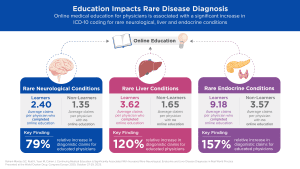
- Rare endocrinology: Education was associated with a significant 157% increase in claims for rare conditions like Cushing syndrome and X-linked hypophosphatemia2
- Rare liver disorders: A significant 120% increase in coding for conditions such as Alagille syndrome and hepatic porphyria from gastroenterologists/hepatologists2
- Rare neurological conditions: Participation in CME was associated with a significant 78.5% increase in claims for 11 complex conditions, including ALS and Rett syndrome2

Why It Matters
The significance of these findings rests in the shift from theoretical knowledge and competence to active clinical application. By providing online, accessible education on a free, membership-based platform, rare disease education gives doctors the knowledge, competence, and confidence to order the right diagnostic tests, and apply the correct diagnostic codes earlier.
These studies suggest that online education is a powerful clinical intervention and a positive lever to improve patient outcomes. By equipping healthcare providers with the tools to recognize “the zebras among the horses,” we can shorten the diagnostic journey, ensuring patients receive life-altering treatments years earlier than they otherwise would.
References:
- Rohani-Montez SC et al. Are Pediatric Neurologists Who Participate in Rare Disease Education More Likely to Order Genetic Tests for Rare Diseases? Presented at World Orphan Drug Congress Europe 2025
- Rohani-Montez SC et al. Continuing Medical Education is Significantly Associated With Increased Rare Neurological, Endocrine and Liver Disease Diagnoses in Real World Practice. Presented at World Orphan Drug Congress Europe 2025
About Medscape Education
Medscape Education (medscape.org) is the leading destination for continuous professional development, consisting of more than 30 specialty-focused destinations offering thousands of free CME and CE courses for physicians, nurses, and other healthcare professional
This content was provided by Medscape Education
Company Details

Latest Content from Medscape Education
Getting to the Heart of the Matter: Medscape Education at AHA 2024!
Come join Medscape Education at the American Heart Association (AHA) 2024 Scientific Sessions in Chicago, IL, from November 16-18 — a dynamic event packed with cutting-edge cardiology education that you…
Medscape Publication is Awarded Poster of Distinction at AASLD
Medscape Education is committed to disseminating the outcomes of the education programs through peer-reviewed publications and posters at leading medical conferences around the world. To this end, Medscape publishes more…
Advancing Education at AASLD 2024
Get ready for an exciting experience at AASLD 2024! The Medscape team is thrilled to be in San Diego from November 15-19 for this year’s AASLD conference, where we will…
Recognizing C diff Awareness Month in 2024
Every year, the medical community recognizes the month of November as Clostridioides difficile (C. diff) Awareness month. C. diff is a public health threat that causes around 500,000 infections every…
Medscape Education presenting at the 17th Annual European CME Forum
With a commitment to advancing the field of continuing medical education, the Medscape team will be travelling to Madrid for the 17th Annual European CME Forum and bringing with them…
Sex, Gender, and the Brain: The Women’s Brain Foundation and Medscape Education Announce Groundbreaking Learning Centre
LONDON–(BUSINESS WIRE)–The Women’s Brain Foundation (WBF), the global pioneer that has advanced the inclusion of sex- and gender-based evidence-generation in all research, drug development, and healthcare since 2017; and Medscape…
Cultivating Interest in Infectious Disease Education at ID Week 2024
IDWeek starts tomorrow, October 16, and Medscape is bringing outcomes and education! We are excited to announce Medscape is presenting six posters that highlight the significant impact of our educational…
Medscape Education Breathes Life Into Pulmonology: Showcasing Success at CHEST 2024
Medscape Education showcases its strong track record in providing high-quality education in the field of pulmonology at the annual conference of the American College of Chest Physicians in Boston, Massachusetts,…
Successful Education at ESC
With World Heart Day just having passed (29th September), Medscape wants to take the opportunity to look back and recap what was accomplished at ESC 2024. At this year’s event,…
How women are revolutionising rare disease
Women have played a crucial role in rare disease awareness and better care, overcoming gender biases and systemic challenges to drive progress in this often-overlooked field.