



#ShortenTheJourney
February 18, 2026 | Education, Real World Outcomes, rare disease
For the millions of people living with a rare disease, the path to a diagnosis (if ever received) is often a long and frustrating odyssey. This delay is frequently driven by a simple but systemic hurdle: many healthcare professionals (HCPs) rarely encounter specific rare conditions in daily practice, and symptoms are often variable and non-specific, leading to missed signs and misdiagnoses. However, new research by Medscape presented at the World Orphan Drug Congress Europe 2025 suggests a powerful solution lies in precision targeted medical education.
The Power of Targeted Learning
A series of analyses conducted by Medscape Education Global evaluated how online Continuing Medical Education (CME) influences real-world clinical behavior. By tracking insurance claims and National Provider Identifier (NPI) data, researchers compared clinicians who participated in rare disease education against similar cohorts who did not. The results across various specialties—neurology, gastroenterology, and endocrinology—were consistent and striking.
- Genetic testing in pediatric neurology: Specialists who participated in education were 69% more likely to order critical genetic tests, such as multigene panels, specific genetic tests, and whole exome sequencing compared with those who didn’t participate1
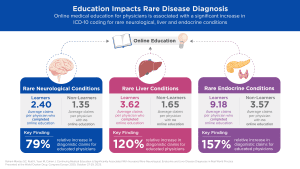
- Rare endocrinology: Education was associated with a significant 157% increase in claims for rare conditions like Cushing syndrome and X-linked hypophosphatemia2
- Rare liver disorders: A significant 120% increase in coding for conditions such as Alagille syndrome and hepatic porphyria from gastroenterologists/hepatologists2
- Rare neurological conditions: Participation in CME was associated with a significant 78.5% increase in claims for 11 complex conditions, including ALS and Rett syndrome2

Why It Matters
The significance of these findings rests in the shift from theoretical knowledge and competence to active clinical application. By providing online, accessible education on a free, membership-based platform, rare disease education gives doctors the knowledge, competence, and confidence to order the right diagnostic tests, and apply the correct diagnostic codes earlier.
These studies suggest that online education is a powerful clinical intervention and a positive lever to improve patient outcomes. By equipping healthcare providers with the tools to recognize “the zebras among the horses,” we can shorten the diagnostic journey, ensuring patients receive life-altering treatments years earlier than they otherwise would.
References:
- Rohani-Montez SC et al. Are Pediatric Neurologists Who Participate in Rare Disease Education More Likely to Order Genetic Tests for Rare Diseases? Presented at World Orphan Drug Congress Europe 2025
- Rohani-Montez SC et al. Continuing Medical Education is Significantly Associated With Increased Rare Neurological, Endocrine and Liver Disease Diagnoses in Real World Practice. Presented at World Orphan Drug Congress Europe 2025
About Medscape Education
Medscape Education (medscape.org) is the leading destination for continuous professional development, consisting of more than 30 specialty-focused destinations offering thousands of free CME and CE courses for physicians, nurses, and other healthcare professional
This content was provided by Medscape Education
Company Details

Latest Content from Medscape Education
#ShortenTheJourney
For the millions of people living with a rare disease, the path to a diagnosis (if ever received) is often a long and frustrating odyssey. This delay is frequently driven…
Why We Must Stop Normalizing the “Pregnancy Itch”
In the world of rare diseases, success is often measured by the speed of diagnosis. However, for women facing rare liver conditions like Intrahepatic Cholestasis of Pregnancy (ICP), the medical…
The Greatest Form of Caring: Medscape’s Commitment to Advancing Cardiovascular Health
A February Focus on the Heart While February is known as the month of love, it is also National Heart Month, a time for highlighting the importance of cardiovascular health….
AI, Agility, and Connected Impact at Alliance 2026
Join the Medscape team in Atlanta, February 16–19, 2026, as Alliance celebrates 50 years of excellence in continuing education for health professionals. We’re bringing our 3 decades of experience in…
Why Sleep Health is the Missing Link in Women’s Wellness
While obstructive sleep apnea (OSA) affects approximately 32% of US adults—nearly 80 million people—it remains an “epidemic hiding in plain sight”. Perhaps most staggering is that 90% of women with…
The Heart and Mouth Connection Every Woman Needs to Know
For decades, modern medicine has treated the mouth and the body as separate entities. But for Dr. Nieca Goldberg, a renowned cardiologist, and Dr. Maria Ryan, Chief Clinical Officer at…
Uncovering Inequities in Alzheimer’s Disease Screening and Care
On December 5, MAPS hosted an educational webinar exploring recent research in Alzheimer’s disease (AD) screening, testing, and treatment. Experts from Komodo Health and Medscape shared findings from their…
Where Are We Today With Artificial Intelligence (AI) in Rare Disease Diagnosis and Care?
Discover how AI-powered tools are transforming rare disease diagnosis, patient care, and clinical decision-making.
Does Rare Disease Education Work?
For a child with a rare disease, a doctor’s continuing education can end a years-long diagnostic odyssey and unlock access to vital care.
From Genetic Puzzles to Precision Therapeutics
How was a new rare disease discovered through Singapore’s Undiagnosed Disease Program? And how will technology allow us to change how we discover rare diseases in the future? Read more…