




The Heart of the Matter: Medscape Education’s Cardiology Footprint at ESC 2026
July 28, 2026 | CME, Cardiology Education, IME, Patient Impact, cardiology
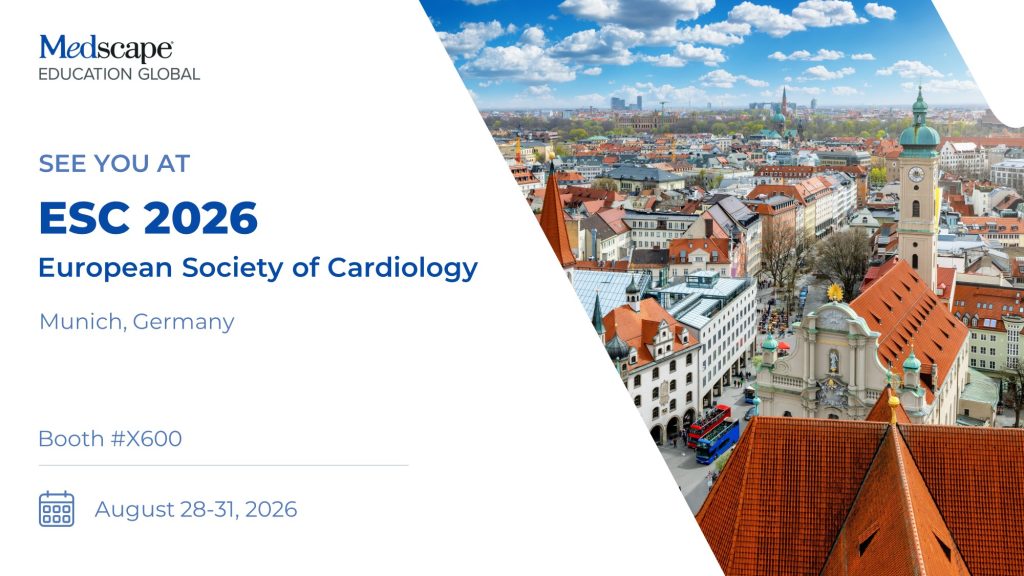
For more than 30 years, Medscape Education has built independent, accredited cardiovascular education designed around one goal: improved patient outcomes. This year at the European Society of Cardiology Congress (ESC 2026), that commitment will be on full display. From Friday, 28 August through Monday, 31 August in Munich, our presence reflects a long-standing view that cardiology remains one of the most urgent, highest-impact specialties in medicine, and one that deserves education built to match.
Here’s an inside look at Medscape’s footprint at ESC 2026, and the evidence behind why it matters.
A Footprint Built for Practice Change
We’ll be on the ground with a full-scale presence designed to put cardiology education in front of the clinicians who matter most. This year, we’re bridging the gap between physical expertise and digital innovation, centering our presence around Medscape AI, delivering clinical precision and trusted intelligence, ensuring cardiologists have verified, evidence-based answers at the point of care.
- Booth #X600: A hub on the exhibition floor where physicians can explore our full range of cardiology education, interact directly with our AI-powered tools, and connect with faculty-led resources.
- Four independently developed symposia across the congress, spanning topics from familial chylomicronemia syndrome recognition and management, to viral triggers and cardiovascular risk, to lipid control innovation and cardioprotection through vaccination. represent clinically rich, case-based education that drives behavior change.
- Invite-only event, “The Bavarian Pulse of AI Innovation,” at Munich’s iconic Hofbräuhaus, this invite-only evening will bring together key cardiology decision-makers for an evening anchored by a fireside chat featuring Carolyn Lam, MBBS, PhD and Manesh Patel, MD.
Together, this is a strategy built on the principle to meet cardiologists wherever they are, on the exhibit floor, in the lecture hall, and in a room where real dialogue happens.
Why Does this Matter? The Impact Behind the Activity…
- 695,882 cardiology HCPs reached globally
- 387,772 cardiologist learners engaged across 164 programs, with 46 of those programs assessed using our proprietary Linked Learner Assessment methodology for advanced-level outcomes.
- 93% of learners report that our cardiology activities will promote improvement in healthcare and/or patient outcomes; 94% say the content learned will directly impact their practice; 92% would recommend the activities to peers.
- 46% improvement in knowledge/competence, 42% reinforcement of existing knowledge/competence, and 38% increase in learner confidence following advanced-outcomes programming.
- An estimated 11 million patient visits impacted every month by Medscape’s cardiology education, a reminder that every learner reached is connected to real patients downstream.
- Our live events consistently land in “great” territory for learner experience, with an NPS of 62 in 2025 and more than 64,000 attendees engaged.
Source: Medscape Internal Data 2025
This is the foundation our ESC 2026 presence builds on, not a one-off congress push, but a continuation of a measurable, evidence-based strategy that’s been refined over three decades and is now sharpened further through AI-powered tools.
A Specialty That Deserves This Level of Commitment
Cardiology touches more patients, more comorbidities, and more emerging science than almost any other specialty, and the clinicians attending ESC 2026 are the ones making decisions that can make a difference to millions of patients. Our scale of presence at this year’s congress, four independently developed symposia, a flagship booth, and a private event built around two leading voices in the field, reflects our commitment of closing gaps in cardiovascular care through rigorous, unbiased education.
We look forward to seeing you in Munich.
For more information on Medscape’s cardiology education, please reach out to your Medscape Education representative.
This content was provided by Medscape Education
Company Details

Latest Content from Medscape Education
Data, Evidence, Education: Tackling the Global Multi‑Trillion‑Dollar Rare Disease Burden
Rare diseases are individually uncommon, yet together they affect an estimated 300 million+ people worldwide and touch the lives of over one billion when families and caregivers are included. For…
#ShortenTheJourney
For the millions of people living with a rare disease, the path to a diagnosis (if ever received) is often a long and frustrating odyssey. This delay is frequently driven…
Why We Must Stop Normalizing the “Pregnancy Itch”
In the world of rare diseases, success is often measured by the speed of diagnosis. However, for women facing rare liver conditions like Intrahepatic Cholestasis of Pregnancy (ICP), the medical…
The Greatest Form of Caring: Medscape’s Commitment to Advancing Cardiovascular Health
A February Focus on the Heart While February is known as the month of love, it is also National Heart Month, a time for highlighting the importance of cardiovascular health….
AI, Agility, and Connected Impact at Alliance 2026
Join the Medscape team in Atlanta, February 16–19, 2026, as Alliance celebrates 50 years of excellence in continuing education for health professionals. We’re bringing our 3 decades of experience in…
Why Sleep Health is the Missing Link in Women’s Wellness
While obstructive sleep apnea (OSA) affects approximately 32% of US adults—nearly 80 million people—it remains an “epidemic hiding in plain sight”. Perhaps most staggering is that 90% of women with…
The Heart and Mouth Connection Every Woman Needs to Know
For decades, modern medicine has treated the mouth and the body as separate entities. But for Dr. Nieca Goldberg, a renowned cardiologist, and Dr. Maria Ryan, Chief Clinical Officer at…
Uncovering Inequities in Alzheimer’s Disease Screening and Care
On December 5, MAPS hosted an educational webinar exploring recent research in Alzheimer’s disease (AD) screening, testing, and treatment. Experts from Komodo Health and Medscape shared findings from their…
Where Are We Today With Artificial Intelligence (AI) in Rare Disease Diagnosis and Care?
Discover how AI-powered tools are transforming rare disease diagnosis, patient care, and clinical decision-making.
Does Rare Disease Education Work?
For a child with a rare disease, a doctor’s continuing education can end a years-long diagnostic odyssey and unlock access to vital care.