



Voices of Change: Women Leading the Menopause Movement
November 20, 2025 | Women in Leadership, Women in healthcare, podcast
For decades, menopause has been swept under the rug, or into the dark corners of clinicians’ offices, often dismissed as something women just had to “get past” and hardly worth discussing. In this episode of “Hear From Her,” learn how three leaders in menopause medicine are building a new standard of care with compassion and education—and shouting their message from the rooftops: Anyone who takes care of women should know about menopause care. Period.
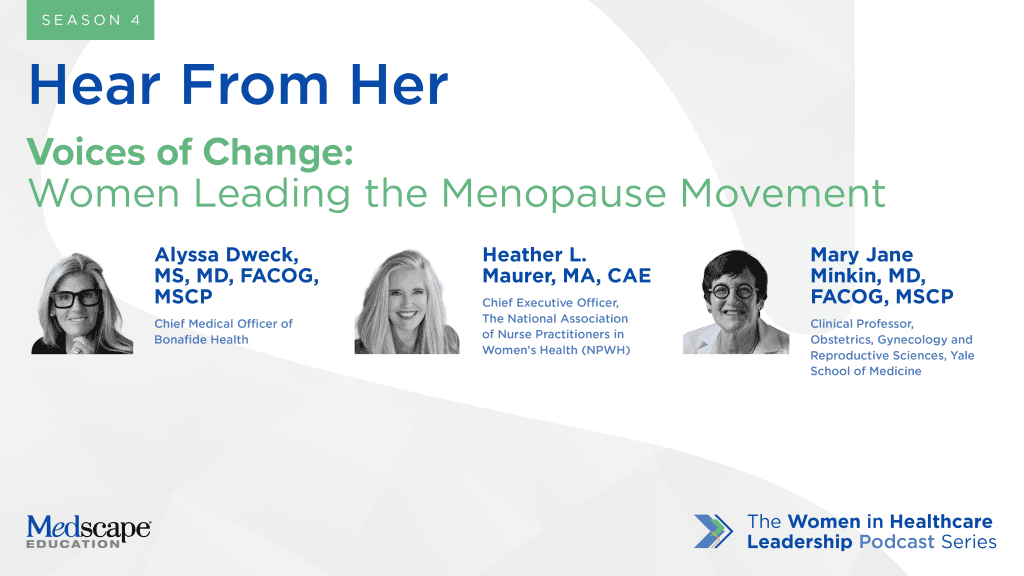
For Dr. Alyssa Dweck, the shift to menopause care came naturally—as stages of life do. As an OB/GYN, she spent her early career delivering babies. But as her patients got older, their health needs changed. “As my patients stopped having babies and started entering perimenopause and menopause, I was growing up with them,” she says. “We didn’t get much training in medical school or residency.” As an underserved space, it was learn-as-you-go.
Heather Maurer’s path into menopause medicine was also shaped by lived experience. As well as being CEO of The National Association of Nurse Practitioners in Women’s Health (NPWH) “I am officially in full menopause,” she says. And looking back, I see missed opportunities in my own care.
“Six years ago I had a frozen shoulder for over a year, and in hindsight I was absolutely in perimenopause. And not once did anyone suggest that it might be estrogen related,” she says. That gap in her own clinical care helped inspire her work to provide continuing education through NPWH for advanced practice providers. Practitioners need evidence-based education and tools to raise the standard of women’s care, she says.
The menopause desert
Dr. Mary Jane Minkin, also an OB GYN, recalls the abrupt halt in menopause education when the 2002 Women’s Health Initiative (WHI) study was published. The study (suggesting that HRT increased risks for breast cancer, heart disease, and stroke, but whose findings were later revealed to depend on many factors), stirred up tremendous fear with both clinicians and patients about hormone replacement therapy. “Menopause education stopped on a dime,” Minkin says.
Around the same time, residency programs were trying to shorten their hours. “And if no one’s taking hormones, then why bother teaching about menopause?” So menopause training went out the window. Twenty years later, Minkin says, we’re still trying to dig out of that hole. We are still in a menopause desert.”
Reshaping menopause care
Historically, women have been excluded from clinical trials, says Maurer. “There’s very little research done specifically in women. [We] were sort of considered little men in terms of extrapolating results and applying them to women’s health, which really just isn’t the case.”
Despite these challenges, the landscape is shifting largely thanks to these passionate women’s healthcare leaders. Patient advocacy, workplace awareness (yes, more toilets and cooler room temperatures go a long way, they say), and entrepreneurial innovation are shining a light on menopause care. Telehealth platforms dedicated to perimenopause and menopause are expanding access. Private companies like Bonafide, where Dweck is Chief Medical Officer, are investing in research and creating products offering hormone-free menopause symptom relief for women. Nurse practitioners are stepping into leadership roles, particularly in underserved areas, to bridge care gaps.
“We have more than 13,000 women’s health nurse practitioners in the U.S., many working in rural or federally qualified clinics,” says Maurer. They are critical in helping women access both treatment and education, and encouraging patients to bring information back to their care teams.
“As a patient, I bring studies to my primary care person who’s not a WHNP or an OB GYN and say, ‘Hey, here’s all this great information about menopause and perimenopause.’” In today’s world, physicians have like 15 minutes for each patient appointment, Maurer says, and everyone has to play a part in maximizing that time.
All three women believe that menopause shouldn’t require specialists at all, and that women’s health should be a standard pillar of medical practice. “It’s basic healthcare, and every provider should know about this,” Minkin says. It’s a chapter in every woman’s life if they’re lucky enough to live that long. “More women will go through menopause than will ever have a baby.”
Adds Maurer: “Anyone who takes care of women should know about menopause care. Period.”
For more information, or to find a menopause specialist in your area, go to menopause.org.
Follow us for updates on upcoming podcasts and more insightful conversations.
For more information, please contact Jelena Spyropoulos (Global) or Piyali Shin (US).
About Medscape Education
Medscape Education (medscape.org) is the leading destination for continuous professional development, consisting of more than 30 specialty-focused destinations offering thousands of free CME and CE courses for physicians, nurses, and other healthcare professionals.
This content was provided by Medscape Education
Company Details

Latest Content from Medscape Education
The Power of Patient Insights to Improve Cancer Care
Two global patient advocacy groups—The Lymphoma Coalition and Lung Cancer Europe— are compiling data from their communities on the real-world experience of living with cancer. What the data reveals sometimes...
Medscape Education Continues Its Patient-Centric Mission at EHA 2024
Anticipation is building at Medscape Education as the team prepares for the EHA 2024 Congress. Medscape Education is excited to announce a significant presence during the congress including a Medscape...
Getting in-sync with Public Health at SYNC 2024
Medscape Education is bringing its public health efforts to Washington, DC for the SYNC conference on HIV, HCV, STIs, Harm Reduction, and LGBTQ health. During the conference, Lindsey will present...
Medscape Education and KDIGO Nephrology Collaboration Accelerates Improvements to Patient Care
Ahead of the 61st European Renal Association (ERA) Congress, Medscape Education and KDIGO (Kidney Disease: Improving Global Outcomes) announce an educational collaboration through a series of webinars to improve anemia-related...
Medscape Brings Impact and Data to ESPGHAN
The ESPGHAN Congress in Milan was full of impact as Medscape Education Global presented 5 scientific posters examining the outcomes of their education. The posters detailed the impact Medscape Education...
Empowering Nurses Through Education
Nurse education is powerful and makes an impact.
Pioneering Paths: Women Leadership in Rare Disease
Rare diseases are often thought of as affecting one in 100,000 or one in 1,000,000 people, and that is true for some conditions. But there are many rare diseases that...
TRANSFORMING CME IMPACT: MEDSCAPE’S GAME-CHANGING APPROACH
It’s time for the CME industry to evolve. During recent years, access to data, modern technologies, and methodologies have allowed for deeper analysis of data and a better understanding of...
Why Women in Medicine Should Embrace Social Media
Of course social media has its downside. But online platforms are a powerful tool for women in medicine in terms of forming communities, fighting misinformation, amplifying one another, and galvanizing...
Exceptional Impact Presented at ECCMID 2024
The ECCMID conference in Barcelona, Spain marked the start of Medscape’s publication season in Europe. With three posters being presented at the conference, Medscape shared highlights from the powerful impact...