



Its Know Your Numbers week
September 11, 2019 | awareness, blood pressure
Do you know yours?
Most people are aware that high blood pressure is to be avoided in the same way we know that being overweight or unfit is unhealthy, but what does it really mean and why is it so important?
There is a danger that we have become de-sensitised to the warnings. Why? Could it be because we are bombarded with swathes of conflicting messages, especially when it comes to food and diet. While one TV advert shamelessly entices us to indulge in a death-by-chocolate, melt-in-the-middle fondant bomb, another hammers home the risks of heart disease, strokes and diabetes.
Yet blood pressure is so important. A sustained high blood pressure is not only a red flag for future life-threatening health conditions, it is also asymptomatic, with some people suffering for years without knowing it until serious health issues become apparent.
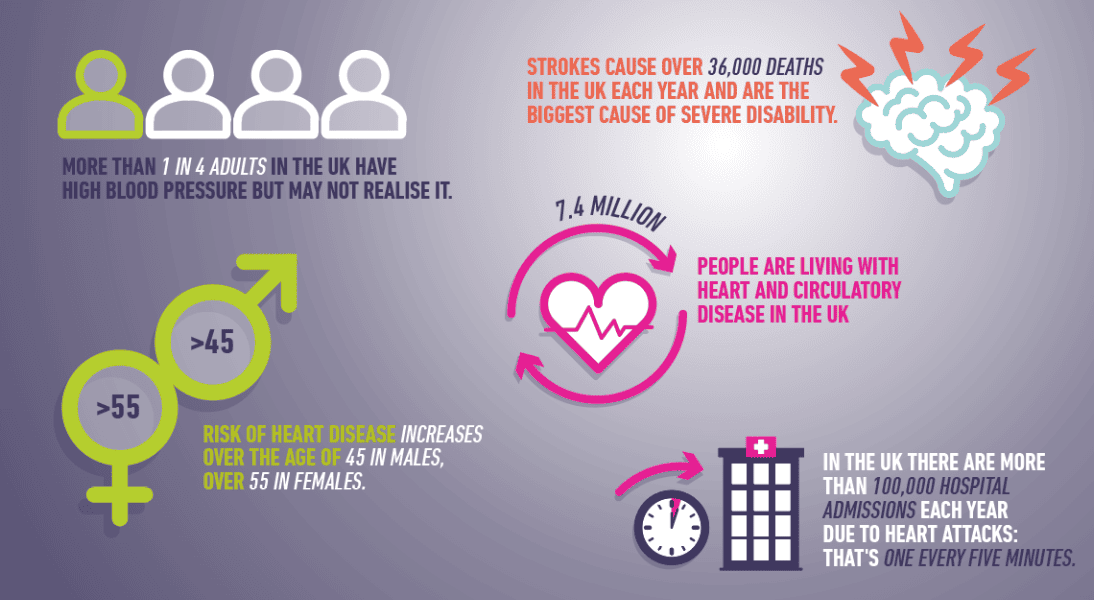
One in 4 adults in the UK has high blood pressure so the risk of developing heart disease, heart attacks, strokes, kidney disease and vascular dementia are very real. More than 100,000 hospital admissions each year are due to heart attacks: that’s one every five minutes.1
Blood pressure is the force exerted by blood against the arteries when the heart pumps. It is measured using an automatic device with sensors and digital displays. A cuff is placed around the upper arm, which inflates until the circulation is temporarily cut off. The pressure is then released, deflating the cuff and allowing the blood to pulse through the arteries again. The pressure is recorded at two points and measured in millimetres of mercury (mmHg). Firstly, a systolic reading is taken as the blood pulses through, and secondly, the diastolic reading is taken when the heart rests between beats. A healthy blood pressure reading should be 120/80mmHg or below. A high blood pressure reading is classed as 140/90mmHg or above, but it would need to be taken several times in order to confirm a diagnosis of high blood pressure.2
Blood pressure can naturally go up and down, for example, after exercise or drinking caffeine without causing any problems. However, high blood pressure becomes dangerous when it is sustained over many months or years, causing blood vessels to weaken and putting a strain on the heart and other organs.3
The NHS recommends that all adults over 40 years of age have their blood pressure tested at least every 5 years. However, if you are in a high-risk group, it should be taken at least once a year. Factors that can increase your risk of developing high blood pressure are:
- Age – the risk of developing high blood pressure increases with age
- A family history of high blood pressure
- A diet with too much salt
- Lack of exercise
- Being overweight
- Chronic Kidney Disease
- Regularly drinking large amounts of alcohol
- Smoking
- Long term sleep deprivation
- Long periods of stress
The good news is, you can get your blood pressure tested very easily at a number of places including your local GP surgery, some pharmacies or even at home, as digital devices are readily available to purchase online.
At Page & Page we take our employees’ health very seriously, so everyone is having their blood pressure tested today in the office today. Wish us luck!

Senior Creative Paul Hunt having his BP check up.
References 1-3:
NHS [online]. Available at https://www.nhs.uk/conditions/high-blood-pressure-hypertension/. Accessed 10/9/19.
Author: Michelle Burt
This content was provided by Page & Page Health
Company Details

Latest Content from Page & Page Health
The concordance conundrum: the art of active listening
The art of active listening explores the links between effective communication and better patient concordance and medical outcomes, why many HCPs still overestimate their ability to communicate effectively and the...
The concordance conundrum: understanding the complexities of behaviour change
Understanding behaviour change looks at the six fundamental steps required to change human behaviour and discusses why HCPs need to start here if concordance is to be improved.
The concordance conundrum: creating space for open dialogue
Growing numbers of patients want a partnership model with their HCP, whereby both parties are equally involved in the decision-making process. This model has been linked with an increase in...
The concordance conundrum: the tech divide
COVID-19 resulted in the rapid adoption of virtual consultations; while they offer increased accessibility and convenience for some, are they really all they are cracked up to be? Consultations in...
Improving patient concordance: where does industry fit in?
What’s in a name? explores the idea that those healthcare organisations that develop tools and support structures to improve concordance will be at an advantage when it comes to product...
The concordance conundrum: the value of improving patient experience
This is the first in a series of articles where we explore how the current climate presents companies with a multitude of opportunities to improve communication between healthcare organisations and...
The Pivot
In times of uncertainty it is critical for businesses to take action to protect their brand image and longevity.
Communicating through video
It's likely that video is about to replace a lot of your face-to-face appointments.
Could coronavirus turn us all into online gamers?
As businesses gauge the potential impact of coronavirus (COVID-19), with a sense of fear and pessimism causing a dampening of economic activity and suspension of the stock market, the healthcare...
Love – it really does make the world go around
No two people are the same nor as individuals are we particularly predictable – we might like to think we are because at some point in time someone decided that...