



Its Know Your Numbers week
September 11, 2019 | awareness, blood pressure
Do you know yours?
Most people are aware that high blood pressure is to be avoided in the same way we know that being overweight or unfit is unhealthy, but what does it really mean and why is it so important?
There is a danger that we have become de-sensitised to the warnings. Why? Could it be because we are bombarded with swathes of conflicting messages, especially when it comes to food and diet. While one TV advert shamelessly entices us to indulge in a death-by-chocolate, melt-in-the-middle fondant bomb, another hammers home the risks of heart disease, strokes and diabetes.
Yet blood pressure is so important. A sustained high blood pressure is not only a red flag for future life-threatening health conditions, it is also asymptomatic, with some people suffering for years without knowing it until serious health issues become apparent.
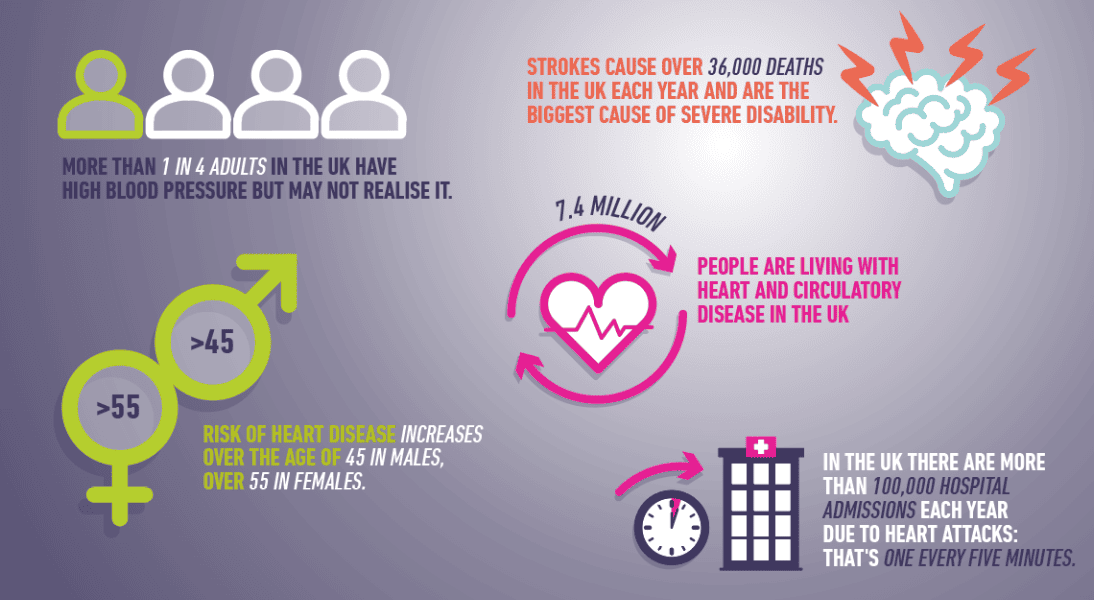
One in 4 adults in the UK has high blood pressure so the risk of developing heart disease, heart attacks, strokes, kidney disease and vascular dementia are very real. More than 100,000 hospital admissions each year are due to heart attacks: that’s one every five minutes.1
Blood pressure is the force exerted by blood against the arteries when the heart pumps. It is measured using an automatic device with sensors and digital displays. A cuff is placed around the upper arm, which inflates until the circulation is temporarily cut off. The pressure is then released, deflating the cuff and allowing the blood to pulse through the arteries again. The pressure is recorded at two points and measured in millimetres of mercury (mmHg). Firstly, a systolic reading is taken as the blood pulses through, and secondly, the diastolic reading is taken when the heart rests between beats. A healthy blood pressure reading should be 120/80mmHg or below. A high blood pressure reading is classed as 140/90mmHg or above, but it would need to be taken several times in order to confirm a diagnosis of high blood pressure.2
Blood pressure can naturally go up and down, for example, after exercise or drinking caffeine without causing any problems. However, high blood pressure becomes dangerous when it is sustained over many months or years, causing blood vessels to weaken and putting a strain on the heart and other organs.3
The NHS recommends that all adults over 40 years of age have their blood pressure tested at least every 5 years. However, if you are in a high-risk group, it should be taken at least once a year. Factors that can increase your risk of developing high blood pressure are:
- Age – the risk of developing high blood pressure increases with age
- A family history of high blood pressure
- A diet with too much salt
- Lack of exercise
- Being overweight
- Chronic Kidney Disease
- Regularly drinking large amounts of alcohol
- Smoking
- Long term sleep deprivation
- Long periods of stress
The good news is, you can get your blood pressure tested very easily at a number of places including your local GP surgery, some pharmacies or even at home, as digital devices are readily available to purchase online.
At Page & Page we take our employees’ health very seriously, so everyone is having their blood pressure tested today in the office today. Wish us luck!

Senior Creative Paul Hunt having his BP check up.
References 1-3:
NHS [online]. Available at https://www.nhs.uk/conditions/high-blood-pressure-hypertension/. Accessed 10/9/19.
Author: Michelle Burt
This content was provided by Page & Page Health
Company Details

Latest Content from Page & Page Health
Is our health at risk by delaying Dr appointments?
It’s Cervical Screening Awareness week 10-16 June, so now is the perfect time to check when your last appointment was.
It’s all about the cake/lettuce balance
World Digestive Health Day (WDHD) is held every year on 29 May, so now is the perfect time to redress the nutrition balance
Playing Mind Games
To give a brief strong direction, we need to ascertain how the brand intends to win attention, how it will engage, what its call to action will be and how...
PM Society Digital Award Finalists
P&P are shortlisted for the ‘Craft in Film’ category at this year’s PM Society Digital Awards
Autism Awareness Week
Autism awareness week highlights the need to support those suffering from the condition, and their families and carers.
International Women’s Day – 8 March 2019
International Women's Day has been celebrated since its inception in 1911. But how far have we come?
The 10-year Web Challenge
Understanding your users’ needs is more critical online today than ever. A site should mould itself around these insights, deliver those needs quickly, efficiently and with plenty of white space.
Happy Hearts
Is Valentine's Day good for your heart?
The Real & The Honestly Fake
In the age of the Instagram filter and the selfie, there appears to be no place in healthcare creative for false perceptions. You’re either REAL, or you’re HONESTLY FAKE.
Tinnitus Awareness Week: Tea for Tinnitus
It's Tinnitus Awareness Week 4-10 February 2019. You can help by taking part in Tea for Tinnitus and increase awareness of this debilitating condition.