




Playing Mind Games
May 24, 2019 | Brief writing, Share of mind
To give a brief strong direction, we need to ascertain how the brand intends to win attention, how it will engage, what its call to action will be and how to build up trust with the audience. It is a chance to take your brand story and archetypes and decide precisely what and how you want to communicate to the outside world.
To give a brief strong direction, we need to ascertain how the brand intends to win attention, how it will engage, what its call to action will be and how to build up trust with the audience. It is ideas that count here. These ideas can take the form of messages, visuals or tactics or a combination of all three. It is a chance to take your brand story and archetypes and decide precisely what and how you want to communicate to the outside world.
At P&P, we use the share-of-mind wheel. The four areas that you will look at are:
- Feelings/ Instincts
What will win the target audience’s attention against the backdrop of a busy day and hefty media bombardment?
- Rational/ Benefits
What claim or benefit can be made that will maintain their attention and achieve engagement?
- Priorities
How will the target audience react, given the things they have top of mind?
- Values/ Beliefs/ Mission
Why should they believe it’s OK to trust your brand?
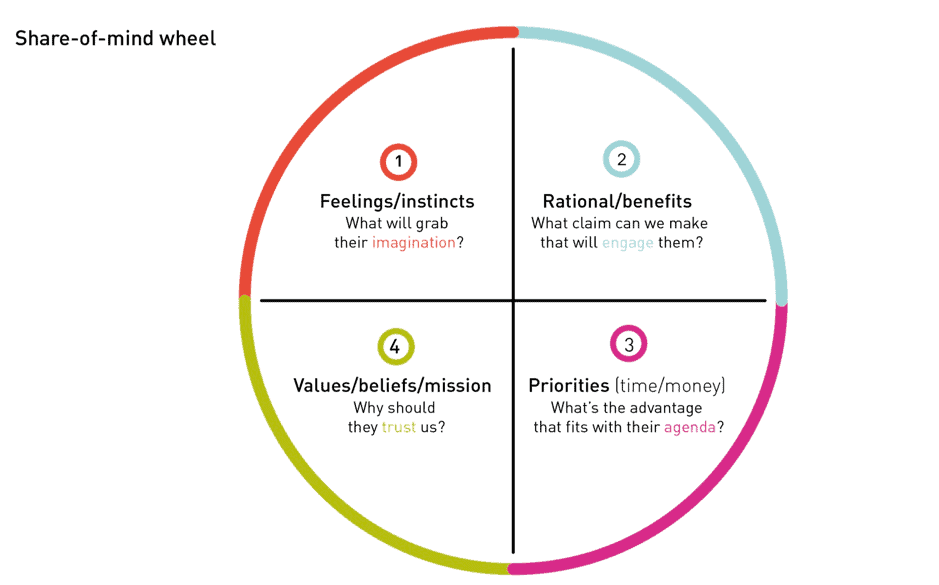
The exercise will differ depending on whether it is for the campaign or one specific piece of communication.
If the brief is being written for a campaign and you are thinking in terms of tactics, the share-of-mind wheel can be viewed as a journey with different media and tactics used to fulfil the four different criteria. For example, by developing something interactive like a game app for phones and tablets, you might win attention and generate curiosity. This will encourage players to follow a link, which leads to engaging information on a website with a clear call-to-action. They can then request further information by email. Slowly they become more involved with the brand as they learn to trust through experience.
This content was provided by Page & Page Health
Company Details

Latest Content from Page & Page Health
The concordance conundrum: the art of active listening
The art of active listening explores the links between effective communication and better patient concordance and medical outcomes, why many HCPs still overestimate their ability to communicate effectively and the…
The concordance conundrum: understanding the complexities of behaviour change
Understanding behaviour change looks at the six fundamental steps required to change human behaviour and discusses why HCPs need to start here if concordance is to be improved.
The concordance conundrum: creating space for open dialogue
Growing numbers of patients want a partnership model with their HCP, whereby both parties are equally involved in the decision-making process. This model has been linked with an increase in…
The concordance conundrum: the tech divide
COVID-19 resulted in the rapid adoption of virtual consultations; while they offer increased accessibility and convenience for some, are they really all they are cracked up to be? Consultations in…
Improving patient concordance: where does industry fit in?
What’s in a name? explores the idea that those healthcare organisations that develop tools and support structures to improve concordance will be at an advantage when it comes to product…
The concordance conundrum: the value of improving patient experience
This is the first in a series of articles where we explore how the current climate presents companies with a multitude of opportunities to improve communication between healthcare organisations and…
The Pivot
In times of uncertainty it is critical for businesses to take action to protect their brand image and longevity.
Communicating through video
It’s likely that video is about to replace a lot of your face-to-face appointments.
Could coronavirus turn us all into online gamers?
As businesses gauge the potential impact of coronavirus (COVID-19), with a sense of fear and pessimism causing a dampening of economic activity and suspension of the stock market, the healthcare…
Love – it really does make the world go around
No two people are the same nor as individuals are we particularly predictable – we might like to think we are because at some point in time someone decided that…