

The Pulse of AI Innovation: From More Data to Better Care
September 17, 2026 |
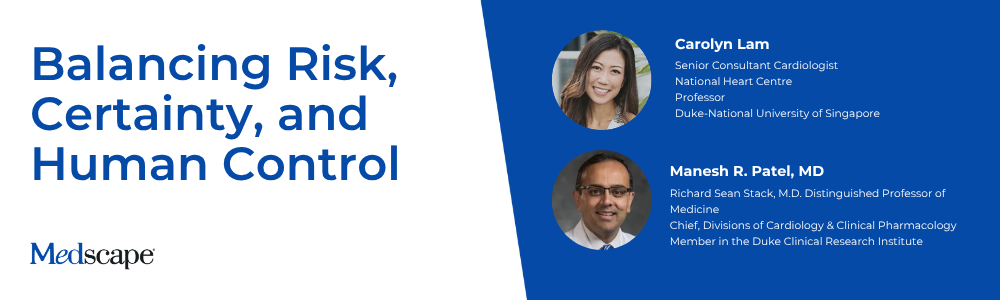
At the European Society of Cardiology (ESC) Congress, two of cardiology’s most influential voices sat down to talk about artificial intelligence at Medscape’s ‘The Pulse of AI Innovation’ event: Professor Carolyn Lam, of the National Heart Centre Singapore, and Professor Manesh Patel, Chief of Cardiology at Duke University. What followed was not a technology showcase. It was a working definition of what responsible AI adoption in cardiovascular medicine actually requires: evidence, governance and education, applied with the same rigor cardiology already applies to any other diagnostic tool.1
That framing matters for the whole healthcare industry, from pharmaceutical to med-tech leaders and clinicians. AI’s promise for cardiovascular care (earlier risk identification, more inclusive trial recruitment, better-supported treatment decisions, more continuous patient support) depends less on the sophistication of the technology than on whether the profession builds the evidence base, oversight structures, and educational infrastructure to use it well. Cardiology is arguably one of the main specialties where that test is happening first. Getting it right here will shape the model for the rest of medicine. Getting it wrong will not be a niche problem.
Cardiologists already trust AI
Cardiologists’ relationship with AI did not start with large language models. Professor Lam pointed to the automated ECG read as the field’s longest-running example of AI-enabled automation: “It’s not predicting; it’s kind of automating what we do manually, but doing it so well that we don’t carry calipers anymore.” She noted the access benefit too: “democratizing ECGs that used to be held in the ivory towers of cardiologists” now puts basic interpretation in the hands of general practitioners, and increasingly, consumer devices.1
Professor Lam’s point lands, but how that data actually get used is another question. A 2026 AMA/Medscape survey of 2,222 physicians across six countries, the United States, Canada, France, Germany, Spain, and the United Kingdom, found that 89% of general practitioners reviewed wearable data, yet only 2% had it built into their workflow. Cardiology led every measure, reviewing, acting on, and integrating wearable data more than any other specialty surveyed, but even there, a knowledge and infrastructure gap remains.2
Beyond the exam room: trials, access and agentic AI
Professor Patel drew the distinction that matters for what comes next. Automation that replicates what a clinician already does is one category of AI. Tools that surface patterns or predictions “beyond what we can do” are a different, higher-stakes category. It’s this second category, not the first, that raises the governance questions healthcare leaders should be tracking.1
Professor Patel described using AI to automate echocardiogram interpretation (a technology he has helped build) while pushing back on the idea that this “robs” clinicians of skill. The more urgent problem, in his view, is capacity: “In the counties in our state where patients have to drive 50 miles to see a cardiologist, finding a way to automate and get echo information to people, so we can work out how to get them to the right center, is what the world needs.”1
Clinical trials came up as a parallel opportunity. Professor Patel pointed to the administrative weight that keeps trials slow and narrow (the same credentialing documents and site questionnaires re-submitted for every study) as exactly the kind of back-office task AI can absorb, freeing capacity for the harder work of enrolling a more representative set of patients. Professor Lam raised a Danish trial that used purely digital channels to screen and recruit patients directly, calling it plausibly “the way of the future,” while flagging the obvious follow-up question: does a digital-first approach widen the digital divide it’s meant to close?1
Both examples point to the same underlying shift Professor Patel named directly: agentic AI, where a tool doesn’t just flag information but starts acting on a clinician’s behalf. “There I think there’s a little bit more complexity,” he said. That complexity is squarely a governance question, not a technology one.1
Governance: certainty, risk, and cardiology’s Kodak moment
Professor Lam opened the governance discussion with a warning borrowed from a debate she’d just left: “The question is not whether LLMs can be used in clinical practice, it is already. If we don’t recognize it, we’re in a Kodak moment.”1
The answer to that risk was not a call for restraint, but for structure. Any AI tool, Professor Patel argued, should meet the same evidentiary bar as any other diagnostic test: “If I’m going to do a diagnostic test, I’d like to know how accurate it is and what happens downstream. Does it improve outcomes or not? And that can be a CT scan, it can be an ECG, it could be an AI tool.”1 AI literacy, on this view, has to go beyond operating a tool: it means being able to assess where an algorithm was trained and validated, its accuracy and failure modes, its equity implications, and who is accountable when it’s wrong, themes echoed across recent reviews of AI and large-language-model use in medical education.3,4,5
Beyond accuracy, Professor Patel described governance as a function of two variables: certainty and risk. A tool flagging that a heart-failure patient needs a rehab referral or dietary counselling is low-risk and, once proven, can operate with a lighter touch. A tool suggesting a new medication warrants more caution. And a tool managing a deteriorating patient remotely sits at the highest-risk, highest-uncertainty end of the spectrum: “And now let’s say our tools or agents want to do something to help that patient there. I think a doctor has to be in the loop. And I think the evidentiary standard might be the highest.”1
Cardiology is not alone in working through where those lines sit. On June 11, at the European Hematology Association’s 2026 congress, a Medscape-supported symposium put a comparable scenario to practicing hematologists and oncologists: should a patient be told that a proprietary AI model contributed to a treatment-eligibility decision? The room split three ways: 43% said always, 33% said no different from any other tool, and the remainder were conditional. That split is a live illustration of exactly the ambiguity Professor Patel’s certainty-and-risk framework is designed to resolve, and a signal that cardiology should build its own disclosure norms deliberately rather than let them emerge by default.6
Education as the safeguard, not an afterthought
If governance sets the rules, education is what makes clinicians capable of applying them, and the risk of getting this wrong is not hypothetical. In a Lancet commentary, Tyler Berzin and Eric Topol describe three failure modes: deskilling, where an existing capability erodes; mis-skilling, where clinicians absorb an AI system’s errors or biases; and never-skilling, where trainees lean on AI before developing core competence at all. Their case in point is concrete: at four Polish endoscopy centres, gastroenterologists who used AI-assisted polyp detection for three months showed measurably lower adenoma-detection rates once the AI support was switched off, in some cases falling below their own pre-AI baseline.7
Professor Lam raised the cardiology-specific version of this concern directly, on automated echocardiography: “We somehow thread that needle with enabling better learning, but yet preserving an ability to think out of the box.”1
Berzin and Topol’s proposed safeguards translate well to cardiology. Aviation dealt with a version of this problem decades ago: autopilot raised safety, but regulators responded by mandating hands-on flight time and simulator drills for failure scenarios. Nuclear plant operators rehearse critical scenarios for the same reason. The clinical parallel is “AI-off” or “AI-delay” intervals (a trainee reads an ECG or echo and logs a finding before the AI output appears), paired with clear task boundaries, where AI absorbs high-volume, rule-based work while clinicians retain contextual, high-stakes judgment.7
There is early evidence that structured education actually moves the needle on this kind of uncertainty. At the same EHA 2026 symposium, faculty-led, case-based, ethics-inclusive teaching shifted physician confidence in applying AI to clinical precision from 19% “mostly or very confident” before the session to 39% after it, in ninety minutes.6
AI can also help build that education, used well. Medscape’s internal analysis of 5,192 learners found a 70% increase in knowledge acquisition among clinicians who received both in-language and English-language education, vs English-only content.8 For global externally funded education programmes, that suggests AI-enhanced, in-language delivery of case-based, ethics-inclusive cardiology education isn’t a distribution nicety. It’s a meaningful lever for closing the same skills gap the AMA and Lancet data both point to.
Why this matters now
Professor Patel closed with a piece of evidence that, in his words, “took my breath away”: the REACT study, presented at this year’s ESC Congress and published in the New England Journal of Medicine. Researchers imaged more than 16,800 adults across Denmark and Spain and found silent atherosclerosis in 57% of participants overall, rising from roughly 1 in 13 among 18-to-29-year-olds to 9 in 10 among 60-to-70-year-olds. Conventional risk-scoring tools missed much of it, particularly in younger patients.1,9
The point Professor Patel drew from it was not despair, but motivation: cardiovascular disease at this scale is largely preventable, but only if it is found. “Our opportunity is to harness it for human health to get better,” he said. Professor Lam’s response set the frame for everyone building on top of this technology in the healthcare industry: “Our patients trust us still. So our opportunity is to think about the science and the way we think about using it.”1
For industry leaders, that is the mandate. AI in cardiology is not short of use cases, patient data, or enthusiasm. What it needs, visibly and now, is the evidence, governance structures, and education that let the specialty use all three responsibly. Cardiology is one of those specialties that got here first. What it builds next is worth watching closely.
Built into Medscape’s own answer
The same distinction that ran through the evening, tools that replace a skill vs tools that build on it, is the one shaping how Medscape is building AI into its own platform. The goal isn’t to deskill clinicians by making them dependent on an answer engine. It’s to upskill them: to meet a genuine point-of-care need without losing the context and judgement that education has always provided, not always at the bedside, but whenever a clinician sits down to look something up, before or after hours.
The same logic extends to equity. The depth of information that has historically sat with a select few, senior clinicians, well-resourced institutions, English-language markets, is what Medscape is working to make available to everyone. That means a system built less like a search engine and more like a personal learning partner: one that adapts to what a clinician needs next, wherever they are in their career, and works in whichever language they’ll learn best in.
Surfacing uncertainty rather than smoothing over it, the same principle running through this entire discussion, is now built into Medscape’s own AI as well. Medscape 2.0, the platform’s AI-native answer engine, is live on desktop for a substantial share of US clinicians, with international markets to follow. Its most relevant feature to this discussion flags “gray areas,” the places where clinical guidelines are unsettled or still evolving, instead of returning a single, falsely confident answer. Paired with a personalized feed that layers relevant education and emerging evidence around each clinician’s own practice, Medscape’s new experience is made for more than a simple lookup tool: it’s designed to support clinical decisions and upskilling by making uncertainty visible rather than hiding it.
Cardiology was one of the first specialties to get here, and the same standard, evidence, transparency, and a clinician kept in the loop, is what Medscape brings to externally funded education and to its own AI alike, from case-based CME to the gray area flags in Medscape 2.0.
If you want to learn more about what Medscape can do for the clinicians you support, please get in touch.
References
1. Medscape’s ‘The Pulse of AI Innovation’ event during ESC Congress, 30.08.2026. Medscape Internal Data, 2026
6. Future‑Ready Hematologists: Practical and Ethical Use of Artificial Intelligence in Hematology and Oncology, EHA 2026 Symposium Report and Live Audience Polling Report, Medscape Education (Stockholmsmässan, Stockholm, 11 June 2026). Medscape Internal Data, 2026
8. Internal analysis of learners who consumed both in‑language and English content versus English‑only content, assessed through pre‑ and post‑activity questions; n=5,192. Medscape Internal Data, 2026
This content was provided by Medscape Education
Company Details

Latest Content from Medscape Education
Medscape Education Wins “Partner of Hope Award” for Scleroderma Advocacy
Medscape Education receives National Scleroderma Foundation’s Rocky Mountain Chapter’s “Partner of Hope Award” for empowering the patient voice and shortening the diagnostic journey. This recognition honors Medscape Education’s significant commitment…
Redefining Pediatric Epilepsy Care: Why We Must Move Beyond Symptom Suppression
For families navigating pediatric epilepsy, the condition dictates every moment of their lives. The constant, crippling “anticipatory anxiety” of when the next seizure might hit transforms daily activities like grocery…
What 90 Minutes of Live AI Case Practice Revealed About Physician Readiness
At EHA 2026 in Stockholm, 425 hematologists and oncologists attended an independent, 90-minute Medscape symposium on the practical and ethical use of AI. The format was case-based. The faculty presented…
Rethinking Prenatal Migraine Management: The Clinical Case for Neuromodulation
Disclaimer: Management of migraine in pregnancy typically combines lifestyle strategies, nonpharmacologic approaches, selected pharmacologic options when benefits outweigh risks, and, increasingly, noninvasive neuromodulation technologies.
Advancing the Frontier of Cancer Care: Medscape’s Mission at ESMO 2026
For more than 30 years, Medscape Education’s dedication has been centered on a single goal: building independent, accredited oncology education that improves patient outcomes. This year, at the European Society…
Using AI Responsibly in CME Outcomes Reporting
ICYMI at #AIS2026: using AI in outcomes reporting is a lot like onboarding a research assistant. There’s real efficiency in having the help, and a significant amount of background teaching,…
The Pulse of AI Innovation: From More Data to Better Care
At the European Society of Cardiology (ESC) Congress, two of cardiology’s most influential voices sat down to talk about artificial intelligence at Medscape’s ‘The Pulse of AI Innovation’ event: Professor…
Next-Level Clinical Practice, Real-World Impact: Evolving Patient Simulation with the Clinical Readiness Studio
Healthcare is changing rapidly, bringing unprecedented data and complex treatment pathways to the point of care. Clinical mastery requires active experience, the confidence to make decisions when real patient outcomes…
Medscape Sponsors The John Ritter Foundation’s “Evening From the Heart”
When independent, evidence-based education directly connects with clinicians at the point of care, clinical practice changes. Driven by this vital mission, Medscape Education was proud to sponsor The John Ritter…
From Booth to Bavaria: A Recap of Impact at ESC 2026
We have officially wrapped up another year at ESC. For Medscape Education, 4 days on the ground confirmed what 3 decades of cardiovascular education have already shown: when independent, evidence-based…