
What 90 Minutes of Live AI Case Practice Revealed About Physician Readiness
October 12, 2026 |
At EHA 2026 in Stockholm, 425 hematologists and oncologists attended an independent, 90-minute Medscape symposium on the practical and ethical use of AI. The format was case-based. The faculty presented unresolved clinical scenarios involving AI output and asked the room to vote in real time.
What the cases exposed
Three scenarios stood out for how divided the room was:
- CAR T-cell eligibility: A proprietary AI model contributed to the eligibility assessment. Physicians were asked whether the patient should be told. 43% said yes, always. 33% said no. The remaining split further, over whether disclosure should depend on the patient asking or on whether the AI changed the recommendation.
- AML risk stratification: An AI model predicted favorable-risk genetics at 78% confidence, ahead of molecular confirmation. 53% said they would wait for confirmation before any risk discussion with the patient.
- DLBCL treatment intensity: Given AI-generated mortality estimates across three regimens for a frail, elderly patient, 41% aligned with the AI recommendation, 34% chose to individualize based on patient preference, and 10% said they don’t trust AI for this kind of decision at all.
None of these cases has a settled answer in the field. That is precisely why they were used: to surface where physician judgment and AI output currently disagree, and where no professional consensus yet exists.
The confidence measurement
Before the case discussions began, attendees were polled on one question “how confident are you using AI platforms to reach a precise clinical decision?”.
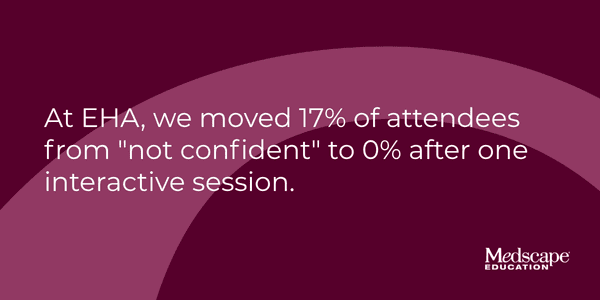
17% rated themselves “not confident.”. After 90 minutes of faculty-led, case-based discussion, including a dedicated module on bias and ethics, attendees were polled again.
0% rated themselves “not confident.” The share reporting “mostly” or “very” confident more than doubled, from 19% to 39%.
Why the result holds up
The session was chaired by Prof. Jakob N. Kather (TU Dresden and University Hospital Heidelberg), lead author of the ESMO guidelines on AI in oncology, with Prof. Matthew Lunning (University of Nebraska Medical Center) and Prof. Chan Cheah (Sir Charles Gairdner Hospital, Perth). During discussion, Kather identified the core evidence gap directly: general-purpose AI vendors will not run the prospective trials needed to calibrate confidence scores for clinical use. That validation work, and the education built on it, falls to medicine and its educators.
The design choices in this session were not incidental to that result: live case-based format over lecture, an explicit ethics and bias module rather than a tools overview, and independent faculty rather than vendor-led content.
What’s next
The full findings, including the polling results, case-by-case breakdowns, and the implications for where independent medical education should focus next, will be published in the upcoming white paper: Closing the AI Confidence Gap.
Be the first to receive the whitepaper here
About Medscape
Medscape is the leading clinical resource for clinicians, delivering trusted medical news, accredited education, evidence-based information, and point-of-care tools, now accelerated by AI. Serving specialists, primary care physicians, nurses, and the broader healthcare community, Medscape combines authoritative medical intelligence with powerful educational and clinical decision support tools. Medscape Education (medscape.org) is the premier destination for continuous professional development, offering 30+ specialty-focused channels with thousands of free CME and CE courses. Medscape is a subsidiary of WebMD Health Corp.
This content was provided by Medscape Education
Company Details

Latest Content from Medscape Education
Medscape Oncology Lights the Night to Advance Blood Cancer Care
MERCER COUNTY, NJ — Recognizing that clinical excellence and patient experience are inseparable, Medscape Oncology served as the official Caregiver Central Sponsor in support of Blood Cancer United’s Mercer County…
Reaching New Heights in Liver Care: The Power of Strategic Advocacy in Liver Health
“The view from the top is always better with the people who helped us get there.”
Medscape Education Wins “Partner of Hope Award” for Scleroderma Advocacy
Medscape Education receives National Scleroderma Foundation’s Rocky Mountain Chapter’s “Partner of Hope Award” for empowering the patient voice and shortening the diagnostic journey. This recognition honors Medscape Education’s significant commitment…
Redefining Pediatric Epilepsy Care: Why We Must Move Beyond Symptom Suppression
For families navigating pediatric epilepsy, the condition dictates every moment of their lives. The constant, crippling “anticipatory anxiety” of when the next seizure might hit transforms daily activities like grocery…
What 90 Minutes of Live AI Case Practice Revealed About Physician Readiness
At EHA 2026 in Stockholm, 425 hematologists and oncologists attended an independent, 90-minute Medscape symposium on the practical and ethical use of AI. The format was case-based. The faculty presented…
Rethinking Prenatal Migraine Management: The Clinical Case for Neuromodulation
Disclaimer: Management of migraine in pregnancy typically combines lifestyle strategies, nonpharmacologic approaches, selected pharmacologic options when benefits outweigh risks, and, increasingly, noninvasive neuromodulation technologies.
Advancing the Frontier of Cancer Care: Medscape’s Mission at ESMO 2026
For more than 30 years, Medscape Education’s dedication has been centered on a single goal: building independent, accredited oncology education that improves patient outcomes. This year, at the European Society…
Using AI Responsibly in CME Outcomes Reporting
ICYMI at #AIS2026: using AI in outcomes reporting is a lot like onboarding a research assistant. There’s real efficiency in having the help, and a significant amount of background teaching,…
The Pulse of AI Innovation: From More Data to Better Care
At the European Society of Cardiology (ESC) Congress, two of cardiology’s most influential voices sat down to talk about artificial intelligence at Medscape’s ‘The Pulse of AI Innovation’ event: Professor…
Next-Level Clinical Practice, Real-World Impact: Evolving Patient Simulation with the Clinical Readiness Studio
Healthcare is changing rapidly, bringing unprecedented data and complex treatment pathways to the point of care. Clinical mastery requires active experience, the confidence to make decisions when real patient outcomes…