



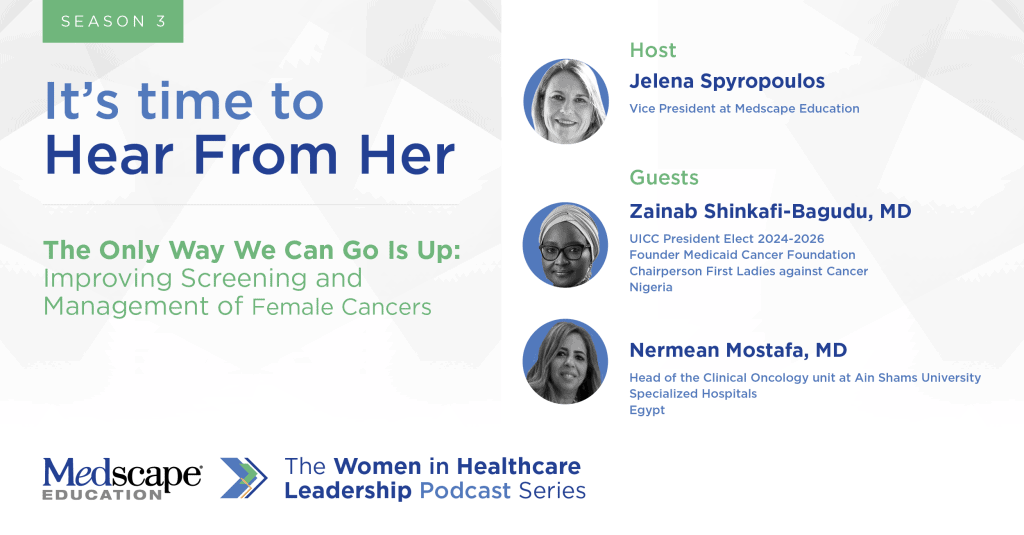
The Only Way We Can Go is Up: Improving Screening and Management of Female Cancers
March 5, 2025 | Hear from her, Women in Leadership, oncology, podcast
One of the toughest challenges of educating many African women about female cancers and disease prevention is overcoming cultural biases, as well as shame, stigma, and misinformation. Here’s how two global leaders in oncology and women’s health, Dr. Zainab Shinkafi-Bagudu and Dr. Nermean Mostafa, are making headway.
“There is a misconception about oncology that it’s a depressive, very sad branch of medicine,” says Dr. Nermean Mostafa, lecturer of Clinical Oncology at Ain Shams University in Cairo, Egypt, and member of the scientific and executive committee of the Presidential Initiative of Cancer, Early Detection and Management. “But to me it’s extremely dynamic, and rewarding. You develop a special, very strong bond with your patients and their caregivers. To them you are God in the Sky.” Those relationships, plus new drug developments that are improving patient outcomes, are the tools to change people’s lives.
Listen to Episode 1 of Season 3 here.
Dr. Zainab Shinkafi-Bagudu, our other guest on this episode focusing on female cancer awareness and prevention, is living proof. After training as a pediatrician in the UK, and self-specializing in neonatology, Dr. Bagudu returned to her native Nigeria, “ready to take on all the children, malnutrition.” What she didn’t expect? That many of the mothers who brought their kids to her hospital would confide their own intimate health concerns to her: a breast lump, a funny discharge. They just saw me as a woman who happens to be a healthcare provider, whom they could share their problems with, she says.
What stunned her was the women’s lack of awareness around their health, particularly breast health. Recognizing a dire need for education, she and a few colleagues took on the challenge, but it soon became apparent that she couldn’t do that plus run her pediatric clinic. So she started the non-profit Medicaid Cancer Foundation in northern Nigeria, and it grew steadily from there. “We rose to fill a need that I discovered through my clinical practice,” she says.
Dr. Bagudu, who is also president-elect of the Union for International Cancer Control, and Dr. Mostafa are passionate about moving the needle, raising awareness about cancer screenings in their part of the world, so it’s detected early and survivors thrive. And the stigma and shame—which are huge—disappear.
“In my language, the local name for cancer is ‘disease of the forest,’ a disease of the wild,” says Dr. Bagudu. “In typical African societies, there’s a belief that illness has supernatural roots rather than a medical cause,” she explains. “Even the most educated people will often come at you with those kinds of ideas,” including in middle-class cities, where you don’t expect it. When it comes to healthcare, women tend to go to places that are faith-based or even to traditional healers, rather than seeking conventional medical care.
Listen to Episode 1 of Season 3 here.
Both Bagudu and Mostafa say they’re laser focused not just on increasing awareness around cancer and disease progression, but also making sure the information is explained in a way that is “contextually, easily digested.” And the education process must begin in childhood, they say, because statistics show that better educated girls grow up to be more empowered, confident women. That dynamic supports better health outcomes not only for the women themselves but also for their families and, ultimately, the community.
If we stay positive and keep moving forward, they say, “the only way we can go is up.”
Listen to Episode 1 of Season 3 here.
Hosted by Jelena Spyropoulos, Vice President at Medscape Education
Follow us on LinkedIn for updates on upcoming podcasts and more insightful conversations. For more information, please contact Jelena Spyropoulos.
Catch up on Season 1 and Season 2 on:
Apple
Spotify
Medscape
About Medscape Education
Medscape Education (medscape.org) is the leading destination for continuous professional development, consisting of more than 30 specialty-focused destinations offering thousands of free accredited CME and CE courses for physicians, nurses, and other healthcare professionals.
This content was provided by Medscape Education
Company Details

Latest Content from Medscape Education
The Pulse of AI Innovation: From More Data to Better Care
At the European Society of Cardiology (ESC) Congress, two of cardiology’s most influential voices sat down to talk about artificial intelligence at Medscape’s ‘The Pulse of AI Innovation’ event: Professor…
Next-Level Clinical Practice, Real-World Impact: Evolving Patient Simulation with the Clinical Readiness Studio
Healthcare is changing rapidly, bringing unprecedented data and complex treatment pathways to the point of care. Clinical mastery requires active experience, the confidence to make decisions when real patient outcomes…
Medscape Sponsors The John Ritter Foundation’s “Evening From the Heart”
When independent, evidence-based education directly connects with clinicians at the point of care, clinical practice changes. Driven by this vital mission, Medscape Education was proud to sponsor The John Ritter…
From Booth to Bavaria: A Recap of Impact at ESC 2026
We have officially wrapped up another year at ESC. For Medscape Education, 4 days on the ground confirmed what 3 decades of cardiovascular education have already shown: when independent, evidence-based…
Why Modern Dermatology Demands Curiosity Over Precision
In the high-stakes world of healthcare research and product development, success has long been measured by rigid definitions of precision and predictable trajectories. However, as Dr. Hawa Dumbuya, Director of…
The Heart of the Matter: Medscape Education’s Cardiology Footprint at ESC 2026
For more than 30 years, Medscape Education has built independent, accredited cardiovascular education designed around one goal: improved patient outcomes. This year at the European Society of Cardiology Congress (ESC…
More Than Pink Walls: What Women-Centric Care Actually Requires
The phrase “patient-centered care” is tossed around freely in healthcare corporate boardrooms. Yet, for more than half the population, that promise routinely fractures. In the latest episode of the Hear…
Women in Healthcare Leadership Have a Lot to Say. Medscape’s Hear From Her Wins an APEX Grand Award.
Medscape Education has been honoured with the prestigious APEX Grand Award for Publication Excellence at…
Moving Beyond the 10%: A New Era in Preterm Birth Prevention
For decades, the rate of spontaneous preterm birth in the United States has hovered stubbornly around 10%. Despite advancements in other areas of medicine, prematurity remains the second leading cause…
Medscape Education to Showcase the Impact of Neurology CME at EAN 2026
Medscape Education, the leading global provider of continuing medical education (CME), has announced its agenda for the upcoming 12th Congress of the European Academy of Neurology (EAN) 2026 in Geneva,…